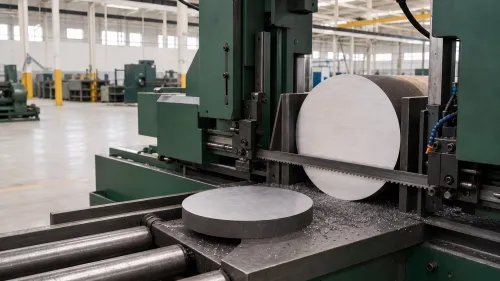
Titanium Band Saw Cutting
Band sawing titanium is not difficult. Band sawing titanium badly is easy, and the damage is not always visible on the cut face.
Titanium conducts heat roughly a sixth as well as steel. Whatever heat the blade generates stays in the cut zone instead of leaving with the chip. Run the band too fast and the tooth stops cutting and starts rubbing — the surface work-hardens under the tooth, the next tooth meets a harder surface than the last one, and the blade is finished within a few cuts. The part is left with a hardened, smeared cut face that the following operation has to remove.
The correction is unglamorous: slower band speed, higher feed pressure, flood coolant. The chip has to curl. If it comes off as powder, the tooth is rubbing.
What Decides the Setup
Band speed. Titanium runs far slower than carbon steel — roughly 20–35 m/min depending on grade and section, against 60–100 m/min for mild steel. Grade 5 (Ti-6Al-4V) sits at the low end of that band; Grade 2 tolerates the high end.
Tooth pitch by section. At least three teeth engaged in the cut at all times, and not many more. Large solid bar takes a coarse pitch. Thin-wall tube and stacked sheet take a fine pitch, or the tooth strips into the wall. Getting this wrong on tube is the most common way to lose both blade and part in one cut.
Blade type. Bi-metal handles commercially pure grades. Alloy grades and heavier sections justify carbide-tipped — more per blade, less per cut.
Coolant. Flood, not mist. The point is carrying heat out of a material that will not carry it away itself.
What a Saw Cut Actually Holds
Sawing is a sizing operation, not a finishing one. Quoting it as though it were precision machining is how disputes start.
- Length tolerance. Typically ±0.5 to ±1.5 mm depending on section and length. Tighter means facing after sawing — a second operation with its own cost and allowance.
- Squareness. A cut face is square within the saw’s capability, not within a drawing tolerance. If perpendicularity is functional — weld preparation, a seating face — say so, and it gets machined.
- Edge condition. As-cut, deburred, or machined. As-cut carries a burr. Specified per order rather than assumed.
- Cutting allowance. Kerf plus any stock left on for the next operation. If the piece goes on to be faced, welded or machined, the allowance changes.
The Part Buyers Actually Get Wrong
One bar with one heat number becomes twenty pieces. Those twenty pieces still have to trace back to that heat number, and the certificate has to follow them.
If your quality system requires material traceability — aerospace, medical, pressure equipment, anything with a third-party inspection release — the cut pieces need marking, and the EN 10204 3.1 certificate has to reference the cut quantity rather than only the parent bar. Agree this before cutting. Reconstructing traceability after a bar has been cut and mixed is usually impossible, and the material becomes uncertified stock.
When Not to Use a Saw
- Thin sheet and foil — the saw cannot hold it. Use laser or water jet.
- Profiles and contours — sawing produces straight cuts. Anything else is a profile-cutting job.
- Faces that must be weld-ready without further work — a saw cut is a starting point, not a weld preparation.
See cut to length for how the routes compare, or laser cutting and water jet cutting for the alternatives.
Ordering
Send the grade and material form, the section size, finished lengths and quantities, the length tolerance you need, the edge condition, and whether traceability marking is required on each piece.
If the tolerance you have asked for is not achievable by sawing alone, we will say so and quote the facing operation separately rather than quietly accepting the drawing.