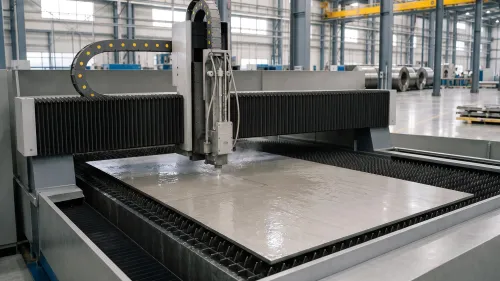
Titanium Water Jet Cutting
Every thermal cutting route leaves something behind in titanium. Laser and plasma leave a heat affected zone and heat tint. Above roughly 500 °C in air, titanium also picks up oxygen and forms alpha case — a hard, brittle surface layer that cracks in forming and welding and is invisible on the surface.
Abrasive water jet leaves none of it. The cutting temperature at the workpiece stays near ambient. There is no heat affected zone, no alpha case, no discoloration to pickle off afterwards.
For anything that gets formed, welded or fatigue-loaded after cutting, that is the whole argument.
What You Are Actually Buying
No post-cut pickling on the edge. A laser or plasma cut edge on titanium usually needs pickling and alpha case removal before the part moves on. A water jet edge does not. On a part with a long cut perimeter, that removed operation is often the real cost difference — not the cutting rate.
No mechanical property change at the edge. The material at the cut face has the same properties as the material 10 mm away. For fatigue-critical parts and for anything going into a welded joint, this matters more than surface finish.
Thickness reach. Abrasive water jet cuts titanium well past the practical limit of laser on this material. Thick plate that no laser will take cleanly is routine on a water jet — slowly, but cleanly.
What It Costs You
Kerf taper. The jet loses energy as it passes through the material, so the kerf is slightly wider at the top than the bottom. On thin sheet this is negligible. On thick plate it is not, and it has to be either accepted, compensated by a tilting head, or machined out. If your part has a tight profile tolerance through the full thickness, say so at quotation — it changes the machine and the price.
Speed. Water jet is slower than laser on thin material, sometimes by a large factor. On sheet under about 3 mm where alpha case is not a concern for the application, laser is usually the better commercial answer.
Garnet embedding. The abrasive is a mineral, and a small amount embeds in the cut edge. For structural parts this is irrelevant. For medical implants, semiconductor and high-purity chemical service, the edge needs cleaning or light machining afterwards. Flag the application and it gets handled — it is not a defect, but it is not automatically acceptable either.
Edge finish varies with speed. Cut quality is a commercial choice, not a fixed property: a slow pass gives a smooth, near-uniform edge; a fast pass leaves visible striation toward the bottom of the cut. Specify which you need rather than assuming the finest.
Choosing Between Routes
| Water jet | Laser | Band saw | |
|---|---|---|---|
| Heat affected zone | None | Yes | None |
| Alpha case risk | None | Yes, needs pickling | None |
| Thin sheet economics | Poor | Best | Not possible |
| Thick section | Good | Limited | Straight cuts only |
| Contours | Yes | Yes | No |
See cut to length for the full comparison.
Ordering
Send the drawing or DXF, the grade and thickness, the quantity, the profile tolerance you need through the thickness, and what happens to the part next. That last item decides whether taper and edge condition matter.
If the application is medical, semiconductor or high-purity chemical, say so — the edge treatment after cutting is different.