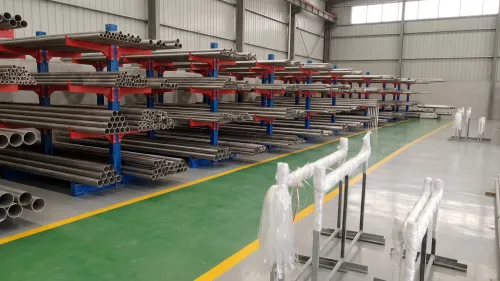
Titanium Stocking Programs
Titanium mill lead times do not match production schedules. A mill run for a given grade and size happens when the mill has enough demand to justify it, which is not when you need the material. Buying on the spot market means accepting whatever lead time exists on the day you order.
A stocking program moves that problem upstream. Material is held against your forecast, and you release it against agreed dates instead of against mill availability.
That is the whole mechanism. What follows is what it does and does not commit to.
What the Program Commits To
A held quantity. An agreed volume of a specific grade, form and size, physically reserved against your account rather than counted as general stock.
Call-off dates rather than lead times. You release quantities against a schedule agreed in advance. The lead time on a release is measured in days, not in mill cycles.
A replenishment trigger. A stock level at which the next mill order is placed, set from your forecast and the current lead time for that grade and size. This is the part that actually keeps the program working — without it, the program is just a one-off purchase with a warehouse attached.
Certification held with the material. The EN 10204 3.1 certificate stays with the reserved material and is issued against each release.
The Reason Qualified Buyers Care
Heat number continuity.
If your part is qualified — a medical device, an aerospace component, a pressure part with a procedure qualification record behind it — then the material heat that qualification was performed on is not interchangeable with any other heat of the same grade. A new heat can mean re-testing, sometimes re-qualifying.
A stocking program lets a single heat be reserved and drawn down across many releases over months. Spot buying cannot do that. Whatever heat the mill happened to run is what you get.
If this applies to your parts, say so when the program is set up. Reserving to a single heat changes the quantity that has to be held and therefore the commercial terms — it is a real cost, and it is usually much smaller than a re-qualification.
What It Does Not Do
It does not remove mill minimums. For common grades and sizes, held stock absorbs the minimum. For an unusual alloy, an off-standard size or a wide-format product, the mill still needs a minimum melt or rolling quantity to run at all. A stocking program can spread that quantity across a year of releases; it cannot make it disappear.
It does not fix a forecast that is wrong. The replenishment trigger is calculated from your forecast. If actual draw-down runs at double the forecast, the program runs dry at the same lead time everyone else faces.
It is not free storage. Held material has a carrying cost, and it sits somewhere. Storage duration, title transfer point and what happens to unreleased balances at the end of the term are agreed in writing at the start, not discovered later.
If you need one-off small quantities rather than a scheduled release, see no minimum order quantity instead — that is a different service and a different commercial basis.
Setting One Up
Send the grade, form and sizes, your annual volume and how it is distributed across the year, the release lead time you need, and whether heat continuity is a requirement.
What comes back is a held quantity, a replenishment trigger, a call-off lead time and the storage terms — in writing, before anything is bought.