Titanium Welding & Fabrication
Titanium welds do not usually fail because of insufficient heat or a poor bead profile. They fail because the weld metal and the heat-affected zone picked up oxygen or nitrogen while they were still hot — and that contamination is largely invisible until the joint cracks.
This page covers welding and welded assemblies. Machining, cutting, forming, heat treatment and surface finishing each have their own page and are linked at the bottom; this one deliberately does not repeat them.
Why Titanium Welding Is a Separate Discipline
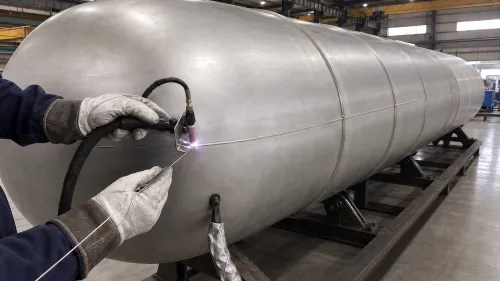
Protection has to continue after the arc stops. Titanium keeps absorbing atmospheric gases while it is above roughly 427 °C (800 °F). Shielding the molten pool alone is not enough — the weld and the surrounding metal have to stay under inert cover until they have cooled. In practice that means some combination of:
- Trailing shield following the torch to cover the cooling weld
- Back purge on the reverse side of the joint, held until the run has cooled
- Purge chambers or local enclosures for critical assemblies and small components
Cleanliness is a process step, not housekeeping. Grease, moisture, marker ink, cutting fluid residue or iron contamination from a previous job all end up in the weld. Titanium fabrication uses dedicated tooling, dedicated grinding and brushing consumables, and non-ferrous contact surfaces — iron picked up from a carbon steel fixture becomes a corrosion site.
The prior surface condition matters. If the material has been hot formed or heat treated in air, it carries alpha case, and welding over alpha case cracks the joint. That surface must be removed by pickling and verified before the parts reach the welding bay.
Weld Discoloration — The Field Check
Weld surface colour is the immediate indicator of how well the shielding worked. It is not a substitute for testing, but it is the first thing to look at on any titanium weld you are handed.
Under AWS D17.1 Table 7.1 (aerospace fusion welding), the following discoloration is listed as acceptable:
| Colour | Status per Table 7.1 |
|---|---|
| Bright silver | Accept |
| Silver | Accept |
| Light straw | Accept |
| Dark straw | Accept |
| Bronze | Accept |
Progressively darker discoloration beyond this range indicates increasing oxidation, and a grey or white powdery deposit indicates heavy contamination — that condition is not repairable by cleaning and the material has to be removed. Where exactly the line falls depends on the weld class invoked by your specification, so the applicable class is agreed before welding rather than argued afterwards.
Pressure equipment work is judged against the design code and the qualified procedure rather than against an aerospace colour table — the principle is the same, the acceptance document is different.
WPS and PQR — What Actually Gets Approved
“We can weld titanium” is not an answer to a procurement question. A welding procedure specification is qualified for a defined envelope, and your joint has to fall inside it:
- Material group and grade
- Thickness range — a procedure qualified on thin sheet does not cover heavy wall
- Joint configuration and welding position
- Process — GTAW, and whether automatic or manual
- Shielding arrangement, including back purge and trailing shield
- Filler metal classification
If your part sits outside the qualified range, the procedure has to be requalified. That is a schedule item, not a formality, and it is better identified at quotation than at inspection.
Welder qualification is separate from procedure qualification, and both are checked against the facility that will actually perform the work.
What Gets Fabricated
Titanium and other reactive metals are used where corrosion rules out steel. Typical fabricated items:
- Process vessels, reactors and columns
- Heat exchangers — shell and tube, plate, and tube-to-tubesheet joints
- Storage tanks and piping systems
- Anode assemblies and anode baskets — see MMO anode coating for the coating side
- Structural and custom weldments to drawing
Rolling, bending and dishing for these assemblies are forming operations; the material condition for forming is the annealed condition, which is why heat treatment sequence and welding sequence have to be planned together rather than separately.
Zirconium and Other Reactive Metals
Zirconium is welded to the same principles as titanium but with less tolerance for error — it is more sensitive to oxygen and nitrogen pickup, and it requires its own procedures, its own consumables and its own clean work area. Zirconium is not welded on titanium parameters, and a shop’s titanium experience does not automatically transfer.
Nickel alloys, niobium and clad constructions each carry their own procedure requirements.
Inspection and Testing
Agreed at order stage and written into the inspection plan rather than added afterwards:
- Visual and discoloration assessment against the applicable acceptance criteria
- Penetrant testing for surface-breaking defects
- Radiography where the code or your specification requires volumetric examination
- Hydrostatic, pneumatic or helium leak testing according to equipment class
- Post-weld heat treatment, where the design code or the service duty calls for it
Documentation follows the same route as material: see inspection and certification for what accompanies the finished assembly.
What to Send With an Enquiry
- Drawing or sketch, with joint details if you have them
- Design code or specification you are working to
- Material grade and product form
- Design pressure and temperature, and the process medium
- Inspection requirements — NDE extent, third-party witness, documentation
- Quantity and required delivery
If the design is not finalised, send what exists. Whether a joint is practical to weld in titanium — and what it costs to inspect — is worth knowing before the drawing is frozen.
Send your fabrication enquiry →
Related Services
CNC machining · Cutting and cut-to-length · Heat treatment · Pickling and alpha-case removal · Surface finishing