Type something to search...

Additive manufacturing

others
IperionX Hits 4.2 Tonnes in March on 24/7 Operations: From 1,400 tpa Math to Production Cadence
By Jason/ On 29 Apr, 2026

IperionX Hits 4.2 Tonnes in March on 24/7 Operations: From 1,400 tpa Math to Production Cadence

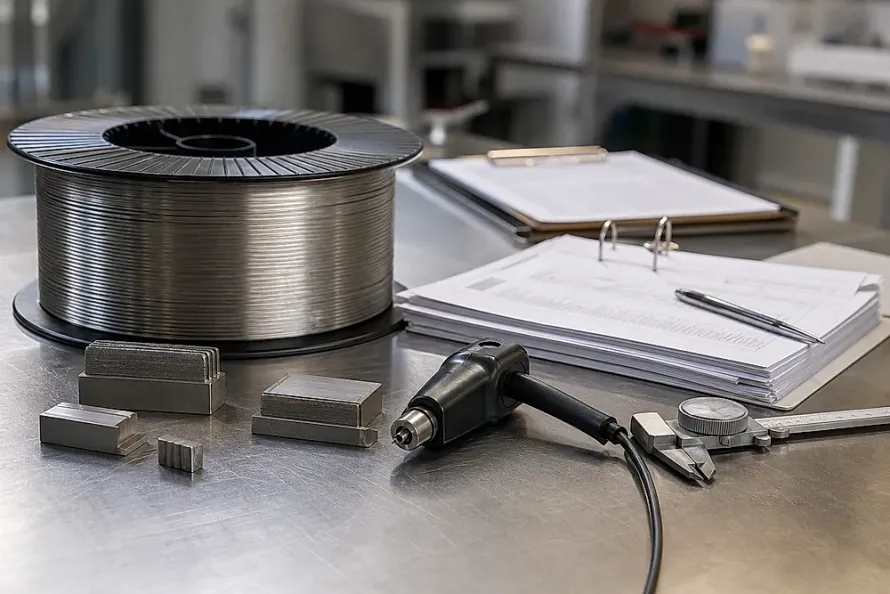
IperionX released its March 2026 quarterly on April 27. Buried under the headline volume figure is a number worth pulling apart: in March the Virginia plant produced 4.2 tonnes of HAMR (Hydrogen Assisted Metallothermic Reduction) titanium powder, putting annualized run-rate around 50 tpa, with a CY2026 year-end target of 200 tpa. The site has now shifted to 24/7 operation. Four days ago we worked through the math showing IperionX's 1,400 tpa would cover only 3.5% of the 40,000-tonne US shortfall — a long-run "patch, not foundation" verdict. Today's news cuts at the same company from the other side: whether the long-run math holds is one question; whether short-run execution cadence is on track is another. The 4.2 tonne figure tells us the second one is happening. What 4.2 tonnes per month actually meansSpread 4.2 tonnes across a month and you get 135 kg/day. For a titanium powder plant that is not a big number — Toho and Osaka push out sponge by the hundred tonnes per day, and the major Baoji powder lines run at tens of tonnes per month. But on the curve of US-domestic titanium powder going from zero to live, this is the first piece of physical evidence that line cadence has stabilized. Pulling out the specific numbers from the quarterly:Cash + committed funding: $48.2M cash + $42.1M of committed reimbursable government funding, plus the $47.1M IBAS award now landed Feedstock locked: 290 tonnes of free DoD scrap titanium transferred — at 200 tpa run-rate that is roughly 1.5 years of feedstock cover Equipment in place: 100-tonne single-axis press optimization complete, 300-tonne SACMI six-axis press installed, and the large-format cold isostatic press (CIP) is in operation Downstream orders: defense fastener line ramping; American Rheinmetall prototype order signed Optional funding path: the SBIR Phase III IDIQ channel runs up to $99MTake those five variables together and IperionX is in possession of the physical conditions to execute on plan through the second half of 2026 and into the first half of 2027. That doesn't contradict our four-day-old "1,400 tpa only covers 3.5%" line — execution-on-plan is line cadence, coverage gap is market structure. Both are true descriptions of the same project at different time horizons. HAMR and traditional Kroll: the product-line split is still clean What deserves spelling out is that IperionX's 4.2 tonnes of titanium powder is not aimed at displacing traditional VAR (Vacuum Arc Remelting) ingot. The HAMR process produces titanium powder or semi-finished alloy directly, and the downstream falls into three buckets: First, additive manufacturing — US defense fasteners, satellite structures, medical AM components. Second, powder metallurgy press parts — mid-size components where isotropy matters. Third, scrap closed-loop recycling — converting the 50,000-tonne stock of US titanium scrap back into usable feedstock. Aerospace large forgings — Boeing 787 spars, F-35 primary structure, Airbus A350 landing gear — still go through the traditional Kroll-route path: Kroll sponge → VAR double or triple melt → large ingot → forge. US-domestic capacity on that route is essentially zero, and supply still leans on Japan (Toho, Osaka), China (Baoti, Pangang, Western Superconducting), and the partly-functional VSMPO output that the EU sanctions keep waving past. In other words, what IperionX solves in 2026-2027 is the localization of the US AM titanium powder supply chain. It does not solve the localization of aerospace large forgings. That product-line distinction is the single thing buyers most often miss when reading IperionX coverage — HAMR is a complement to Kroll, not a replacement. What we see at the Titanium Valley endIn our Baoji (China's Titanium Valley) physical inventory system as of late April 2026:Titanium powder: spherical Ti-6Al-4V (TC4) / Gr.23 ELI in the 15-53 μm size band, roughly 800 kg in stock. Specification matches direct LPBF (Laser Powder Bed Fusion) / SLM print requirements Titanium wire: Φ1.0 / Φ1.2 / Φ1.6 / Φ2.0 / Φ2.4 mm, five diameters, roughly 1 tonne combined in stock. Matches the dominant feed-wire diameters for WAAM (Wire Arc Additive Manufacturing)That stock picture isn't large in absolute terms, but it is interesting against IperionX's 4.2-tonne/month reference. The US HAMR route is biased toward "non-spherical / direct-alloy" output, and spherical LPBF powder still depends on offshore supply. AM customers running qualification on spherical powder care about oxygen content (<0.13%), satellite particle ratio, and flowability — none of which has a fully equivalent US-domestic substitute through 2026-2027. Inquiry frequency from US and European AM customers has clearly increased this week. The inquiry profile has a common thread: small order, tight qualification. Typical sample batches run 200-500 kg, but each batch demands the full ICP chemistry report + particle size distribution (PSD) + Hall flow stack. That profile maps almost exactly onto IperionX's own early-customer profile, which suggests the same demand category is being served on both sides — only the geography differs. Checklist for buyers and materials engineers If you are planning titanium powder and wire procurement for late-2026 through mid-2027, three things to do right now: First, build separate qualified vendor lists for the HAMR route and the Kroll route. For the former, US-domestic supply via IperionX is the lead choice (US compliance priority); for the latter, you still need a stable feed from offshore Tier 1 mills. Run them as two separate tracks — don't conflate them. Second, lock "spherical powder PSD ≤53 μm + oxygen ≤0.13% + satellite particles ≤2%" into your RFQ template as a hard requirement. That is the entry threshold for direct LPBF/SLM print. The HAMR process route doesn't cover that sub-specification near-term. Third, settle stock vs futures separately. What we see across our titanium wire and powder lines is that customers who can pull physical sample material clear AM project qualification four to six weeks ahead of customers depending purely on futures supply. In the window before IperionX hits volume production, that is a real first-mover advantage. The variable worth tracking over the next 12 months is not whether IperionX hits its 200 tpa target — most likely it does — but how many Chinese and Japanese mills make it onto the US AM titanium powder qualified vendor lists. That curve determines what real share Asian powder mills hold in the US market post-2027. Related Products & ServicesService → No Minimum Order Quantity Sourcing — the 200-500 kg single-batch qualification channel for early-stage AM projects Product → Titanium Wires — Φ1.0-2.4 mm WAAM-grade titanium wire from stock, multi-grade Product → Special Titanium Alloys — Ti-6Al-4V / Gr.23 ELI spherical powder and matched AM grade stockAbout: Titanium Seller is a supply chain platform based in Baoji, China's Titanium Valley.

Ready to Start Your Project?

Get factory-direct pricing on titanium products. No minimum order.

Get a Free Quote
Quick Inquiry