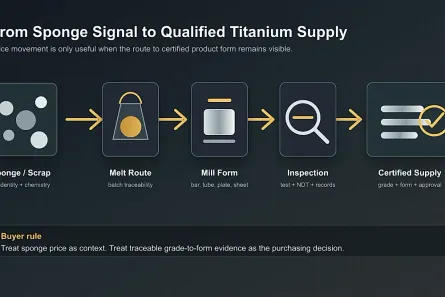
Sponge Titanium's Price Standoff Shows Why Buyers Need a Grade-to-Form Evidence Chain
Sponge titanium is sending a mixed signal to titanium buyers. In an April 30 update, SMM reported that China's sponge titanium output rose 3.49% month on month in April 2026, while prices moved to RMB 48,000-50,000 per metric ton. Yet the same update pointed to inventory pressure and weak buying momentum from downstream titanium materials.For buyers of titanium bars, tubes, plates and sheets, forgings and machined components, that is not just a price note. It is a reminder that the cheapest or most visible upstream feedstock is not automatically usable supply. A sponge market can look loose while qualified mill products remain constrained by chemistry, melting capacity, conversion route, heat treatment, inspection, documentation and customer approval. The practical question is therefore not "Is sponge titanium available?" It is "Can this lot become the specific titanium form, grade and evidence package my application needs?" The Market Signal Is Real, But Incomplete The SMM update matters because sponge titanium sits upstream of many processed titanium products. Higher output with narrow price movement can influence producer negotiations, working capital and expectations for mill product costs. If downstream demand remains cautious, some buyers may assume that bars, tubes or plates should become easier to source. That assumption is too simple. Sponge titanium is an intermediate input. It still has to pass through melt and conversion steps before it becomes the material forms that procurement teams actually buy. Each step can narrow the useful supply pool. A low-priced sponge lot may be commercially attractive, but it does not answer whether the final bar or tube will meet a buyer's grade, mechanical properties, dimensional tolerance, inspection records, origin requirements or certification package. The structural context makes this even more important. The U.S. Geological Survey's 2026 titanium summary said the United States did not produce titanium sponge metal in 2025 and showed net import reliance for sponge at 100%. It also noted that U.S. producers of ingot and downstream products relied on imported sponge and scrap. In other words, the industry is not only watching price; it is watching whether upstream material can move through an auditable route into qualified downstream supply. Why Sponge Availability Does Not Equal Certified Titanium Products Processed titanium buyers usually purchase a form, not a raw market signal. A medical parts buyer may need bar stock — often Gr.23 Ti-6Al-4V ELI — with traceable chemistry and validated machining behavior. A chemical-processing fabricator may need plate or tube — often Gr.2 or Gr.7 — with corrosion-service suitability, welding records and pressure-boundary documentation. Aerospace and industrial buyers may care about source approval, heat treatment history, ultrasonic inspection, mechanical testing and long-term repeatability — typically calling out Gr.5 (Ti-6Al-4V) forgings certified to AMS 4928. Those requirements can create a gap between sponge price and usable supply. The gap begins with chemistry. Titanium sponge grade, impurity control and lot consistency affect the melt route and downstream properties. It continues through melting and ingot conversion, where process discipline and batch identity have to remain visible. It widens again at the mill-product stage, where plate, sheet, tube, bar or forging stock must be matched to application, tolerance, test plan and documentation. That is why a buyer who treats sponge price as a direct proxy for finished-material readiness can misread the market. Inventory pressure upstream may reduce some cost pressure, but it does not automatically create qualified stock in the exact grade, dimension and delivery window a project needs.A Grade-to-Form Evidence Chain A better way to read the current market is to separate feedstock availability from form-qualified supply. The chain is simple, but it has to be explicit.Procurement question Evidence that should travel with the materialWhat sponge or scrap input is being used? Lot identity, chemistry, impurity controls and origin documentationHow does the input become ingot or billet? Melt route, batch traceability and process recordsWhich product form is being delivered? Bar, tube, plate, sheet, forging or machined component specificationWhat properties have been verified? Mechanical testing, dimensional inspection, NDT where applicable and heat-treatment recordsCan the lot fit the application? Grade match, service environment, customer approval status and certificate reviewCan the supplier repeat the route? Capacity, lead-time history, quality-system discipline and change-control processThis framework does not turn every purchase into an aerospace qualification exercise. It gives buyers a disciplined way to decide where strict evidence is necessary and where a simpler commercial certificate is enough. The Downstream Market Is Not Moving As One Block The same week that sponge titanium data showed inventory pressure, high-end downstream signals remained more selective. Howmet Aerospace's May 7 first-quarter update reported strong growth in commercial aerospace and gas turbines, while also noting that a titanium alloy production operation was moved into its Engineered Structures segment for operational alignment. That does not mean every titanium product is tight, but it illustrates how downstream titanium demand is segmented by application, process route and customer approval. This segmentation is visible across titanium products: Bars and billets are often judged by grade consistency, machinability and mechanical-property documentation. Tubes need dimensional control, surface condition and sometimes pressure or corrosion-service evidence. Plates and sheets may be tied to flatness, thickness tolerance, weldability and heat-treatment history. Forgings and machined parts add route approval, inspection burden and repeatability risk. When the upstream sponge market is under inventory pressure, buyers can use the moment to negotiate. But negotiation should not replace qualification discipline. The right question is whether price relief is arriving in the part of the chain that matters to the buyer's product form. What Buyers Should Ask This Quarter Procurement teams can turn the current sponge-titanium signal into a useful supplier review without overreacting to monthly price movement. First, ask suppliers to separate raw-material price movement from finished-form lead time. If a quote says sponge costs are easing, it should still explain melt availability, conversion capacity, rolling or forging schedule, inspection queue and certification timing. Second, request lot-level traceability before accepting a price advantage. A lower material price has limited value if chemistry, heat identity or origin documentation becomes unclear later in the project. Third, match the evidence burden to the application. Industrial maintenance stock, chemical equipment, medical components, aerospace structures and semiconductor tooling do not need identical documentation, but none benefit from vague material identity. Fourth, watch inventory age and change control. In a slow downstream market, available stocking-program inventory may be useful, but buyers should still check whether it matches current specifications, surface requirements and certificate expectations. Finally, evaluate repeatability. One qualified lot is helpful; a repeatable grade-to-form route is more valuable for programs that require stable sourcing across multiple orders. The Buyer Takeaway The current sponge titanium price standoff is not a simple bearish or bullish signal for titanium products. It is a test of supply-chain translation. If sponge output rises while downstream demand stays cautious, buyers may gain negotiating room. But for titanium bars, tubes, plates, sheets, forgings and machined parts, real supply is created only when upstream material can be traced through melt, conversion, inspection and application approval. In 2026, titanium procurement is less about reading one price and more about proving the route from grade to form. Related Products & ServicesTitanium Bars — Gr.1/Gr.2/Gr.5/Gr.7/Gr.23 with full mill certification Titanium Tubes — heat exchanger and pressure-boundary use Titanium Sheets & Plates — chemical, marine and aerospace forms Titanium Forgings — aerospace and industrial qualified routes Titanium CNC Machining — qualified machining service Stocking Programs — buffer stock for sponge-driven volatility