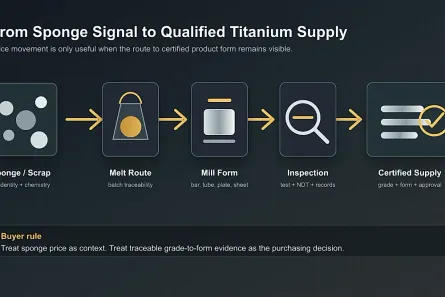
Howmet's Portfolio Moves Show Why Titanium Buyers Need a Supplier Continuity Dossier
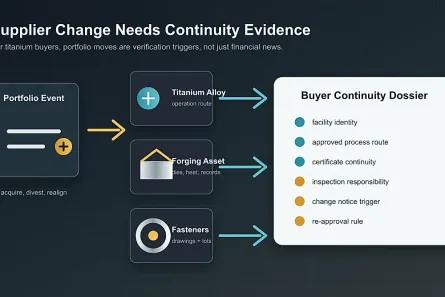
Howmet Aerospace's latest quarter was more than another aerospace demand update. In its May 7 first-quarter 2026 results, the company reported 19% year-over-year revenue growth, completed the acquisition of Consolidated Aerospace Manufacturing (CAM) on April 6, sold its Savannah, Georgia disk forging facility on March 31 for about $230 million, and moved a titanium alloy production operation from Engine Products to Engineered Structures for better operational alignment.For investors, those are portfolio and segment items. For titanium buyers, they point to a practical procurement issue: when a major engineered-materials supplier acquires, divests, or reorganizes titanium-related operations, a purchase order may still look familiar while the evidence chain behind it changes. That matters for titanium bars, tubes, plates and sheets, forgings, fasteners and machined components. Buyers do not only need material. They need continuity of facility identity, approved source status, process route, inspection responsibility, certificate language, change-control notice and contact ownership. The question is not whether a supplier portfolio move is good or bad. The question is whether the buyer can still prove that the material route behind each titanium part remains controlled. A Strong Market Can Still Create Continuity Risk Howmet's results underline the strength of high-end aerospace and gas-turbine demand. The company said commercial aerospace OEM customers continue to target production rate increases supported by record backlogs, while engine spares, defense markets and gas turbines remain active. Its Q1 2026 presentation showed Engine Products revenue up 29% year over year and Fastening Systems revenue up 14% year over year. That is a positive demand signal. But for procurement teams, growth and portfolio optimization can also create interface risk. When CAM is added to a fastening systems business, when a disk forging facility is sold, or when a titanium alloy operation is moved between reporting segments, customers may need to confirm what changes operationally and what does not. The Howmet release said the titanium alloy operation move had no impact on consolidated results, financial position or cash flows. That statement is about financial reporting. Buyers still need their own operational view of certificates, source approvals, quality contacts and delivery routes. In titanium procurement, continuity is not a soft relationship concept. It is part of the evidence package. Why Titanium Buyers Should Track Supplier Changes Differently Titanium is rarely bought as a generic metal when the application is demanding. A tube for chemical processing, a plate for a pressure-boundary fabrication, a forged aerospace component, a machined medical or industrial part, and a precision fastener all carry different evidence burdens. Supplier changes can touch those burdens in subtle ways:Portfolio or operating change Buyer continuity questionAcquisition of a fastener or component business Are approved supplier lists, drawings, part numbers and certificate formats still aligned?Sale of a forging facility Which orders, materials, dies, process records or approved routes remain with the seller or move to the buyer?Reassignment of a titanium alloy operation Does the facility, quality system, heat identity or responsible contact change?Product rationalization Are long-tail titanium forms still available, or will buyers need an alternate qualified route?Segment recasting Are commercial metrics changing only on paper, or is operational responsibility also moving?This is not about distrusting a supplier. It is about preventing administrative change from turning into evidence loss. The issue is especially important for export buyers who may be several layers away from the original titanium operation. A distributor, machine shop or equipment builder may receive a certificate that looks complete, but still need to know whether the underlying facility, process and approval route remain the same after a portfolio change.The Supplier Continuity Dossier A useful buyer response is to maintain a supplier continuity dossier for critical titanium materials and components. It does not have to be complicated. It should answer six questions for each key supplier, facility and product family. First, identify the facility. Record the plant, legal entity, address, primary operation and whether the delivered product is made, processed, inspected, stored or only distributed there. A brand name alone is not enough. Second, identify the product family. Separate titanium bar, tube, plate, sheet, forging, fastener, casting, machined part and powder-related products. A supplier may be strong in one category and no longer active, approved or commercially focused in another. Third, identify the process route. Buyers should know whether the order depends on melting, billet conversion, forging, rolling, tube making, heat treatment, machining, surface treatment or outside testing. If the supplier reorganizes, the route may need re-confirmation. Fourth, preserve certificate continuity. Certificate templates, heat numbers, lot numbers, test standards (e.g. ASTM B265 for sheet/plate, B348 for bar, B338 for tube, AMS 4928 for aerospace forgings), inspection signatures and quality-system references should remain coherent after acquisitions or facility changes. Fifth, capture change notices. Buyers should ask suppliers to notify them when production location, subcontracted processing, inspection lab, quality ownership, drawing revision, approved source status or certificate format changes. Sixth, define the re-approval trigger. Some changes may be administrative. Others may require a first-article review, additional testing, customer notification or temporary dual sourcing. What This Means For Titanium Product Forms Bars and billets are often exposed to continuity risk when material source, melt route or heat-treatment responsibility changes. The buyer may need to verify whether the same grade — typically Gr.2, Gr.5 (Ti-6Al-4V), Gr.7 or Gr.23 Ti-6Al-4V ELI — heat identity and mechanical testing basis still apply. Tubes and pipes are more sensitive to dimensional route, weld or seamless status, pressure-service evidence, surface condition and cleaning requirements. A new facility or subcontracted step can matter even if the alloy remains unchanged. Plates and sheets may require continuity of rolling route, flatness control, ultrasonic inspection, surface condition and heat-treatment records. For chemical or industrial service, the buyer should also preserve corrosion-service assumptions. Forgings and disk-related components can be particularly sensitive because tooling, press capability, grain flow, heat treatment and inspection records may be tied to a facility or approved route. If a forging asset is sold, the buyer should ask whether any active order, repair, replacement or long-term program depends on that asset. Fasteners and machined components add drawing control, lot segregation, thread or feature inspection, coating or passivation requirements, and final release responsibility. An acquisition can expand capability, but the buyer still needs a clean handoff between old and new quality records. A Practical Review After Supplier Portfolio Moves The best time to run the continuity review is when news breaks, not when a shipment is late or a certificate is challenged. Procurement and quality teams can start with a short supplier note:Review item What to askFacility scope Which facilities will make, process, inspect or ship our titanium products after the change?Product scope Which bars, tubes, plates, forgings, fasteners or machined parts are affected?Certificate continuity Will certificate format, responsible entity, heat identity or test references change?Approved source status Do any customer or end-user approvals need update, acknowledgement or revalidation?Work in progress Are existing orders, safety stock, tooling, dies or process records moving between entities?Change control What future changes will trigger buyer notification before shipment?This review should be proportionate. A standard industrial order may only need a supplier confirmation and updated contact list. A regulated medical part, aerospace forging, pressure-equipment component or critical fastener may need a deeper review with drawings, certificates, inspection records and customer approvals. The Buyer Takeaway Howmet's quarter shows a broader reality in titanium supply: demand growth and portfolio optimization can happen at the same time. That combination can be healthy for the industry, but it also forces buyers to keep better records. For titanium bars, tubes, plates, sheets, forgings, fasteners and machined components, supplier continuity is part of qualification. When a supplier acquires, divests or realigns a titanium operation, buyers should not wait for a problem. They should update the dossier that proves who made the product, where it was processed, how it was inspected, which certificate applies and when a change requires re-approval. In a tight, high-value titanium market, the most resilient buyer is not only the one with a second source. It is the one that can prove continuity before the shipment leaves the dock. Related Products & ServicesTitanium Bars — Gr.2/Gr.5/Gr.7/Gr.23 with full heat traceability Titanium Tubes — seamless and welded routes with B338 documentation Titanium Sheets & Plates — chemical, marine and aerospace forms Titanium Forgings — aerospace and industrial approved routes Titanium Fasteners (Nuts & Bolts) — precision titanium fastening hardware Titanium CNC Machining — qualified contract machining Stocking Programs — continuity-friendly buffer inventory