Norsk Titanium's Hittech Expansion Shows Why Semiconductor Titanium Needs a Preform Evidence Chain
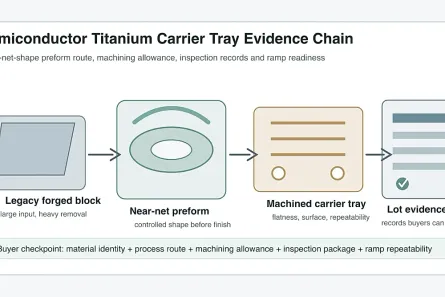
Semiconductor demand is starting to change the titanium question. For years, many precision titanium buyers treated the problem as one of block, plate or forging availability followed by enough machining time to reach the finished geometry. Norsk Titanium's latest Hittech update points to a different problem: when a large titanium component can move from a legacy forged block to a near-net-shape preform, buyers need proof that the new route can hold material integrity, dimensional control and repeatable performance at production speed.On 7 May 2026, Norsk Titanium and Hittech announced an expanded semiconductor collaboration through 2027. The companies said Norsk's Rapid Plasma Deposition process had replaced legacy titanium forged blocks with near-net-shape preforms for large titanium carrier trays used in demanding semiconductor equipment applications, including advanced lithography systems. They also said semiconductor business volumes were expected to increase multiple-fold in 2026 and more than double again in 2027 (Norsk Titanium). That matters because the demand backdrop is no longer quiet. The Semiconductor Industry Association reported that global semiconductor sales reached $298.5 billion in Q1 2026, up 25% from the previous quarter, with March sales rising sharply year over year (SIA). SEMI separately projected worldwide 300mm fab equipment spending to rise to $133 billion in 2026 and $151 billion in 2027, citing AI chip demand, advanced capacity and supply-chain restructuring (SEMI). Those figures do not prove a direct titanium boom. They do explain why semiconductor equipment suppliers are under pressure to reduce bottlenecks in precision components. In that environment, the titanium input form becomes more than a purchasing line item. Why Carrier Trays Are Not Ordinary Titanium Parts The Norsk-Hittech announcement is useful because it names both the part family and the manufacturing shift. A titanium carrier tray for semiconductor equipment is not simply a commodity plate cut into a shape. It sits inside a precision equipment chain where material cleanliness, stiffness, flatness, dimensional repeatability, machining stability and surface condition can affect downstream performance. When a buyer starts with a large forged block, much of the cost and schedule can sit in material removal. The part may still need extensive machining, stress control, inspection and documentation. A near-net-shape preform can reduce that burden, but only if the preform route is controlled well enough that less machining does not become more risk. This is the core buyer lesson. The substitution is not "additive manufacturing instead of forging." It is a different evidence path from input material to finished precision component. Norsk's first-quarter operational update adds a second clue. The company said it had resumed deliveries of titanium wafer carrier trays to Hittech, expected 2026 volumes to rise multiple-fold versus 2025, and was building shorter-cycle industrial opportunities across semiconductors, energy and other markets. It also described a broader operating model focused on converting qualified programs into recurring production revenue (Norsk Titanium Q1 update). For titanium processors and export buyers, that wording is important. Semiconductor work may move faster than aerospace qualification, but it does not remove qualification. It compresses the commercial timeline while increasing the need for clean process evidence. The Block-to-Preform Evidence Chain For buyers evaluating titanium preforms, machined trays, fixtures or other large precision parts, the practical framework is:Evidence gate What buyers should ask Why it mattersLegacy baseline What forged block, plate or billet route is being replaced? A preform only creates value when it is compared with the real incumbent processMaterial identity Which titanium alloy, specification window, chemistry and oxygen controls apply? Semiconductor equipment parts still need material records, not just geometryPreform route How is the near-net shape built, controlled, heat treated and documented? The route affects internal condition, residual stress and machining behaviorMachining allowance How much stock remains, where is it located and how stable is removal? Reduced machining is useful only if final dimensions remain controllableInspection package Which dimensional, surface, density, NDT or process records are supplied? Precision equipment buyers need lot-level proof of repeatabilityRamp readiness Can the supplier repeat the route as volumes rise? A prototype route is not the same as a production supply chainThis framework keeps the discussion grounded. If a near-net-shape route reduces rough machining, that is a real supply-chain advantage. But buyers should still ask how the supplier proves chemistry, oxygen level, thermal history, residual stress control, surface condition, dimensional repeatability and final inspection. The same evidence-first logic appears in our parallel reads — the recycled titanium powder-to-part chain (six gates, IperionX HAMR ramp) and the TITAN-AM aerospace additive evidence frame (seven gates, GKN/AFRL programme). What This Means for Titanium Product Buyers For buyers of titanium bars, plates and forgings, the news is a warning that some industrial applications may not keep buying the same input form forever. If a near-net-shape preform can reduce waste and shorten machining, a buyer may prefer an integrated route over a larger block that consumes machine hours. That does not make bar, plate or forging suppliers obsolete. It changes where they must show value. A mill product supplier may need stronger evidence around consistency, flatness, ultrasonic testing, chemistry, heat treatment and machinability. A forging supplier may need to show why forged grain flow, fatigue performance or qualification history still matters for a given part. A machining supplier may need to prove that it can control distortion, surface finish and inspection at higher throughput. For semiconductor equipment suppliers, the risk is different. They should not treat a preform as approved just because it removes less material. They need a release package that connects input material, process route, machining plan, inspection data and repeat production. If the part is used in a lithography-related application, the buyer's tolerance for unexplained variation will be low. The export buyer question is therefore not "Can you make this titanium shape?" It is "Can you explain the route well enough that our quality team can approve it without rebuilding the whole evidence file from scratch?" What Suppliers Should Prepare Now Titanium suppliers that want to serve semiconductor equipment programs should prepare documentation before the order arrives. A useful package can include alloy and heat traceability (Gr.5 / Ti-6Al-4V is most common for these applications), chemistry and oxygen records, preform process parameters, heat treatment history, machining allowance maps, dimensional inspection reports, surface condition records, nonconformance handling, change-control rules and ramp-rate assumptions. Aerospace-equivalent specs like ASTM B348 (bar) and ASTM B381 (forgings) often serve as starting reference points even when the end use is industrial. The supplier should also separate three claims that are often blended together. Material savings means less waste. Throughput means the route can deliver enough parts on schedule. Qualification means the customer has accepted the evidence package for its application. A strong supplier can discuss all three without pretending they are the same. That is the site-original insight from the Norsk-Hittech development. AI-driven semiconductor equipment demand is not only lifting the need for tools. It is exposing where titanium supply chains still depend on heavy material removal, long lead times and fragmented evidence. Near-net-shape titanium preforms can help, but only when buyers can audit the route from material identity to finished carrier tray. The winners will not be the suppliers that simply say additive manufacturing is faster. They will be the suppliers that make the preform evidence chain as inspectable as the machined part itself.Related Products & ServicesTitanium forgings — Gr.5 / Ti-6Al-4V near-net forge stock with ASTM B381 / AMS 4928 traceability Titanium bar / rod — ASTM B348 machining stock with batch traceability Titanium sheet & plate — ASTM B265 plate stock for precision component blanks Special titanium alloys — Gr.5 (Ti-6Al-4V) reference for semiconductor equipment programs Contract machining services — finish machining, dimensional verification, inspection-ready delivery for preform / blank routes Titanium industry news — ongoing tracking of qualification chains across aerospace, semiconductor, medical, chemical and powder routes