Type something to search...

Am titanium release evidence

Aerospace and Defense
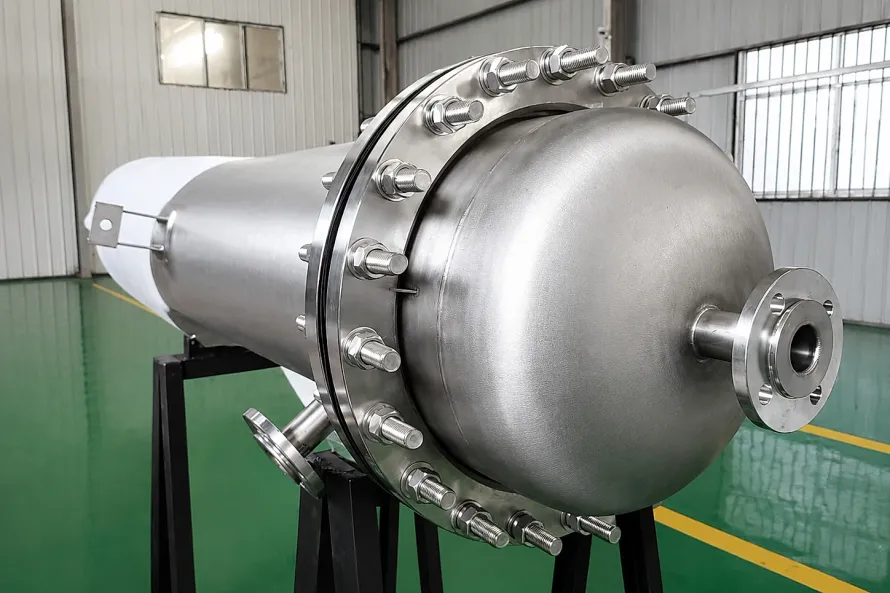
Bolted titanium pressure component with machined flanges and vessel interfaces
By Jason/ On 03 Jul, 2026

Northrop's Single-Piece Titanium Tank Turns AM Buying Into an Inspection-Map Question

Northrop Grumman's reported single-piece Ti-64 propellant tank is a useful signal for titanium buyers because it does not just say additive manufacturing can save machining time. It shows what happens when a traditional pressure assembly is collapsed into one titanium product. According to 3D Printing Industry, the tank was built with directed energy deposition in titanium Ti-64, drew on the GAMAT material-data effort, and moved into formal performance testing after showing roughly 50% lead-time reduction and about 30% cost reduction versus the forged-and-welded version. The important procurement lesson is not the percentage alone. It is that the old evidence structure changes. In a forged and welded tank, buyers can ask separate questions about forging route, weld procedure, weld inspection, joint geometry and final pressure testing. In a single-piece DED tank, some of those interfaces disappear physically, but the buyer's responsibility does not disappear with them. It moves into a different map: material data, deposition route, integrated hard points, inspection access, pressure-boundary proof and release authority all have to describe the same part. Consolidation Removes Parts, Not Evidence Part consolidation is often sold as a design advantage. For a titanium pressure component, it is also an evidence transfer. A weld that no longer exists cannot be inspected as a weld. A hard point printed directly into a tank wall cannot be treated as an attached bracket unless the local geometry, build history and acceptance route support that interpretation.That is why the Northrop case is more useful when read as a buyer framework than as an AM success story. The source says the team used DED in Ti-64 and drew on the GAMAT dataset. America Makes describes GAMAT as a project to generate statistically based bulk material properties for Ti-6Al-4V through laser powder feed DED, addressing a lack of widely accepted design data for AM parts. That kind of material-data work helps the industry speak more consistently about DED Ti-64. But a material dataset is not the same as a released tank. The buyer still has to connect the dataset to the process route, machine envelope, part geometry, local features, inspection method and performance test. For critical titanium products, the mistake is to let "single piece" sound like "single question." It is not. It is a different set of questions. The Inspection Map Buyers Should Ask For A practical inspection map for a monolithic titanium pressure part should separate seven evidence layers (see our earlier reads on the titanium pressure-retention evidence file and AM data-package release evidence).Evidence layer What the buyer needs to see Why it mattersPressure-boundary definition Which surfaces, ports, transitions and local features carry pressure or launch load The releasable product is defined by function, not only by alloy and shapeMaterial-data basis How Ti-64 allowables, coupon data or internal design data apply to the exact DED route General AM material confidence does not automatically cover every build envelopeDeposition and thermal route Machine, feedstock, process controls, heat treatment and post-processing records The route becomes part of material identity for AM titaniumIntegrated feature control Hard points, feed tubes, bosses, flanges and transition zones tied to drawing intent Consolidated features can shift stress, inspection access and acceptance criteriaInspection access NDE, dimensional, surface, internal-quality and leak or pressure-test methods matched to geometry Old weld-inspection logic may not cover the new risk locationsPerformance test bridge How the tested article represents future production parts or purchase-order lots A demonstration result has to be translated into repeatable release evidenceRelease authority The customer, design authority or quality system that accepts the part for its intended boundary Supplier capability is not the same as buyer authorizationThis framework applies beyond spacecraft tanks. It matters for titanium pressure vessels, heat-exchanger shells, custom tube assemblies, machined flanges, AM preforms and any buyer-facing product where fabrication stages are consolidated. A buyer comparing a traditional route with an AM route should ask which evidence has been removed, which evidence has been replaced and which evidence has become newly necessary. The Product Form Still Matters Northrop's official space additive manufacturing page lists titanium across electron beam powder bed fusion, laser powder bed fusion, automated stir friction welding and wire directed energy deposition for structures, subsystem products, launch vehicles, motors and space vehicle or payload products. That range is important because it shows why titanium procurement cannot be reduced to "AM or conventional." Titanium bar, tube, plate, forging, shell and machined-component buyers still buy a product form. AM can change the route into that form, or it can make the route and final form harder to separate. In either case, the release packet has to be specific. A tube-stock certificate does not release a pressure tank. A DED material dataset does not release an integrated port. A performance test on one article does not automatically release every future geometry.For export buyers, that distinction affects RFQs and supplier evaluation (see our read on AM audit-scope-to-order release evidence). If a supplier quotes a single-piece titanium component, the buyer should not ask only for alloy grade, lead time and price. The RFQ should ask for the process route, inspection surfaces, pressure or leak evidence where relevant, drawing change rules, material-data basis, acceptance authority and the exact wording that will appear on the certificate or release document. The Strong Signal Is Discipline, Not Hype The most useful point in the Northrop story is that additive manufacturing is treated as a way to solve a product problem, not as a universal replacement for forgings and welds — the same discipline we saw in the titanium lattice load-curve release file. The reported savings matter because they are tied to a specific pressure component and a formal testing path. They would be much less meaningful if they were detached from inspection and qualification. For titanium suppliers, the opportunity is to make consolidated products easier to trust, not merely easier to print. For buyers, the safer question is not whether a single-piece Ti-64 tank is impressive. It is whether the evidence map is as integrated as the part. When that map is complete, AM consolidation can reduce interfaces without weakening buyer control. When it is incomplete, the missing weld can become a missing inspection point.

Ready to Start Your Project?

Get factory-direct pricing on titanium products. No minimum order.

Get a Free Quote
Quick Inquiry