Type something to search...

Rpd titanium

Aerospace and Defense
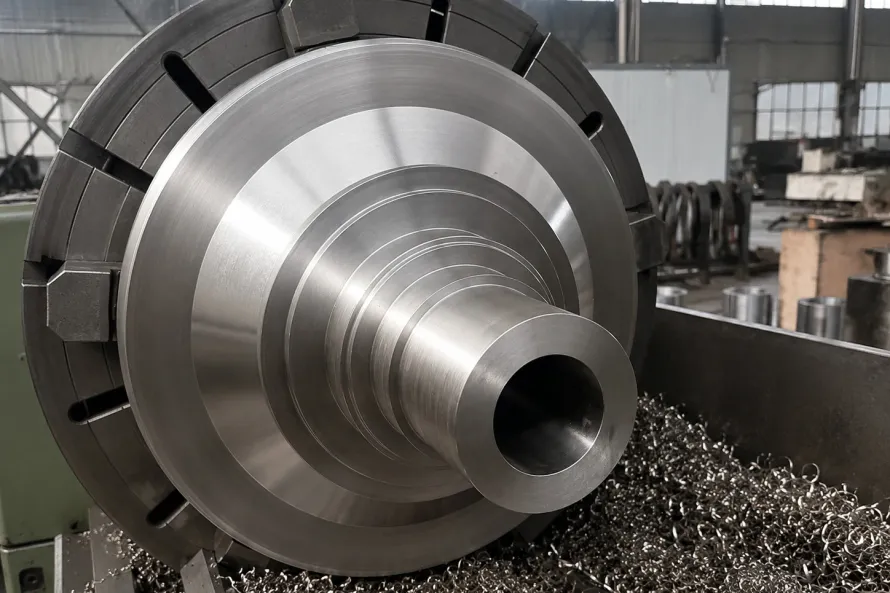
Large machined titanium component on a lathe, illustrating why submarine-adjacent parts need mission-envelope qualification evidence.
By Jason/ On 13 Jun, 2026

Norsk's Submarine Contract Shows Why Titanium Buyers Need a Mission-Envelope File

The latest titanium additive-manufacturing contract is not only a supplier-development story. It is a reminder that submarine-adjacent titanium parts cannot be judged by alloy grade, production route or supplier credential alone. They need evidence that the part fits the mission environment it is expected to survive.On June 11, 2026, Norsk Titanium announced that it had received nearly $4.2 million in a contract investment from the Office of the Assistant Secretary of War for Industrial Base Policy in support of the Defense Industrial Base Expansion, Development, and Growth Enterprise, known as DIB-EDGE. The announcement says DIB-EDGE is focused on next-generation manufacturing capabilities for U.S. maritime and submarine industrial capacity, and that the investment funds Rapid Plasma Deposition, or RPD, development over the 18-month term of the contract. That is a strong signal for titanium buyers, but it is also easy to read too broadly. The announcement does not identify the exact submarine components, alloy grades, acceptance standards or production volumes. The useful buyer conclusion is narrower: when titanium moves toward submarine and maritime work, the evidence file must expand from "qualified process" to "qualified mission envelope." Submarine Work Changes The Qualification Question Titanium is attractive in marine and defense applications because it can combine strength, corrosion resistance and weight reduction. But a submarine environment changes the approval question. A part may need to survive seawater exposure, pressure-related loading, vibration, fatigue, shock, galvanic interfaces, restricted inspection access, long maintenance intervals and strict configuration control. For a buyer, that means the first question is not simply whether the supplier can make a titanium part. It is whether the product form and process route have been qualified for the specific duty that the part will see. A machined titanium fitting, a forged or near-net-shape preform, a tube assembly and a structural bracket do not carry the same evidence burden. One part may be judged by dimensional repeatability and fatigue behavior. Another may need corrosion exposure data, weld or joining evidence, pressure-boundary review, non-destructive examination and installation-interface control. A third may be acceptable in one location but not in a more critical area of the vessel. This is why the phrase "highly critical applications" matters. It does not remove the need for proof. It raises the standard for proof. Qualification Is Not One Credential Norsk's recent announcements show how layered qualification has become. On May 29, 2026, the company announced Nadcap accreditation for additive manufacturing at its Plattsburgh operations. That matters because Nadcap is a special-process accreditation path used by aerospace and defense supply chains to evaluate process control, repeatability and traceability. But Nadcap is not the same as part release. It can reduce the audit burden and improve confidence in the manufacturing system, but the buyer still has to connect the credential to the part number, product form, route, drawing, inspection plan, environmental exposure and approval authority. The same lesson appears in a different market. On June 2, 2026, Norsk and Airbus announced a cooperation and research agreement to industrialize and qualify RPD for high-criticality structural titanium parts. That work includes titanium wire qualification, process validation and standardization. The details are aerospace-specific, but the discipline is transferable: a route becomes useful to buyers only when material input, process controls, inspection basis and application boundary are tied together. Norsk also states that it has 700 MT of production capacity and that RPD printed parts are already flying on commercial aircraft. Those facts show industrial maturity. They do not, by themselves, answer whether a specific titanium part is ready for a submarine mission envelope. The Mission-Envelope File The practical response is a mission-envelope qualification file. This is not a replacement for drawings, purchase orders, material certificates or customer approval. It is the bridge that shows why those records are valid for the operating environment.Evidence layer Buyer question Records to requestMission boundary Where will the titanium part operate? Vessel area, criticality level, pressure or load role, exposure condition, maintenance interval and approval authorityMaterial form What physical form is being qualified? Wire-fed preform, billet, forging, plate, tube, fitting or machined component; alloy grade; heat or lot identityRoute lock Which route is allowed for this part? RPD route, forging route, machining route, heat treatment, surface treatment, joining route and subcontractor boundaryEnvironment evidence What proves the part fits the service condition? Corrosion, fatigue, vibration, shock, pressure, temperature, galvanic or fluid-compatibility evidence as applicableInspection release What inspection proves the part can ship? Dimensional report, NDT, surface inspection, material testing, defect acceptance criteria and nonconformance closureInterface control What must match the surrounding system? Drawing revision, mating geometry, bolt pattern, tube or pipe interface, sealing face, assembly clearance and installation torque where relevantSustainment path How will the part be repaired or replaced? Spare route, approved local manufacturing rules, technical-data transfer, maintenance release and change historyChange trigger What forces re-review? New lot, feedstock change, machine change, parameter change, route substitution, inspection method change or design revisionThe file forces a disciplined distinction. A supplier may have process capability. A part may have material traceability. A buyer may have a delivery schedule. None of those alone proves that the product fits the mission envelope. What Titanium Buyers Should Ask Now For titanium buyers outside prime defense programs, the lesson is still useful. Export distributors, marine-equipment buyers, energy-equipment purchasers and precision-machining customers often receive broad claims about aerospace or defense readiness. Those claims may be relevant, but they need to be translated into part-level evidence. For a machined titanium component, ask whether the input form, machining allowance, heat treatment, surface condition, dimensional tolerances, NDT and certificate wording are linked to the actual application. For a titanium tube or fitting, ask whether the wall, bend, end connection, weld or joining boundary, surface finish, pressure role and corrosion exposure are all inside the approved route. For a near-net-shape preform, ask whether the buyer is approving the preform route, the finished geometry, or both.The question becomes sharper when a supplier proposes an alternative route. If a part was historically forged and machined, a wire-fed preform may reduce waste or lead time. But the buyer still needs a bridge between the legacy route and the new route: material input, process envelope, heat treatment response, inspection method, defect population, machining stock, surface condition and approval boundary. That bridge should be written before the purchase order becomes a schedule problem. Maritime AM Context Is Moving, But It Does Not Remove The Gate The maritime context around this story is also moving. In the June 2026 Australia-UK Ministerial Consultations statement, ministers said the UK submarine HMS Anson completed a scheduled maintenance period in Western Australia, the first such maintenance period by a UK nuclear-powered submarine in Australia. The statement said 17 Australian businesses supported the activity, 34 locally manufactured components were produced, more than 2,500 person hours of Australian industry work were completed, and 620 hours of trilateral uniformed work supported the maintenance period. USNI News also reported that QinetiQ supported the HMS Anson maintenance period with additive-manufactured replacement parts delivered in 4 weeks after approval by the UK Submarine Delivery Group Additive Manufacturing Team. That is not a titanium-specific case, and it should not be read as one. Its value is in the workflow: reverse engineering, secure technical-data transfer, local manufacturing, approval by the responsible authority and installation during a controlled maintenance event. For titanium products, that workflow points to the same conclusion as the Norsk contract. Speed is useful only when it remains inside the approval chain. Local manufacturing is useful only when the technical data, route, inspection and configuration records remain intact. Additive manufacturing is useful only when the mission envelope is proven, not assumed. The Buyer Takeaway The June 11 contract is a strong signal that titanium AM is moving deeper into maritime and submarine industrial-base conversations. But the buyer value is not a headline about "submarine titanium." The buyer value is a better question: what evidence proves this titanium part fits its mission envelope? The answer should connect material form, route lock, environmental evidence, inspection release, interface control, sustainment path and change triggers. Without that file, a supplier credential can be mistaken for part approval. With it, the buyer can separate manufacturing capability from mission-ready release. That distinction is where professional titanium procurement now has to live.

Ready to Start Your Project?

Get factory-direct pricing on titanium products. No minimum order.

Get a Free Quote
Quick Inquiry