Type something to search...

Titanium mtr evidence

Aerospace and Defense
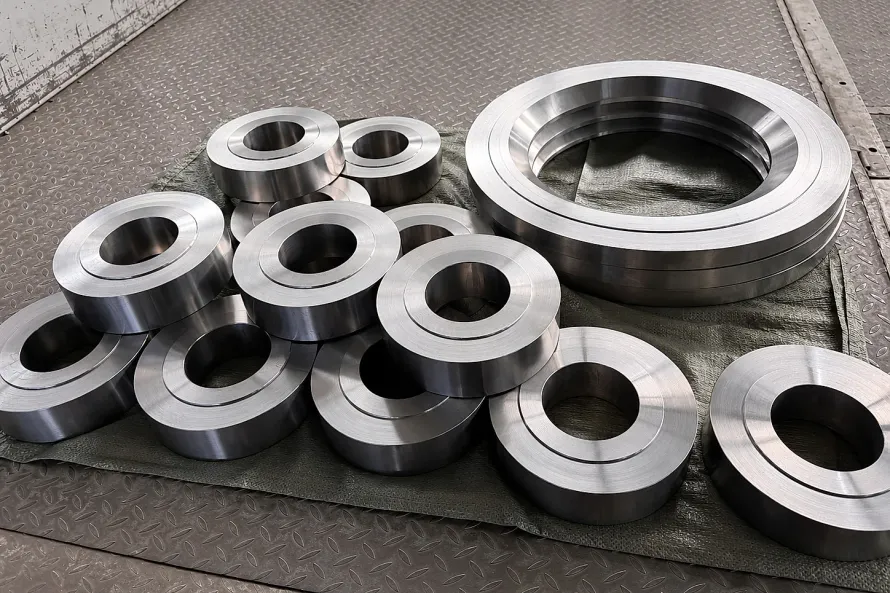
Machined titanium ring blanks grouped for shipment, illustrating why source control has to travel from strategic supplier decisions into lot-level release records.
By Jason/ On 27 Jun, 2026

Airbus and Safran's Aubert & Duval Move Makes Titanium Buyers Ask a Source-Control Question

Airbus, Safran and Tikehau Capital said on 2026-06-25 that they had signed an agreement for Airbus and Safran to buy Tikehau Capital's stake in Aubert & Duval. The transaction is expected to close before the end of 2026, subject to customary approvals. For titanium buyers, the useful signal is not that one more supplier has changed ownership. Aubert & Duval sits in a part of the aerospace supply chain where ownership, alloy route, melt practice, forging scope, machining boundary, recycling input and release documentation can all affect whether a titanium product is acceptable for a particular program. The buyer question is therefore narrower and more practical: when a strategic metallurgical source becomes more tightly controlled by prime aerospace groups, what evidence still has to travel with each titanium lot? The official release describes Aubert & Duval as a strategic supplier of critical components and materials for sectors including civil and military aerospace, defence, nuclear and medical applications. It also names high-performance steels, superalloys, titanium and aluminum, and says the company has a fully integrated industrial value chain from the design of new materials to the production of forged and machined parts. Aubert & Duval's own civil aviation materials page says it works with high-performance steels, superalloys, aluminum and titanium for complex aviation parts, with activity that reaches from material and part design to after-sales recycling. That wording matters because it is not only a capacity story. It is a source-control story. Ownership Control Is Not Lot Release A prime-controlled metallurgical supplier can improve continuity for aircraft programs that need stable material knowledge, approved routes and long-cycle industrial planning. It may also reduce uncertainty around strategic investments in melting, forging, machining, heat treatment and recycling. But none of that automatically releases a titanium billet, ring, bar, tube, plate or machined component for a buyer. A released titanium product still needs a chain of evidence. The alloy grade and specification have to match the order. The melt route and any VAR or other remelting step have to be recorded where they matter. The forging or conversion route has to stay inside the approved envelope. Heat treatment, machining, dimensional inspection, NDT where required, MTR data and change-control records have to connect the physical lot to the paperwork. If recycled titanium input is part of the route, the buyer still needs the material pedigree and allocation boundary, not just a broad recycling claim. That is why the Airbus-Safran move should not be read as a simple shortage or price signal. The public sources do not say that titanium supply has changed, that pricing will move, or that any buyer allocation has been revised. The stronger reading is procedural: high-value aerospace titanium is moving further into source-controlled systems where buyers must understand which evidence belongs to the supplier, which evidence belongs to the product form, and which evidence belongs to the released lot.The Source-Control-to-Lot Release File For procurement and quality teams, the reusable framework is a source-control-to-lot release file. It should not be a marketing folder. It should be a short, auditable bridge between the strategic source and the physical titanium product.Evidence layer Buyer question Why it mattersStrategic source identity Which approved source, mill, converter or forging route is tied to the product? Ownership control does not prove that this exact route is approved for this order.Alloy and specification basis Which grade, specification, chemistry and mechanical requirements govern the lot? Titanium product forms are not interchangeable just because they come from a strategic supplier.Melt and input pedigree What melt, remelt, scrap or recycled-input record supports the material identity? Recycling and integrated metallurgy need traceability before they become buyer evidence.Conversion and forging route Which billet, bar, ring, plate, tube or forged blank route created the product form? The release risk sits in the route boundary, not only in the company name.Heat treatment and machining boundary What process steps changed the material condition or final geometry? A good source can still produce a nonconforming part if the process envelope changes.Inspection and release package Which MTR, dimensional, PMI, NDT or other acceptance records travel with the lot? Buyers release physical material, not corporate strategy.Change-control trigger What source, route, facility, input or process change requires buyer review? Prime ownership can reduce uncertainty, but change control still decides continuity.This file is especially useful for titanium rings, forgings, precision machined parts and aerospace stock where buyers cannot treat material availability as separate from qualification evidence. It also helps non-aerospace buyers who purchase titanium for medical, chemical, energy or semiconductor equipment. The names in the source-control chain may differ, but the logic is the same: product acceptance depends on a documented route, not on a broad statement that an important supplier exists. What Buyers Should Watch Next The next useful public evidence will not be a headline saying that a shareholder transaction closed. It will be more specific: approved-source list changes, route disclosures, mill or forging investments, recycling qualification language, customer program references, audited process credentials, or product-form data that shows where the new control structure reaches the lot level. For titanium suppliers outside the Airbus-Safran-Aubert & Duval chain, the practical lesson is also clear. Competing in source-controlled product categories requires more than saying that Grade 5 or Ti-6Al-4V material is available. Buyers will increasingly ask how the supplier connects material origin, conversion route, inspection release and change control. A clean quote without that bridge may look cheaper, but it leaves the buyer with a qualification gap.The defensible conclusion is restrained. The Aubert & Duval agreement does not prove a new titanium shortage, a new price direction or a new approval path. It does show that strategic aerospace metallurgy is being treated as a controlled industrial capability. For titanium product buyers, that makes the release file more important, not less: every bar, tube, plate, forging or machined component still has to carry its own evidence from source control to lot release.

Ready to Start Your Project?

Get factory-direct pricing on titanium products. No minimum order.

Get a Free Quote
Quick Inquiry