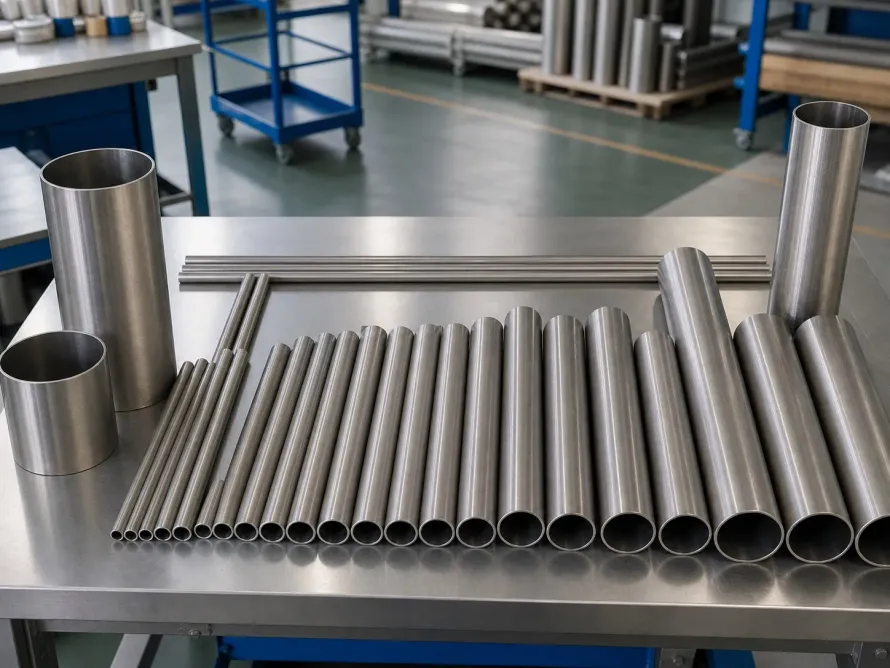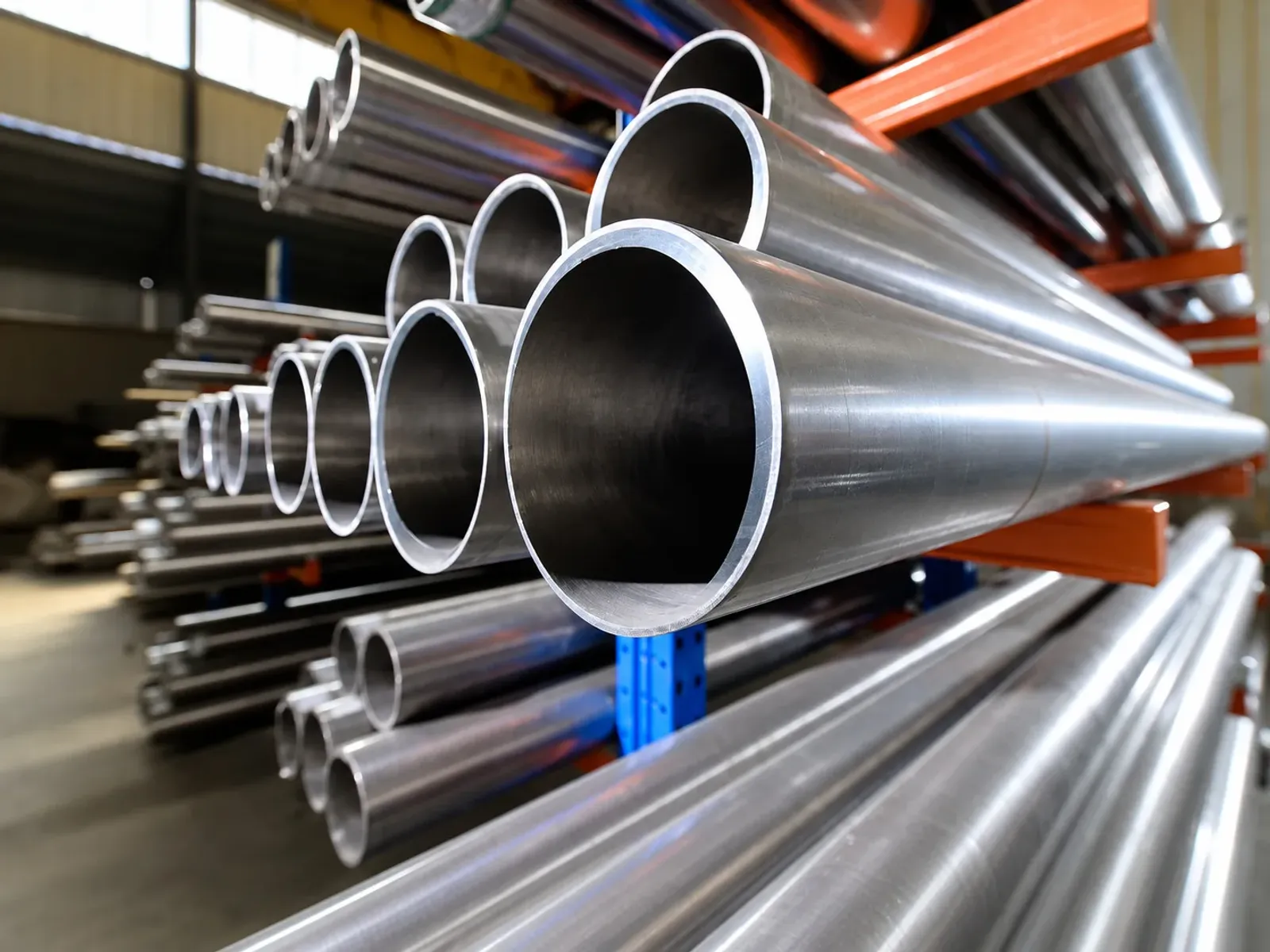
Round tube form alone does not identify Grade 2 or Grade 12; the substitution decision depends on chemistry, service and design evidence.
Grade 12 titanium tube can be a strong candidate when a process system needs better performance than commercially pure Grade 2 in hot brines or reducing environments. It is not a drop-in upgrade. Grade 12 is a distinct Ti-0.8Ni-0.3Mo alloy with a higher minimum strength set, so a substitution can change corrosion assumptions, allowable section, bending behavior and tube-to-tubesheet fabrication at the same time. Approve it only after the actual service chemistry, governing specification and design basis are rechecked together.
The alloy change is the first decision, not the grade number
Alleima identifies Grade 12 as ASTM Grade 12 / UNS R53400 and lists 0.2–0.4% molybdenum plus 0.6–0.9% nickel. Its current Grade 2 tube page lists no intentional molybdenum or nickel range. That makes Grade 12 a different alloy system, not “Grade 2 with a higher number” and not Grade 2H.
The same-producer tube pages also show a different minimum property set. Grade 12 is listed at 483 MPa minimum tensile strength, 345 MPa minimum yield strength and 18% minimum elongation. Grade 2 is listed at 345 MPa, 275 MPa and 20%. These figures help explain why a designer may consider Grade 12, but they do not prove that a thinner wall or the same geometry is acceptable. The current product standard, design code, pressure and load case still control that decision.
Grade 12 earns attention in a defined service envelope
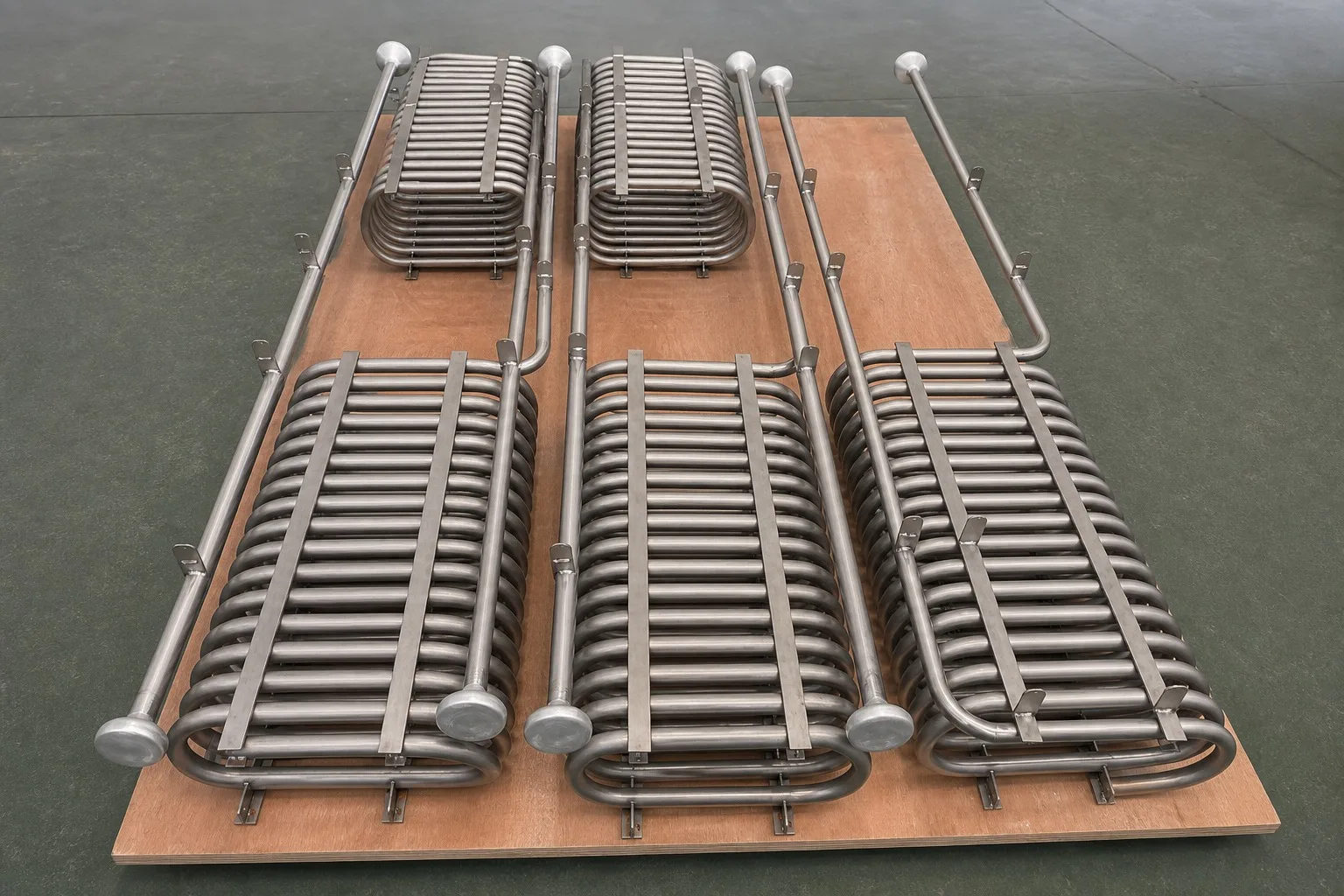
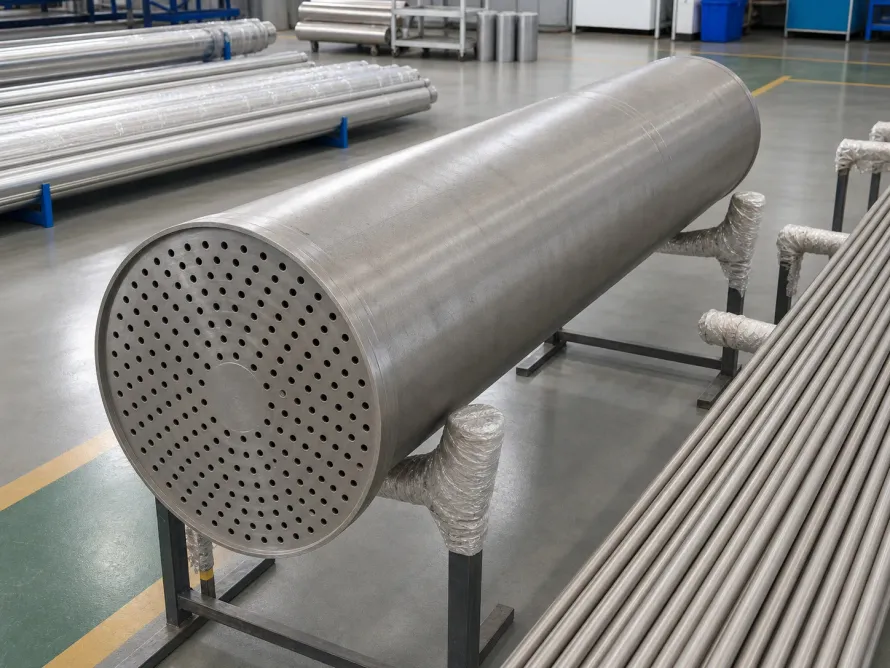
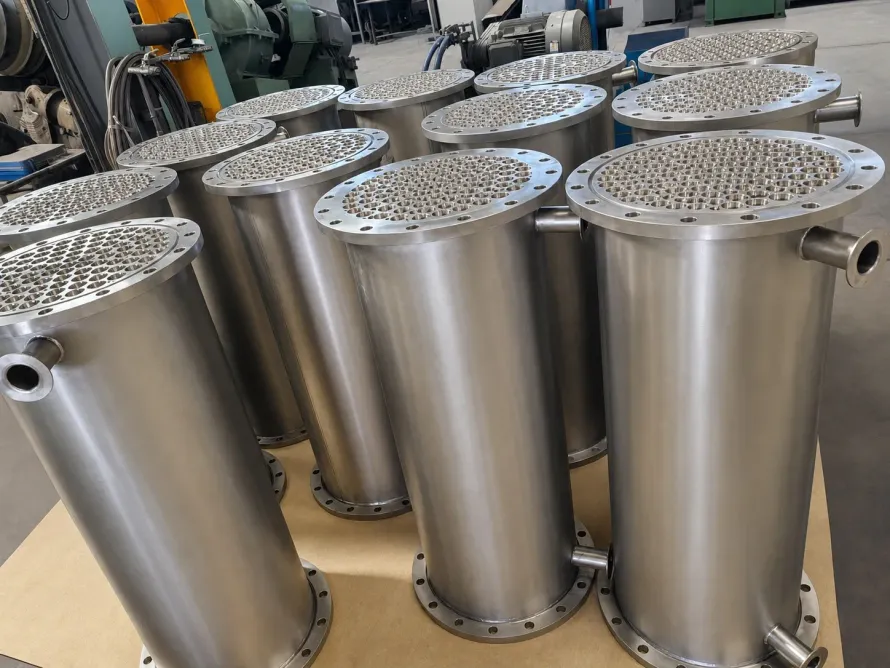
Heat-exchanger tubing is a system choice: alloy, process medium, geometry, forming and joints must be assessed together.
Alleima describes Grade 12 as suitable for shell-and-tube heat exchangers and chemical-industry service, with resistance in reducing and oxidizing environments. TIMET’s historical Grade 12 sheet adds the more specific comparison: improvement over unalloyed titanium, particularly for crevice corrosion in hot brines, and comparative data for acids and saturated sodium-chloride brine.
That evidence supports a screening question, not a universal answer: does the real service resemble the tested chemistry and crevice conditions closely enough to justify application-specific evaluation? A buyer still needs the medium, concentration, contaminants, temperature range, oxygen condition, crevice geometry, flow, cleaning chemistry and upset case. “Hot chloride service” alone is too broad to convert a historical chart into an acceptance limit.
The comparison with Grade 2 also matters. Grade 2 already has strong resistance in many chloride-containing environments, so Grade 12 should not be specified merely because it sounds more corrosion resistant. Its value appears when the Grade 2 service envelope is genuinely challenged and the Mo-Ni alloy has relevant evidence for that challenge.
Higher minimum strength does not automatically create wall savings
TIMET’s historical sheet and Alleima’s current page agree on the displayed Grade 12 minimum values of 483 MPa tensile strength, 345 MPa yield strength and 18% elongation. That consistency is useful, but structural efficiency is not a purchase shortcut.
A wall reduction changes pressure stress, buckling margin, vibration response, erosion allowance, handling damage, weld or expansion geometry and inspection sensitivity. It may also change the product size that can be sourced. A valid thinner-wall proposal therefore needs the applicable code calculation and equipment design basis; it cannot be inferred from tensile strength alone.
Fabrication needs its own qualification
Alleima says Grade 12 tubing can be bent with standard tooling, but recommends a lubricated mandrel for thin-wall or tight-radius bends and reports springback at about twice that of stainless steel. It also suggests 10% wall reduction when roller-expanding the tube into a tubesheet for pull-out strength.
Alleima’s Grade 2 page gives the same general forming and roller-expansion guidance. Those statements therefore do not quantify a Grade 12-versus-Grade 2 fabrication difference; they only show why the actual procedure and acceptance evidence must be checked before transfer.
Those are useful producer starting points, not universal project settings. If Grade 12 replaces Grade 2, the supplier should not silently retain an old bend program, expansion value or first-article record. Tube outside diameter, wall, condition, finished bend geometry, tubesheet material, hole preparation, expansion method and acceptance evidence all need to remain traceable to the actual Grade 12 part.
Build the substitution record around three linked questions
| Decision | Evidence needed | What not to assume |
|---|---|---|
| Does Grade 12 address the service chemistry? | Medium, concentration, temperature, contaminants, crevice and upset conditions; relevant corrosion evidence | A generic “hot brine” label proves suitability |
| Can the design use its higher strength? | Governing product standard, code calculation, loads, pressure, geometry and inspection basis | Higher minimum yield strength automatically permits thinner wall |
| Can the approved fabrication route transfer? | Grade 12-specific bend or expansion procedure, first-article measurements and surface/geometry acceptance | Standard tooling means Grade 2 settings and records remain valid |
The practical choice is conditional. Select Grade 12 because its alloyed corrosion behavior and strength are relevant to a defined service and design problem. Then qualify the product form and fabrication route. If the service does not need those differences, Grade 2 may remain the simpler basis; if it does, the Grade 12 decision should be documented as an engineering change rather than a purchasing synonym.
Sources
- Alleima Ti Grade 12 — tube and pipe, seamless — current producer datasheet updated May 9, 2025; accessed October 16, 2026.
- Alleima Ti Grade 2 — tube and pipe, seamless — current producer comparison page updated May 9, 2025; accessed October 16, 2026.
- TIMETAL Grade 12 — historical producer technical datasheet used for bounded comparative context; accessed October 16, 2026.