Type something to search...

Titanium forgings

others
Embraer's New Forging Supplier Signal Shows Why Titanium Buyers Need a New-Source Qualification File
By Jason/ On 16 May, 2026

Embraer's New Forging Supplier Signal Shows Why Titanium Buyers Need a New-Source Qualification File

Embraer's latest supplier announcement is not a titanium order announcement. That distinction matters. The company said on May 11 that it had named Bharat Forge as a new Indian supplier for forged raw materials, and the supplier's Business Wire release described a long-term contract for critical landing gear forgings across Embraer's commercial and defense aircraft programs.For titanium buyers, the value of the news is not a material claim. The announcement does not say that every forging covered by the contract is titanium. The useful signal is the sourcing mechanism: a new forging source is being added to a global aerospace supply chain at a time when production rate, backlog and supplier diversification are becoming more important. Embraer's own May 11 supplier release says the agreement supports the company's strategy of expanding and diversifying its global supplier base. A few days earlier, Embraer reported first-quarter 2026 revenue of US$1.4 billion, 44 aircraft delivered in the quarter and a backlog of US$32.1 billion. Those figures do not automatically create titanium demand. They do show why aerospace OEMs keep looking for qualified, resilient and scalable sources for safety-critical metallic components. That is where processed titanium suppliers and buyers should pay attention. When a new source enters the qualification path for forged raw material, landing gear forgings or other critical structural components, the buyer problem is not only price or capacity. It is whether the supplier can move from first approval to repeatable rate production without losing control of material identity, route evidence, inspection responsibility and change notification. New Source Is Not The Same As Qualified Rate A new aerospace supplier can be commercially attractive before it is operationally easy. The first contract, audit or approval milestone only begins the buyer's evidence work. It does not prove that every future lot, product family, process route or subcontracted step will remain stable at production rate. This matters for titanium because titanium products often sit upstream of the final forging or machined component. A titanium billet can feed a forged blank. A forged blank can become a machined structural part. A plate or bar can be cut, heat treated, inspected, machined and released under a customer-specific drawing. Each step adds value, but each step also creates a point where the evidence chain can become unclear. The strongest suppliers do not ask buyers to accept a new-source story on reputation. They show how the source will be controlled. The New-Source Qualification File A practical buyer response is to create a new-source qualification file before relying on a new supplier for critical titanium products. It is not the same as a general supplier profile. It is a controlled record that explains exactly which product, route and approval state the buyer is accepting.Evidence layer Buyer question Titanium and forging records to requestSupplier scope Which legal entity, facility and product family is actually approved? Facility address, quality-system scope, approved product family, contact ownership and customer approval statusMaterial scope Which alloy, grade, melt source and product form are included? Heat identity, alloy grade, titanium billet/bar/plate/forging form, certificate language and material specificationProcess route Which process path is frozen for production? Forging route, rolling or billet conversion, heat treatment, machining allowance, outside processing and route travelerQualification state Is this development, first article, limited production or rate production? First-article records, customer sign-off, production readiness review, capacity plan and open actionsInspection package What proves each lot remains inside the approved population? Mechanical testing, chemistry, ultrasonic/NDT, dimensional reports, surface condition, hardness and final release recordsChange control What changes must trigger buyer notice or re-approval? Facility move, die or tooling change, subcontractor change, heat-treatment change, inspection lab change and certificate format changeRamp discipline Can the supplier repeat the route without evidence thinning out? Lot segregation, nonconformance history, on-time release data, audit findings and corrective-action closureThe file should be product-specific. A supplier approved for one forged raw material route is not automatically approved for every titanium bar, plate, forging, tube, machined component or heat-treatment condition the buyer may later request.What Titanium Product Buyers Should Watch For titanium billets and bars, the key issue is whether heat identity and size range remain connected to the downstream forging route. If a new source changes billet conversion, outside processing or heat-treatment responsibility, the buyer should treat that as a review trigger. For titanium forgings, the evidence file should separate raw material approval from forged-shape approval. Grain-flow assumptions, die route, heat treatment, NDT, dimensional control and final machining allowance are not generic supplier attributes. They belong to the product family and route — typically Gr.5 Ti-6Al-4V certified to AMS 4928 for aerospace work. For machined titanium components, the buyer should identify where the qualification boundary sits. If the supplier delivers a forged blank, the machine shop may own dimensional release. If the supplier delivers a near-finished component, the supplier may own more of the inspection and drawing-control package. The purchase order should make that responsibility visible. For plates, sheets and tubes used in aerospace-adjacent, chemical or industrial programs, the same lesson applies at a lower intensity. A new source may be commercially approved, but the buyer still needs to know which forms, thicknesses, conditions and inspection levels are covered. The practical risk is evidence dilution during ramp-up. First lots often receive heavy attention. Later lots can become routine, especially when demand rises. A good new-source file prevents routine production from becoming thinner documentation. Why This Is Different From Supplier Continuity Supplier continuity is about preserving evidence when an existing supplier changes ownership, facility, reporting segment or operating responsibility. A new-source qualification file is different. It starts before the supplier has long production history with the buyer. That difference changes the questions. Continuity asks: did the route stay the same after a change? New-source qualification asks: what route is being accepted in the first place, and what evidence proves it can repeat? The Embraer-Bharat Forge news is useful because it shows the front end of that process. Embraer is expanding its supplier base, while Bharat Forge's release emphasizes high-integrity landing gear forgings and stringent certification standards. For titanium buyers watching similar sourcing moves, the right takeaway is not to copy the contract. It is to copy the discipline: define the product boundary, freeze the route, prove the first article and control the ramp. A Buyer Checklist Before Relying On A New Titanium Source Before moving critical titanium products to a new source, procurement and quality teams should ask five questions. First, does the supplier approval cover the exact facility, product form and process route being quoted? Second, are material certificates, heat numbers, inspection reports and route travelers linked to the same lot identity — see our allowables-to-lot evidence map for the broader framework? Third, has the first article or initial production lot been reviewed against the buyer's drawing, specification and application assumptions? Fourth, which changes require notification before shipment rather than after a certificate is challenged? Fifth, does the supplier have a documented plan for rate production, not only a successful launch lot? For export buyers, this is especially important because the original forging source, processor, distributor and end user may sit in different countries. The farther the buyer is from the process floor, the more the new-source file matters — and the form-to-code evidence file becomes a useful companion on the trade side. Buyer Takeaway The current Embraer sourcing signal shows a broader aerospace reality: supply chains are diversifying, but safety-critical metallic products still become trusted only through evidence. For titanium bars, billets, plates, forgings and machined components, the buyer's question should not be whether a new source sounds capable. The question is whether the qualification file proves the accepted route can repeat at rate. Related Products & ServicesTitanium Forgings — aerospace AMS 4928 approved routes Titanium Bars — billet & bar with heat / lot traceability Titanium Sheets & Plates — ASTM B265 + rolling route records Titanium Tubes — seamless / welded with B338 documentation Titanium CNC Machining — qualified contract machining Stocking Programs — ramp-friendly buffer inventory Titanium Standards & Specifications — full spec catalog

others
Sponge Titanium's Price Standoff Shows Why Buyers Need a Grade-to-Form Evidence Chain
By Jason/ On 11 May, 2026

Sponge Titanium's Price Standoff Shows Why Buyers Need a Grade-to-Form Evidence Chain

Sponge titanium is sending a mixed signal to titanium buyers. In an April 30 update, SMM reported that China's sponge titanium output rose 3.49% month on month in April 2026, while prices moved to RMB 48,000-50,000 per metric ton. Yet the same update pointed to inventory pressure and weak buying momentum from downstream titanium materials.For buyers of titanium bars, tubes, plates and sheets, forgings and machined components, that is not just a price note. It is a reminder that the cheapest or most visible upstream feedstock is not automatically usable supply. A sponge market can look loose while qualified mill products remain constrained by chemistry, melting capacity, conversion route, heat treatment, inspection, documentation and customer approval. The practical question is therefore not "Is sponge titanium available?" It is "Can this lot become the specific titanium form, grade and evidence package my application needs?" The Market Signal Is Real, But Incomplete The SMM update matters because sponge titanium sits upstream of many processed titanium products. Higher output with narrow price movement can influence producer negotiations, working capital and expectations for mill product costs. If downstream demand remains cautious, some buyers may assume that bars, tubes or plates should become easier to source. That assumption is too simple. Sponge titanium is an intermediate input. It still has to pass through melt and conversion steps before it becomes the material forms that procurement teams actually buy. Each step can narrow the useful supply pool. A low-priced sponge lot may be commercially attractive, but it does not answer whether the final bar or tube will meet a buyer's grade, mechanical properties, dimensional tolerance, inspection records, origin requirements or certification package. The structural context makes this even more important. The U.S. Geological Survey's 2026 titanium summary said the United States did not produce titanium sponge metal in 2025 and showed net import reliance for sponge at 100%. It also noted that U.S. producers of ingot and downstream products relied on imported sponge and scrap. In other words, the industry is not only watching price; it is watching whether upstream material can move through an auditable route into qualified downstream supply. Why Sponge Availability Does Not Equal Certified Titanium Products Processed titanium buyers usually purchase a form, not a raw market signal. A medical parts buyer may need bar stock — often Gr.23 Ti-6Al-4V ELI — with traceable chemistry and validated machining behavior. A chemical-processing fabricator may need plate or tube — often Gr.2 or Gr.7 — with corrosion-service suitability, welding records and pressure-boundary documentation. Aerospace and industrial buyers may care about source approval, heat treatment history, ultrasonic inspection, mechanical testing and long-term repeatability — typically calling out Gr.5 (Ti-6Al-4V) forgings certified to AMS 4928. Those requirements can create a gap between sponge price and usable supply. The gap begins with chemistry. Titanium sponge grade, impurity control and lot consistency affect the melt route and downstream properties. It continues through melting and ingot conversion, where process discipline and batch identity have to remain visible. It widens again at the mill-product stage, where plate, sheet, tube, bar or forging stock must be matched to application, tolerance, test plan and documentation. That is why a buyer who treats sponge price as a direct proxy for finished-material readiness can misread the market. Inventory pressure upstream may reduce some cost pressure, but it does not automatically create qualified stock in the exact grade, dimension and delivery window a project needs.A Grade-to-Form Evidence Chain A better way to read the current market is to separate feedstock availability from form-qualified supply. The chain is simple, but it has to be explicit.Procurement question Evidence that should travel with the materialWhat sponge or scrap input is being used? Lot identity, chemistry, impurity controls and origin documentationHow does the input become ingot or billet? Melt route, batch traceability and process recordsWhich product form is being delivered? Bar, tube, plate, sheet, forging or machined component specificationWhat properties have been verified? Mechanical testing, dimensional inspection, NDT where applicable and heat-treatment recordsCan the lot fit the application? Grade match, service environment, customer approval status and certificate reviewCan the supplier repeat the route? Capacity, lead-time history, quality-system discipline and change-control processThis framework does not turn every purchase into an aerospace qualification exercise. It gives buyers a disciplined way to decide where strict evidence is necessary and where a simpler commercial certificate is enough. The Downstream Market Is Not Moving As One Block The same week that sponge titanium data showed inventory pressure, high-end downstream signals remained more selective. Howmet Aerospace's May 7 first-quarter update reported strong growth in commercial aerospace and gas turbines, while also noting that a titanium alloy production operation was moved into its Engineered Structures segment for operational alignment. That does not mean every titanium product is tight, but it illustrates how downstream titanium demand is segmented by application, process route and customer approval. This segmentation is visible across titanium products: Bars and billets are often judged by grade consistency, machinability and mechanical-property documentation. Tubes need dimensional control, surface condition and sometimes pressure or corrosion-service evidence. Plates and sheets may be tied to flatness, thickness tolerance, weldability and heat-treatment history. Forgings and machined parts add route approval, inspection burden and repeatability risk. When the upstream sponge market is under inventory pressure, buyers can use the moment to negotiate. But negotiation should not replace qualification discipline. The right question is whether price relief is arriving in the part of the chain that matters to the buyer's product form. What Buyers Should Ask This Quarter Procurement teams can turn the current sponge-titanium signal into a useful supplier review without overreacting to monthly price movement. First, ask suppliers to separate raw-material price movement from finished-form lead time. If a quote says sponge costs are easing, it should still explain melt availability, conversion capacity, rolling or forging schedule, inspection queue and certification timing. Second, request lot-level traceability before accepting a price advantage. A lower material price has limited value if chemistry, heat identity or origin documentation becomes unclear later in the project. Third, match the evidence burden to the application. Industrial maintenance stock, chemical equipment, medical components, aerospace structures and semiconductor tooling do not need identical documentation, but none benefit from vague material identity. Fourth, watch inventory age and change control. In a slow downstream market, available stocking-program inventory may be useful, but buyers should still check whether it matches current specifications, surface requirements and certificate expectations. Finally, evaluate repeatability. One qualified lot is helpful; a repeatable grade-to-form route is more valuable for programs that require stable sourcing across multiple orders. The Buyer Takeaway The current sponge titanium price standoff is not a simple bearish or bullish signal for titanium products. It is a test of supply-chain translation. If sponge output rises while downstream demand stays cautious, buyers may gain negotiating room. But for titanium bars, tubes, plates, sheets, forgings and machined parts, real supply is created only when upstream material can be traced through melt, conversion, inspection and application approval. In 2026, titanium procurement is less about reading one price and more about proving the route from grade to form. Related Products & ServicesTitanium Bars — Gr.1/Gr.2/Gr.5/Gr.7/Gr.23 with full mill certification Titanium Tubes — heat exchanger and pressure-boundary use Titanium Sheets & Plates — chemical, marine and aerospace forms Titanium Forgings — aerospace and industrial qualified routes Titanium CNC Machining — qualified machining service Stocking Programs — buffer stock for sponge-driven volatility

others
Aerospace Orders Are Turning Titanium Procurement Into a Qualification Chain
By Jason/ On 06 May, 2026

Aerospace Orders Are Turning Titanium Procurement Into a Qualification Chain

voestalpine's new aerospace order book is not only a contract story. It is a signal about how aircraft supply chains are valuing titanium products in 2026: not as isolated bars, sheets, tubes or forgings, but as qualified material packages tied to processing, inspection evidence, certification readiness and delivery control. The Austrian steel and technology group said on April 8 that its High Performance Metals Division had secured aerospace orders worth around EUR 1 billion over five years. The agreement includes Airbus-related business and covers high-performance materials, complex forged parts and global logistics. The company said its aerospace portfolio includes bars, sections, sheets, plates and special forged parts, with titanium alloy forgings produced at Kapfenberg and high-tech titanium sheets produced at Muerzzuschlag. It also described heat treatment, surface treatment, additive manufacturing processes and a global service network as part of the division's capability set (voestalpine).For titanium processors and export buyers, the important point is not that one European supplier won a large order. The more useful signal is that aerospace customers are buying a chain of assurance. A titanium plate, bar or forged billet has limited value in aircraft programs if it is separated from the route that proves chemistry, mechanical performance, heat history, inspection status, traceability and delivery reliability. Why the Order Matters Beyond One Supplier Aerospace demand remains strong enough to keep pressure on qualified material channels. Airbus reported 9,037 commercial aircraft in its order backlog at the end of March 2026, even as Q1 deliveries fell to 114 aircraft from 136 a year earlier. The company said it was continuing its ramp-up while navigating Pratt & Whitney engine shortages (Airbus). That pattern matters for titanium because aircraft production is constrained by qualified components and inputs, not only by final assembly demand. Reuters reported in February that aviation supply constraints had become a durable operating condition, with some component and material orders stretching toward a year. In the same report, a Future Metals executive said titanium and nickel tubing lead times were still 50 to 60 weeks, far above the pre-pandemic norm of about 20 weeks (Reuters via Investing.com). Even if some lead times have improved from 2025 extremes, the procurement lesson remains: qualified titanium availability is still a planning variable, especially for tubing, forgings and precision material forms that must enter certified assemblies. The raw-material side adds another layer. The U.S. Geological Survey's 2026 titanium summary said the United States did not produce titanium sponge metal in 2025 and estimated net import reliance for sponge at 100%. It also reported estimated 2025 sponge imports of 44,000 metric tons and noted that most titanium metal use was in aerospace applications, with the rest spread across armor, chemical processing, marine hardware, medical implants, power generation and other uses (USGS). That does not mean every titanium buyer faces an immediate shortage. It does mean downstream buyers should distinguish between feedstock exposure, mill product availability and qualified component readiness. These are related, but they are not the same risk. The New Buyer Framework: Five Gates, Not One Price For titanium bars, tubes, plates, sheets and forgings, aerospace procurement increasingly works through five gates:Gate What buyers need to verify Why it mattersMaterial form Bar, tube, plate, sheet, forging, billet, wire or powder route The form determines downstream machining, forming, inspection and qualification workProcess route Melting, rolling, forging, heat treatment, machining or additive manufacturing path Process history affects mechanical properties and repeatabilityInspection evidence Chemical tests, mechanical tests, ultrasonic or other non-destructive inspection, dimensional records Aerospace programs need proof, not only supplier claimsCertification package Standards, mill test certificates, traceability, conformity documents and customer-specific approvals Documentation failure can stop an otherwise usable materialDelivery resilience Lead time, logistics, inventory discipline and alternate qualified routes Aircraft programs need predictable flow, not spot availabilityThis framework is more practical than asking whether titanium prices are rising or falling. A lower raw-material price does not solve a missing NDI record. Available plate stock does not solve a forgings bottleneck. A fast quote does not replace customer-approved process history.Additive Manufacturing Reinforces the Same Lesson The same evidence-chain logic is visible in titanium additive manufacturing. On April 13, GKN Aerospace announced an $8.4 million TITAN-AM program with the U.S. Air Force Research Laboratory to industrialize Laser Metal Deposition with Wire for large titanium aerostructures. The program is not framed only around printing parts. It focuses on process industrialization, titanium material datasets, simulation, non-destructive inspection techniques and component demonstration (GKN Aerospace; see our earlier read on TITAN-AM and the aerospace titanium qualification picture). That detail is important for traditional titanium product suppliers. Wire-fed additive manufacturing does not simply replace forged or machined products overnight. It adds another qualified route that still depends on material data, inspection methods and customer confidence. For some structural components, additive routes may reduce waste or shorten specific process chains. For many other applications, forged billet, rolled plate, tube or machined bar stock will remain the practical route. In both cases, buyers are rewarding suppliers that can explain the process route and prove repeatability. What Export Titanium Suppliers Should Take From This For export suppliers of titanium bars, tubes, plates, sheets and forgings, the commercial opportunity is not to imitate the scale of voestalpine's aerospace business. Most suppliers will not compete directly for integrated aircraft-program packages. The useful takeaway is narrower and more actionable: serious buyers are screening for evidence maturity. A supplier that sells titanium tubes into heat exchangers, plates into chemical equipment, bars into machined parts or forgings into aerospace-adjacent applications can strengthen its position by making the evidence chain easier to inspect. That means clearer grade control across Gr.1/Gr.2/Gr.5/Gr.7/Gr.12 and Gr.23 grades, more disciplined heat and batch traceability, test records that match the buyer's standard, transparent processing limits, and realistic lead-time communication. The same applies outside aerospace. Medical, chemical processing and energy buyers may not have the same program structure as Airbus suppliers, but they often care about the same titanium properties: corrosion resistance, strength-to-weight ratio, fatigue behavior, cleanliness, dimensional stability and documented compliance. When raw material supply is globally concentrated and qualified processing capacity is uneven, documentation becomes part of the product. The defensible conclusion is simple: aerospace orders are not just pulling more titanium through the system. They are pulling titanium through a more demanding qualification chain. Suppliers that can connect product form, process route, inspection evidence, certification and delivery discipline will be easier for buyers to evaluate. Suppliers that only describe titanium as available stock will look less prepared for the procurement reality now shaping high-value titanium demand.Related Products & ServicesTitanium forgings — Gr.1/Gr.2/Gr.5/Gr.7/Gr.12, AMS 4928 / ASTM B381 channels Titanium tubes — heat exchanger and aerospace-adjacent tubing with traceable mill certs Titanium sheets & plates — chemical, marine and structural plate stock Titanium bar / rod — ASTM B348 / B381 with batch traceability Titanium wire — feedstock-grade wire for AM and welding routes Special titanium alloys (Gr.5 / Gr.23 / Ti-6Al-4V ELI) — aerospace and medical-grade reference Contract machining services — finish machining, dimensional verification and inspection-friendly delivery Titanium industry news — ongoing tracking of aerospace titanium qualification, procurement and supply-chain shifts

others
Safran's April Double Move: Non-Russian Titanium Transition Done + €150M Gennevilliers Forging Expansion — Western Titanium Forging Supply Tightens Structurally
By Jason/ On 04 May, 2026

Safran's April Double Move: Non-Russian Titanium Transition Done + €150M Gennevilliers Forging Expansion — Western Titanium Forging Supply Tightens Structurally

On April 21, Safran Moved "Non-Russian Titanium" From Strategy to Past Tense On 21 April 2026, French engine manufacturer Safran announced that its non-Russian titanium transition for forging procurement is complete. Billet and landing-gear forgings — the entire volume — has shifted from VSMPO-AVISMA to a Western and Japanese partner network. The gap with market expectations is the tense. Safran did not say "transitioning"; it said "transitioned." Airbus, in the same window, still discloses Russian titanium at roughly 20% of its supply and is compressing it gradually. Safran walked the same road and finished it. Safran's replacement plan is two-tiered:Military primary supplier: Ecotitanium — Aubert & Duval's titanium recycling subsidiary, full ramp by 2028 Civil: a three-way balance across Ecotitanium, Japanese partners, and US partners by 2030The announcement did not name the Japanese or US partners, but the industry consensus points to Toho Titanium / Osaka Titanium in Japan and TIMET / ATI in the US — currently the only Western-aligned mills with stable, qualified capacity for aerospace-grade Ti-6Al-4V billet. Ecotitanium's Critical Element Is Not Capacity — It's the Route A recycled-route ingot means two things to a buyer. First, the feedstock chain shortens: instead of titanium ore → sponge → tetrachloride → magnesium reduction, the input is aerospace titanium scrap (turnings, cropped offcuts, scrapped forgings) remelted into ingot. No magnesium reduction means no exposure to the cadence of Chinese magnesium exports (China holds 90%+ of global magnesium and from 6 January 2026 has applied dual-use export controls toward Japan). This is the underlying reason Safran chose Ecotitanium rather than building greenfield primary titanium capacity. Second, on the compliance side, Ecotitanium runs dual remelting — VAR plus EBCHM — and aerospace titanium revert, after two vacuum remelts, has a microstructure (α-β phase distribution) equivalent to primary ingot. It qualifies across AMS 4928 forgings, AMS 4911 sheet, Ti-6Al-4V ELI medical-grade, and the rest of the standard envelope. Ecotitanium is not a downgrade — it is a compliant equivalent. But full ramp lands in 2028, and that date defines the asymmetry. Safran's transition being complete does not mean supply is comfortable. 2026-2027 is Ecotitanium's ramp window, and actual supply still depends on Japanese and US partners filling the bins.Gennevilliers €150M: Safran Takes Forging Capacity Onshore Eight days earlier, on 13 April 2026, Safran Aircraft Engines announced a €150M investment at its Gennevilliers site north of Paris: a 30,000-ton-class hydraulic forging press, online by 2029, full annual output of 14,000 large forgings, and 130 new jobs. Read the two announcements together and the logic snaps into focus:21 April = solving the feedstock and billet sourcing problem 13 April = solving the in-house large-part forging problemA 30,000-ton press is sized for next-generation civil engine large parts — titanium compressor cases, fan disk hubs, low-pressure turbine disks for long-cycle programs like CFM RISE / Open Fan — not in-service LEAP-1A/-1B production parts. Put differently, Safran is locking forging capacity 5-7 years ahead of the 2030s engine programs. That is the standard cadence for Western civil aviation forging expansions (compare with RTX's three-year forging build-out and Aubert & Duval's repeated forging investments). The Three-Year Bottleneck Window in Western Titanium Forgings For 2026-2029, Western titanium forging buyers face a cold fact pattern:Ecotitanium full ramp in 2028 — capacity short in 2026-2027 Safran Gennevilliers online in 2029 — large parts on subcontract through 2026-2028 VSMPO channel closed (for Safran) — the back door is bricked up by Safran's own decisionThat means through 2026-2028 Safran's civil large-part forging stays on subcontract with Aubert & Duval, TIMET, ATI and the Japanese mills. Forging lead times that ran 12-18 months are likely to stretch to 18-30 months. Tier 2/3 civil aviation parts makers (Mecachrome and Lisi Aerospace in France, GKN in the UK and others) that have not booked their 2027-2028 forging slots by 2026 will be staring at a supply-demand mismatch in 2027.Indirect Effect on Non-Aerospace Buyers: Capacity Crowd-Out Aerospace Tier 1 forging capacity is not a parallel universe. Chemical, marine and medical titanium forgings have always shared the same heavy hydraulic press lines as aerospace. Safran's expansion effectively assigns a swathe of qualified forging capacity in northern Paris and central France to civil large parts, and non-aerospace titanium forging demand either queues longer or spills over to Chinese Tier 2 mills and qualified shops in India and Türkiye. Gr.2 commercially pure titanium forgings and Gr.5 (Ti-6Al-4V) titanium forgings from Chinese mills like Baoti Group and Western Superconducting already have stable Western downstream channels in chemical reactors, desalination heat exchangers, and medical implants (ISO 13485 route). The Safran event does not change those channels' compliance bar, but it does raise utilization of the China channel as a procurement category for non-aerospace titanium forgings. Bottom Line: This Is Not a Single Event — It's a Procurement Map Redrawn The substance of Safran's April double move is folding two long-cycle links — feedstock and forging — into a Western/US-Japan closed loop simultaneously, redrawing the procurement map. Short term (2026-2028), Western titanium forging supply tightens. Medium term (2028-2030), once Ecotitanium and Gennevilliers both come online, supply normalizes — but the pricing center moves up: Ecotitanium recycled-route titanium ingot combined with Western heavy-tonnage forging carries a systemic premium over VSMPO long-contract pricing, and the aerospace-grade premium over commercial-grade titanium continues to widen (industry consensus). For a Chinese B2B titanium supplier like Titanium Seller, this is a window of "aerospace compliance channels keep tightening + non-aerospace channels expand." Three things worth tracking next:Ecotitanium's 2026-2028 ramp data — determines whether Safran's short-term decoupling from VSMPO is real Toho Titanium / Osaka Titanium actual tonnage to Safran — public language is "partner" only; no contract tonnage disclosed Baoti / Western Superconducting compliance progress in European aerospace Tier 2 — AS9100 + NADCAP runs an 18-36 month review windowRelated Products & ServicesTitanium Forgings (Gr.1/Gr.2/Gr.5/Gr.7/Gr.12) — chemical, marine and medical compliance routes Titanium Bar, Plate and Tube — full ASTM B265/B348/B348M coverage Contract Forging and Machining Services — Tier 2/3 non-aerospace fast-slot booking Titanium Industry News — continuous tracking of structural shifts in the Western titanium supply chain

Production Updates
Titanium Forging & Ring Rolling in Action — Daily Production Update
By William Jacob/ On 07 Apr, 2026

Titanium Forging & Ring Rolling in Action — Daily Production Update

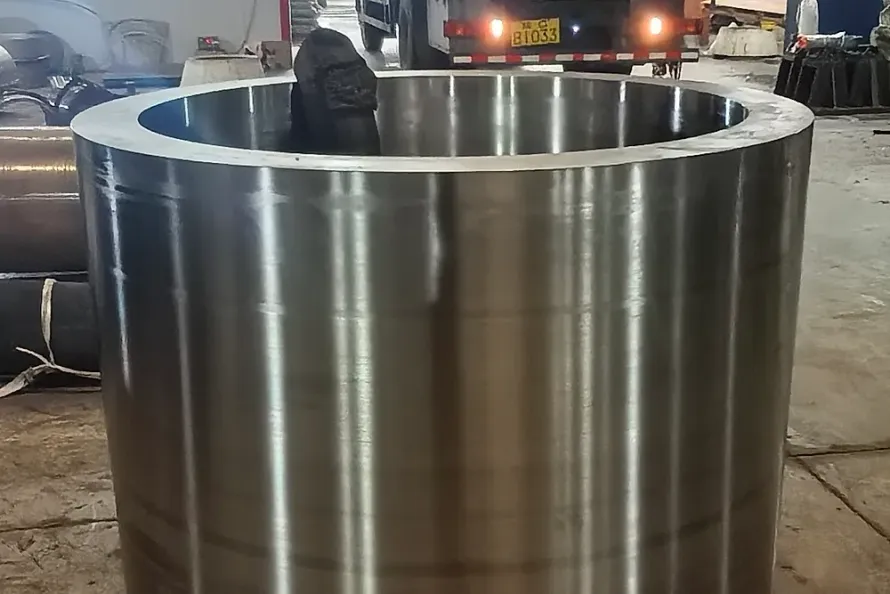
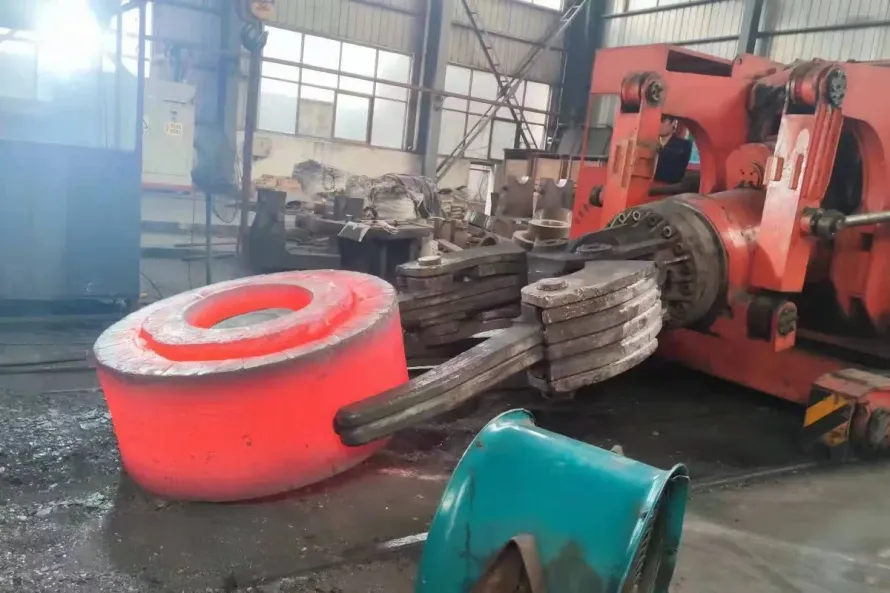
Another day on the forging floor. Here is a look at today's production run — titanium ring forgings going from raw billet to finished product, right here in our Baoji workshop. From Billet to Red-Hot Ring The process starts with titanium billets and hollow blanks, cut to weight and preheated in our gas-fired furnace. Once the material reaches forging temperature (typically 900–950°C for Ti-6Al-4V), it moves to the ring rolling mill.Ring Rolling in Progress The glowing titanium blank is placed on the ring rolling machine, where it is expanded into the target diameter through continuous rotational compression. The entire rolling cycle takes just minutes, but the temperature window is critical — too cold and the material cracks, too hot and grain growth reduces mechanical properties. Finished & Ready to Ship After rolling, the rings are heat-treated, ultrasonically inspected, and machined to final dimensions. Today's batch includes DN100 flanges destined for chemical processing equipment.This is what daily production looks like at Titanium Seller — no stock photos, just real metal moving through real machines. Need custom titanium forgings? Get in touch and we will quote your next order.Related Articles:Titanium Forgings — From Billet to Precision Shape Why Titanium Is Taking Over Modern Manufacturing

Ready to Start Your Project?

Get factory-direct pricing on titanium products. No minimum order.

Get a Free Quote
Quick Inquiry