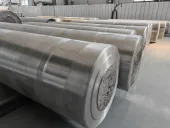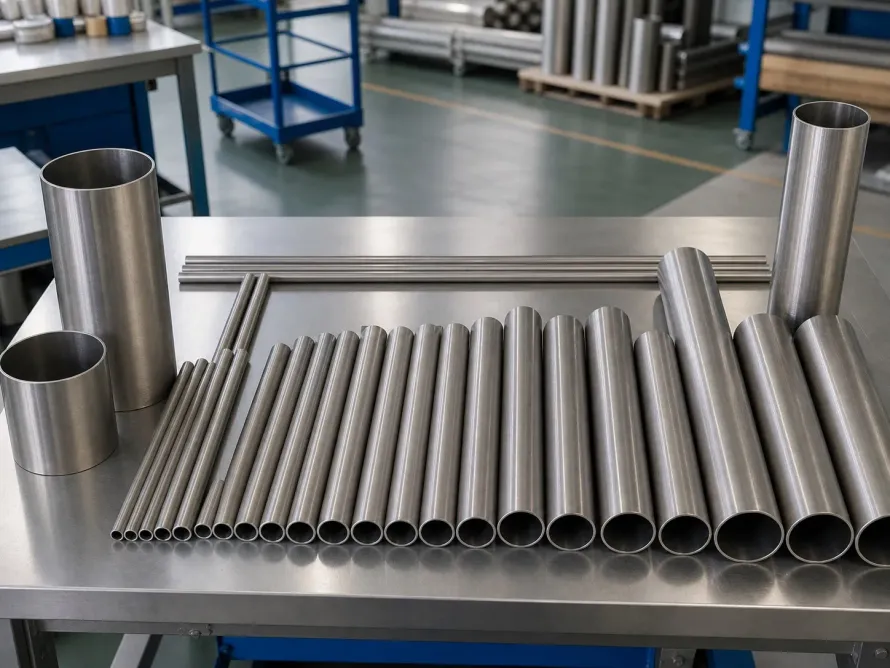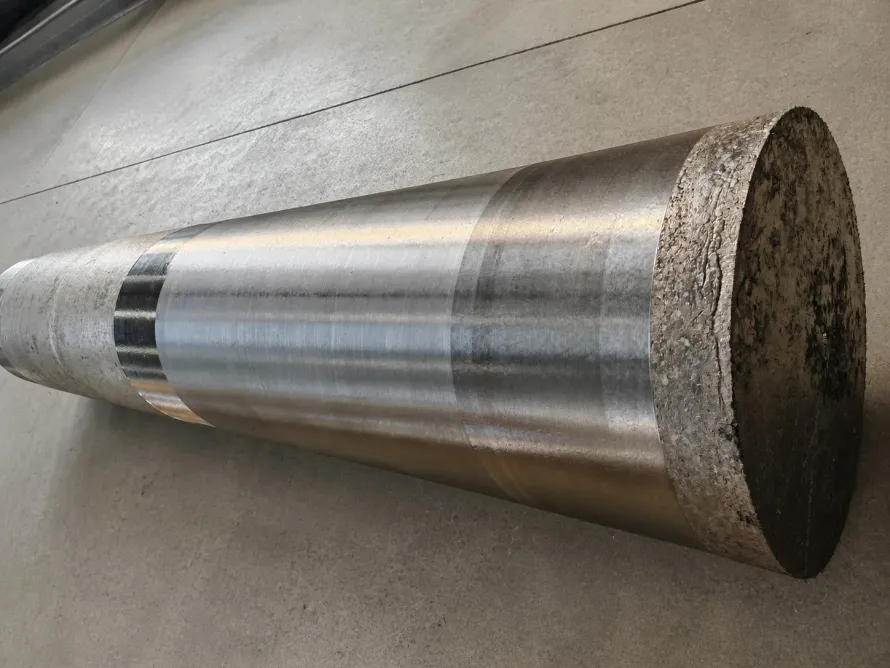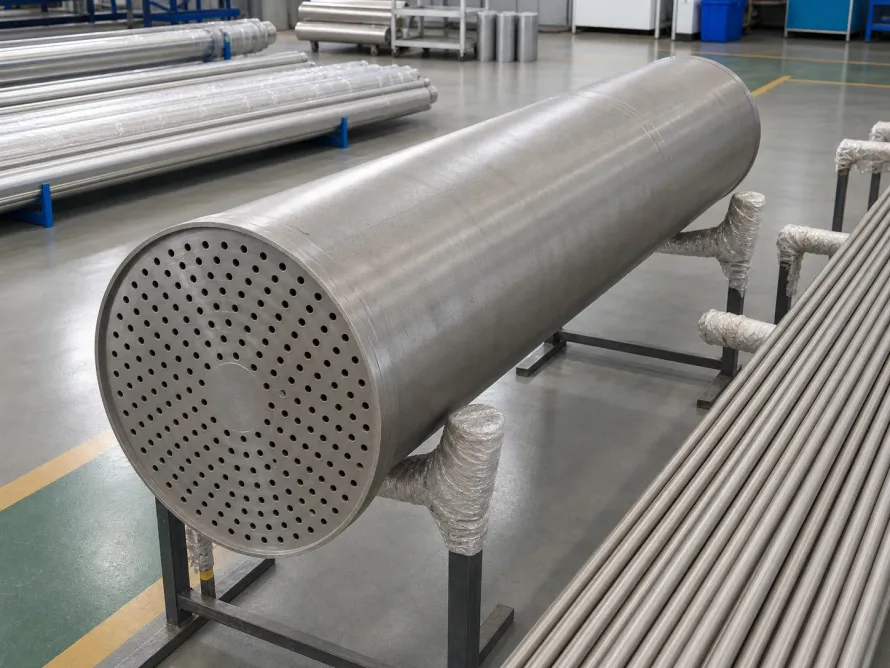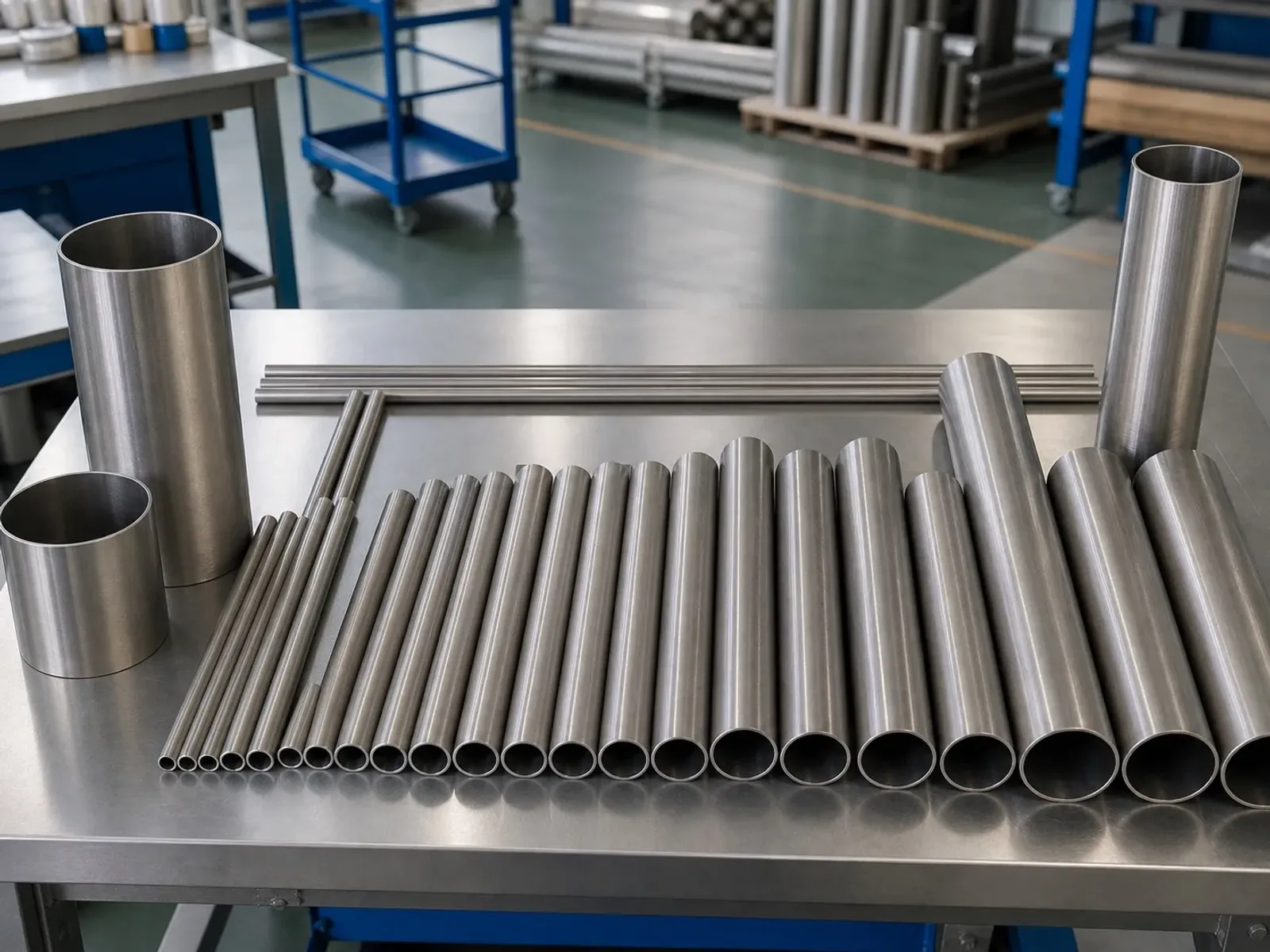
Titanium tube product forms; alloy grade, dimensions and delivery condition are not identified by the image.
A Grade 9 seamless titanium tube offer should not replace a Grade 2 requirement merely because it provides higher minimum tensile strength. In Alleima’s current datasheets, Grade 2 is commercially pure titanium, while Grade 9 is Ti-3Al-2.5V; Grade 9 properties also change materially between annealed and cold-worked, stress-relieved (CWSR) conditions. A valid substitution therefore has to keep the service environment, product route, dimensions, condition, fabrication route and acceptance basis aligned.
The useful decision is not “which grade is better?” It is whether the proposed Grade 9 tube solves a defined mechanical need without reopening a corrosion, hydrogen, forming, welding or documentation boundary that the Grade 2 design already controls.
Where the substitution case starts
Alleima identifies both products as seamless titanium tube and lists ASTM B338 among their specifications. The shared product family is real, but the datasheets do not describe the same material.
| Datasheet item | Grade 2 | Grade 9 |
|---|---|---|
| Alloy identity | Commercially pure titanium, UNS R50400 | Ti-3Al-2.5V, UNS R56320 |
| Listed condition for minimum values | Not separately identified in the cited tensile-property table | Annealed |
| Minimum ultimate strength | 345 MPa | 620 MPa |
| Minimum yield strength | 275 MPa | 483 MPa |
| Minimum elongation | 20% | 15% |
The Grade 9 datasheet also lists a CWSR condition at 860 MPa minimum ultimate strength, 725 MPa minimum yield strength and 10% elongation. That is not a small purchasing detail: “Grade 9” alone does not identify which minimum-property set an offer is using.
Higher minimum strength may motivate a mechanical design review or a strength-to-weight comparison. It does not, by itself, prove that an existing Grade 2 wall, bend, joint, tubesheet interface or qualification record remains valid. Those conclusions depend on the actual design and fabrication basis, which the datasheet comparison does not recalculate.
Shared seawater language is not a matched corrosion comparison
Both Alleima pages list seawater, brines, heat exchangers and chloride-containing equipment among relevant applications. That supports considering either grade for a defined chloride service. It does not establish universal interchangeability.
The corrosion statements use different conditions. For Grade 2, Alleima says commercially pure titanium will not exhibit crevice corrosion below 80°C in salt solutions, including super-chlorinated conditions. For Grade 9, the page gives a critical crevice temperature of about 110°C in saturated sodium-chloride brine at pH 5–8.
Those two statements are not a controlled head-to-head test. One is a below-temperature statement for commercially pure titanium; the other is a critical-crevice-temperature result tied to a named brine and pH range. The responsible reading is therefore conditional: use each result only inside its stated environment, and do not convert 80°C versus 110°C into a general Grade 9-over-Grade 2 ranking.
The Grade 9 page adds another boundary. It says hydrogen uptake can occur when atomic hydrogen is generated on the tube surface, typically in the presence of galvanic coupling or impressed cathodic current, and that high temperature and low pH enhance the risk. A substitution review for cathodically protected equipment or mixed-metal assemblies therefore needs that charging environment, not just a general seawater label.
Grade 9 condition belongs in the purchase order
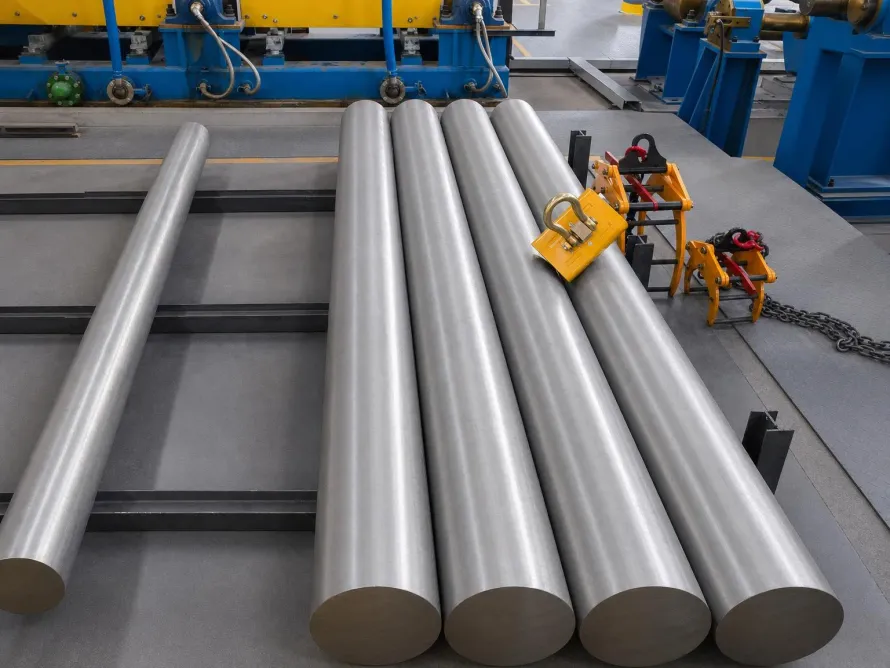
Generic tube-processing context; the material, route and delivery condition are not established by the image.
Alleima lists Grade 9 tube as cold reduced or heat treated to annealed or stress-relieved condition, with multiple surface conditions. The mechanical table separately identifies annealed and CWSR minimum values. If an RFQ says only “Grade 9 to ASTM B338,” it leaves a decision-driving condition unresolved.
The practical control is to bind the selected condition to the drawing, purchase order, mill certificate and fabrication procedure. That record should use one property basis consistently. It should also show whether bending, welding, expansion or another forming step was qualified for the delivered condition rather than for a generic Grade 9 label.
This is especially important for repeat orders. A second supplier may offer the same grade and nominal size but a different cold-work level, heat-treatment condition or surface delivery. Alleima’s disclaimer also limits its figures to Alleima material and says final suitability depends on actual service conditions. The frozen pages are therefore evidence for comparing these two product descriptions, not a universal certificate for every mill’s tube.
A narrower approval path
Start by naming why Grade 9 is being proposed. If the reason is mechanical, compare the required minimum properties and selected condition on the same basis. If the reason is availability or price, do not let that commercial benefit silently become an engineering equivalence claim.
Then compare the service variables that can change the corrosion conclusion: medium, concentration, temperature, pH, crevice geometry, deposits, flow, galvanic contacts and impressed current. Use the datasheet statements only where their stated conditions match; otherwise obtain project-specific corrosion evidence.
Finally, close the fabrication and release interface. Confirm product route, dimensions, condition, surface, bend and weld procedure, inspection, certificate wording and change-control expectations. The approval question is not whether Grade 9 is stronger. It is whether the exact Grade 9 tube being offered is supported for the same component, service and release decision.
Sources
- Alleima, Alleima Ti Grade 9 — Tube and pipe, seamless, datasheet updated 9 May 2025; accessed 30 September 2026.
- Alleima, Alleima Ti Grade 2 — Tube and pipe, seamless, datasheet updated 9 May 2025; accessed 30 September 2026.