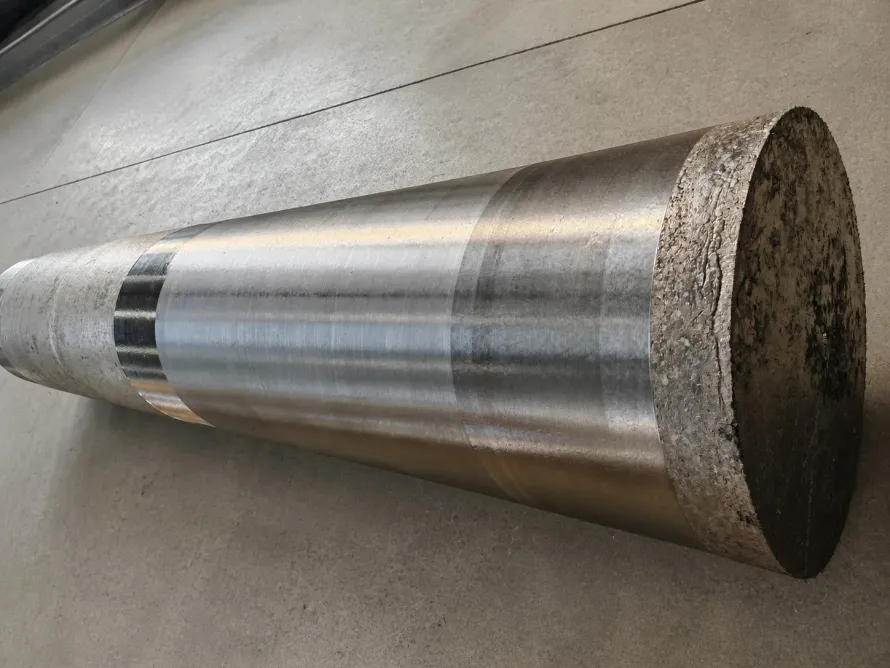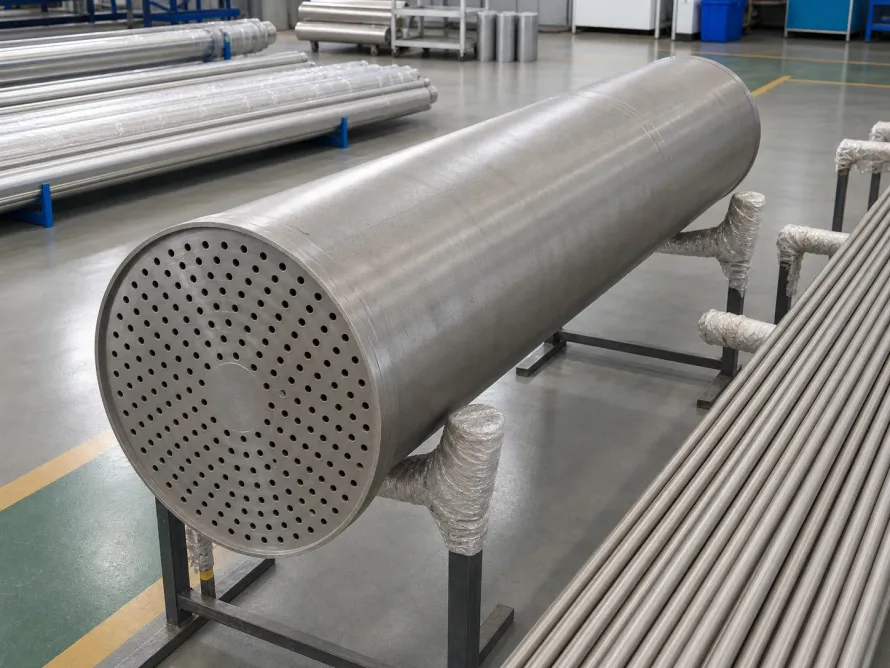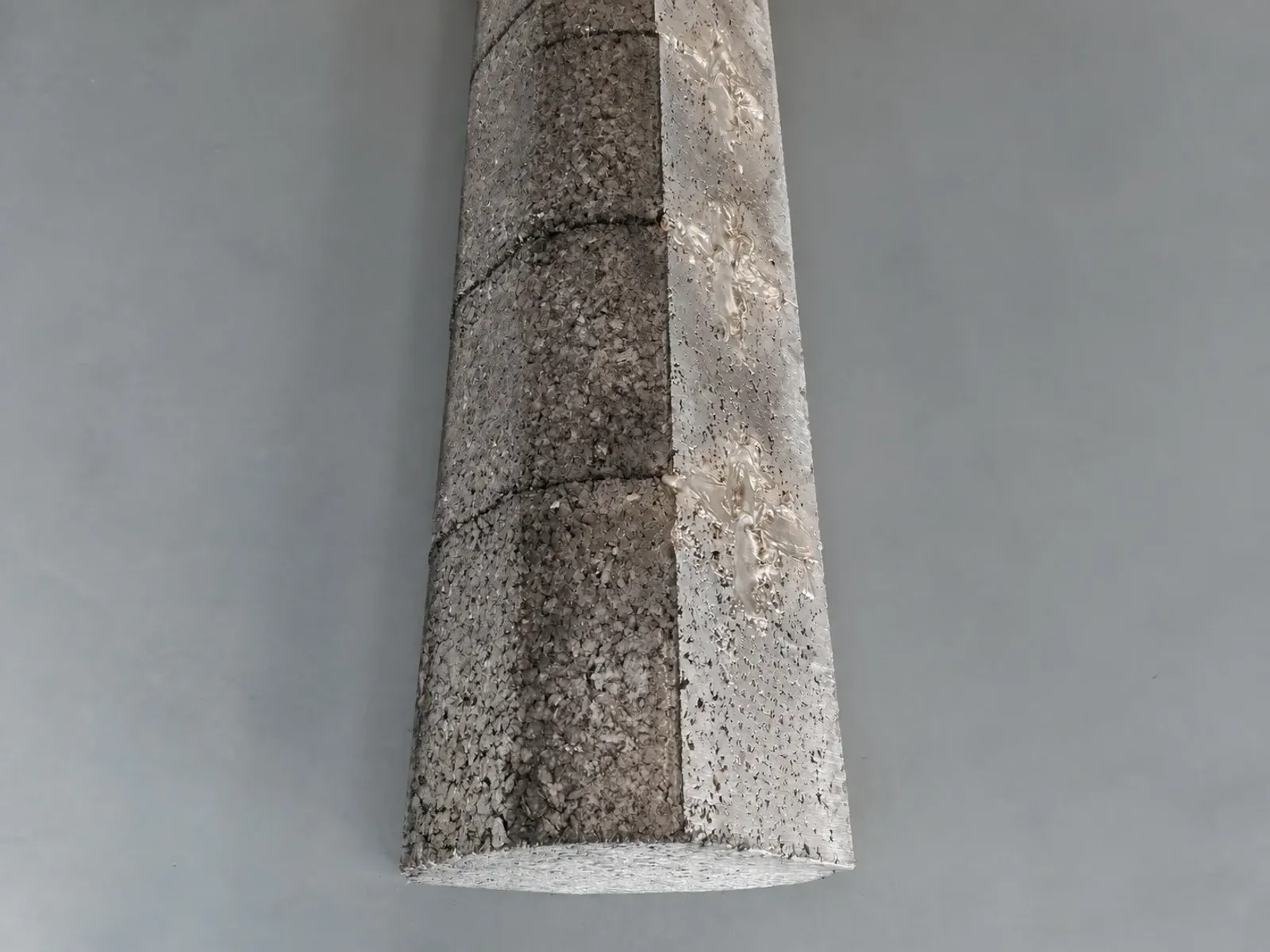
A rough titanium-material compact shown for product-form context; it is not the Ti-2Al-3Fe specimen reported in the study.
An MDPI study published on September 22, 2026 found that a cold-pressed Ti-2Al-3Fe compact cycled four times between 850 °C and 950 °C reached a final density similar to two warm-pressed heat-and-hold routes. Against the 900 °C hold route, the reported mean values moved in different directions: yield stress and hardness were slightly higher, while strain and ultimate tensile strength were slightly lower. The paper did not report a significance test for those route-to-route differences.
- Density result: the three routes retained about 6.3 ± 0.5% residual porosity despite different starting green densities.
- Mechanical result: the cyclic route reported mean yield stress of 742 ± 16 MPa and strain of 1.3 ± 0.1%, versus 730 ± 17 MPa and 1.6 ± 0.3% for the 900 °C hold route.
- Decision boundary: the result supports a larger process-development trial, not a production, qualification, supply or cost claim.
The new result is a route comparison, not a price claim
The researchers made 100 g blended-elemental powder batches, mixed them for 30 minutes at 60 rpm and pressed cylindrical compacts about 40 mm in diameter and 20 mm high at 600 MPa. Two comparison routes used warm pressing at 200 °C followed by a five-minute hold at either 800 °C or 900 °C. The cyclic route used cold pressing at 25 °C, then four induction-heating cycles between 850 °C and 950 °C across the alloy’s estimated 886 °C beta transus.
That design tests whether cycling can compensate for a lower starting green density. It does not isolate sintering schedule from forming condition, because pressing temperature and thermal route changed together.
Cycling recovered density from a lower green starting point
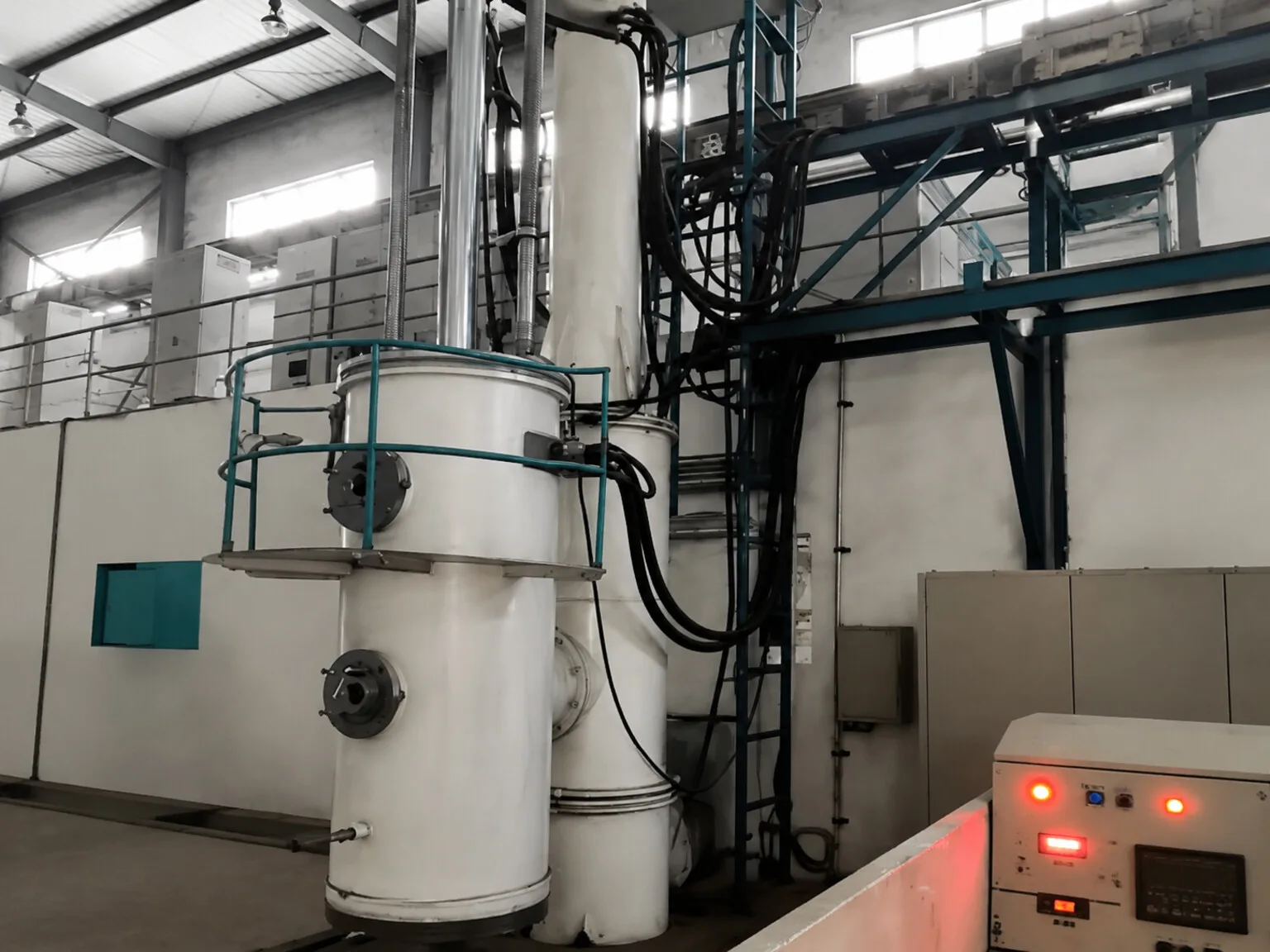
Generic thermal-processing equipment shown to distinguish the sintering stage; this is not the study apparatus.
The cyclic specimens started from the lower-density cold-pressed condition, yet the three routes finished at similar density. The paper reports about 6.3 ± 0.5% residual porosity across them. For the cyclic route, density change was 9.8% and densification was 58.9%; those larger changes reflect the lower starting point and should not be read as a higher final density.
The useful advance is therefore narrower and more specific: under this compact geometry and induction setup, cycling across the beta transus compensated for the lower green density enough to reach the same final-density range. That is a bounded reason to run a larger route-development trial.
Reported mechanical means moved in different directions
Against the 900 °C five-minute hold route, the four-cycle route reported yield stress of 742 ± 16 MPa versus 730 ± 17 MPa and hardness of 877 ± 3 N/mm² versus 831 ± 4 N/mm². The same comparison moved the other way for strain and ultimate tensile strength: 1.3 ± 0.1% versus 1.6 ± 0.3%, and 784 ± 28 MPa versus 799 ± 4 MPa.
The paper did not report whether those route-to-route differences were statistically significant. The defensible reading is therefore mixed reported means, not a proven mechanical advantage. A route screen should keep strength, hardness and deformation together rather than selecting only the higher yield-stress mean and hiding the lower strain mean.
Residual pores remain central to the result
The paper reports a homogeneous pore distribution and connects limited plastic deformation primarily to residual pores. Its mechanical program used a minimum of three dog-bone samples.
For the four-cycle route, EDS analysis reported complete dissolution of the alloying-element powder particles and full chemical homogenization. The paper also says oxygen content affects the mechanical response because oxygen strengthens and embrittles titanium, but it does not report finished-alloy oxygen measurements for each route.
For a next-stage trial, the comparison record should preserve pressing condition, green density, thermal cycle, final porosity, chemistry, finished-alloy oxygen and all four mechanical endpoints. That is a study-specific decision rule, not a generic audit list: these fields are needed to avoid crediting the thermal cycle for a result that also depends on the starting compact or composition, and to avoid trading away deformation while tracking strength alone.
What the study changes—and what it does not
The publication adds measured laboratory evidence for cyclic induction sintering in the Ti-2Al-3Fe system. It shows similar final density can be reached from the lower green-density condition, reports full chemistry homogenization for the cyclic route, and reports mixed mechanical means against the 900 °C hold route.
Before the route can support a released part or sourcing claim, it still needs part-scale thermal-uniformity and repeatability evidence, accepted-yield and qualification data, and a commercial cost basis. End-use-specific properties such as fatigue or corrosion also remain outside this study.
Sources
- Bolzoni et al., “On the Processing of a Powder Metallurgy Low-Cost Ti Alloy via Different Induction Sintering Strategies”, Journal of Manufacturing and Materials Processing, electronically published September 22, 2026; accessed September 24, 2026.