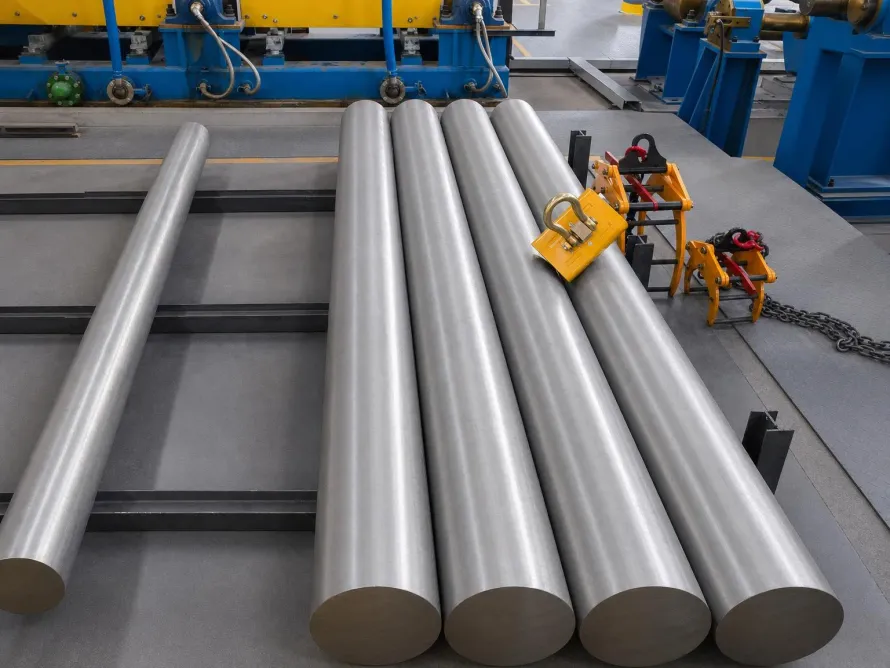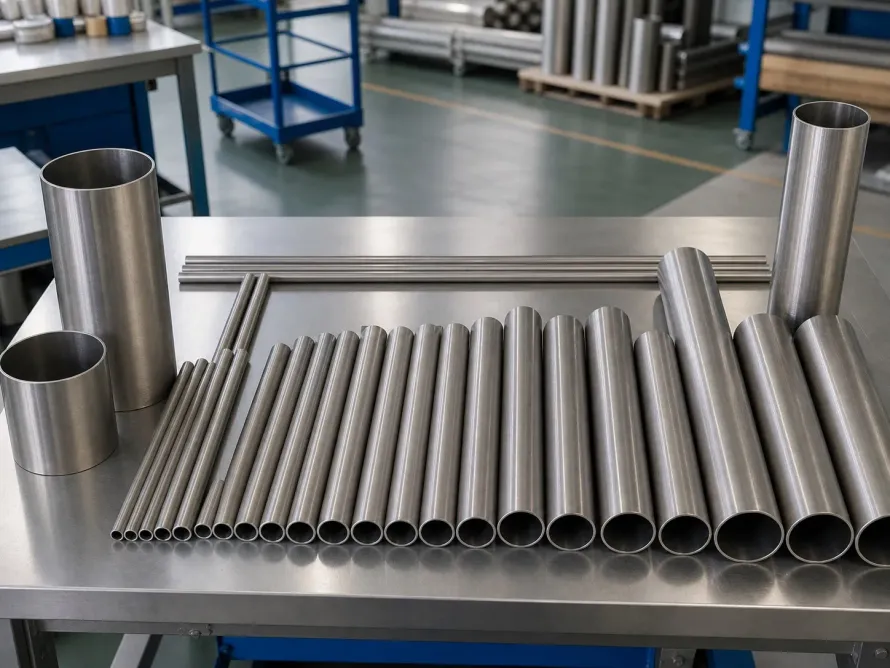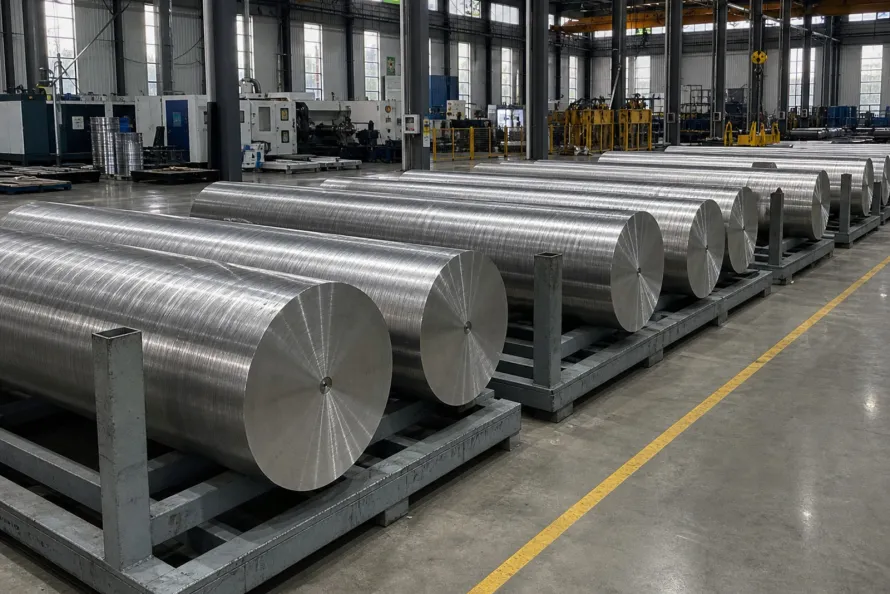
Generic round-rod stock illustrating the consumable form; not the study’s Ti-6Al-4V rod or test setup.
A peer-reviewed paper published on October 12, 2026 deposited single Ti-6Al-4V tracks on Grade 2 titanium sheet by friction surfacing. With horizontal speed fixed at 200 mm/min and the vertical-to-horizontal feed ratio at 0.4, the authors screened 4000–8000 rpm. The 6000 rpm condition gave the best overall balance of track geometry, surface condition, shear response and the selected electrochemical results. That is a useful development signal, but it is not a transferable multilayer or repair specification.
- Process signal: 5000–7000 rpm produced the more stable surface range, with 6000 rpm giving the best combined result in this machine and fixed-feed setup.
- Mechanical meaning: the five coating groups were not statistically different in mean shear strength; fracture occurred in the deposited Ti-6Al-4V rather than at the interface.
- Qualification boundary: the work covers single tracks, three shear specimens per condition and short laboratory electrochemistry—not multilayer builds, fatigue, wear, component repairs or service life.
What the experiment actually held constant
Generic flat-plate stock illustrating the substrate form; not the paper’s Grade 2 specimens.
The consumable was a Ti-6Al-4V rod and the substrate was Grade 2 titanium sheet. The main experiment used rod-consumption-rate mode. After preliminary visual screening, horizontal travel was fixed at 200 mm/min and the ratio of vertical rod feed to horizontal travel was fixed at 0.4. Only rotational speed changed: 4000, 5000, 6000, 7000 or 8000 rpm.
That design isolates one parameter within one apparatus, but it also limits transfer. It does not show that 6000 rpm remains best when rod diameter, feed ratio, travel speed, machine stiffness, alloy lot, substrate geometry or track overlap changes.
Why 6000 rpm led the screen
The 4000 rpm track was less regular. Tracks made at 5000, 6000 and 7000 rpm had lower roughness amplitudes, while 8000 rpm again showed greater irregularity. The paper reports the lowest undercut at 6000 rpm and identifies that condition as the best overall balance rather than the minimum of every individual metric.
This distinction matters. The result is a bounded process-window observation: intermediate rotational speeds improved plastic flow and track consistency in the tested setup. It is not proof that 6000 rpm is a universal optimum for friction surfacing Ti-6Al-4V onto commercially pure titanium.
What the shear and corrosion data do—and do not—show
Average shear strength was 486.8 ± 3.3 MPa for the Grade 2 substrate and 684.3 ± 30.4 MPa for the annealed Ti-6Al-4V rod material. The five deposited conditions ranged from 706.35 to 769.17 MPa. The 6000 rpm group had the highest mean and relatively low scatter, but the coating groups were not statistically different from one another. All tested coating failures occurred within the deposit, not at the substrate interface.
The electrochemical comparison was narrower. It tested polished 4000, 6000 and 8000 rpm coatings plus the annealed Ti-6Al-4V rod material in Hank’s Balanced Salt Solution. Open-circuit potential was monitored for six hours, and the electrochemical tests were triplicated. The authors describe the overall polarization-resistance and constant-phase-element response as similar, but their Table 8 reports significant polarization-resistance differences for the annealed rod versus 8000 rpm and for 6000 versus 8000 rpm; Q did not differ significantly in any pairwise comparison. The study did not use Grade 2 as an electrochemical control or test service conditions, so it cannot establish long-duration corrosion resistance.
What a repair or multilayer program still has to establish
The next step can use 6000 rpm as a hypothesis for the same equipment family, not as a frozen production setting. A qualification plan should select, as applicable, independent deposition repeats, multilayer overlap and build-height trials, lot and chemistry controls, residual-stress and distortion assessment, fatigue and fracture testing, wear, longer corrosion exposure, nondestructive inspection and component-representative repair trials.
Those gates should follow the intended part, failure modes and service environment. The practical conclusion is narrow: this paper improves where to start a Ti-6Al-4V-on-Grade-2 friction-surfacing development program, while leaving the evidence needed to release an actual coating or repair specification open.
Sources
- Version-of-record paper — published October 12, 2026; accessed October 13, 2026.
- Crossref record for DOI 10.1007/s40964-026-02002-1 — accessed October 13, 2026.