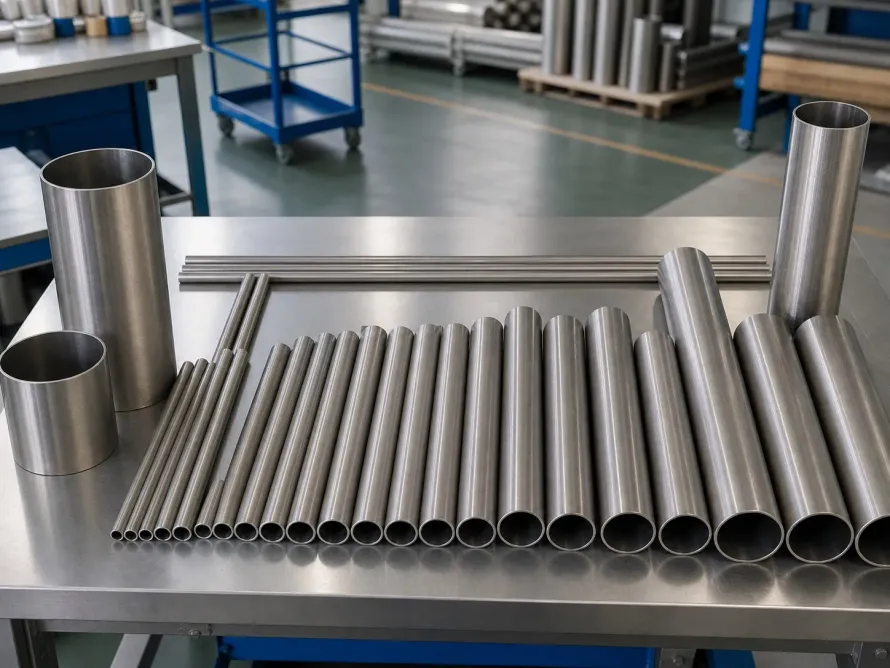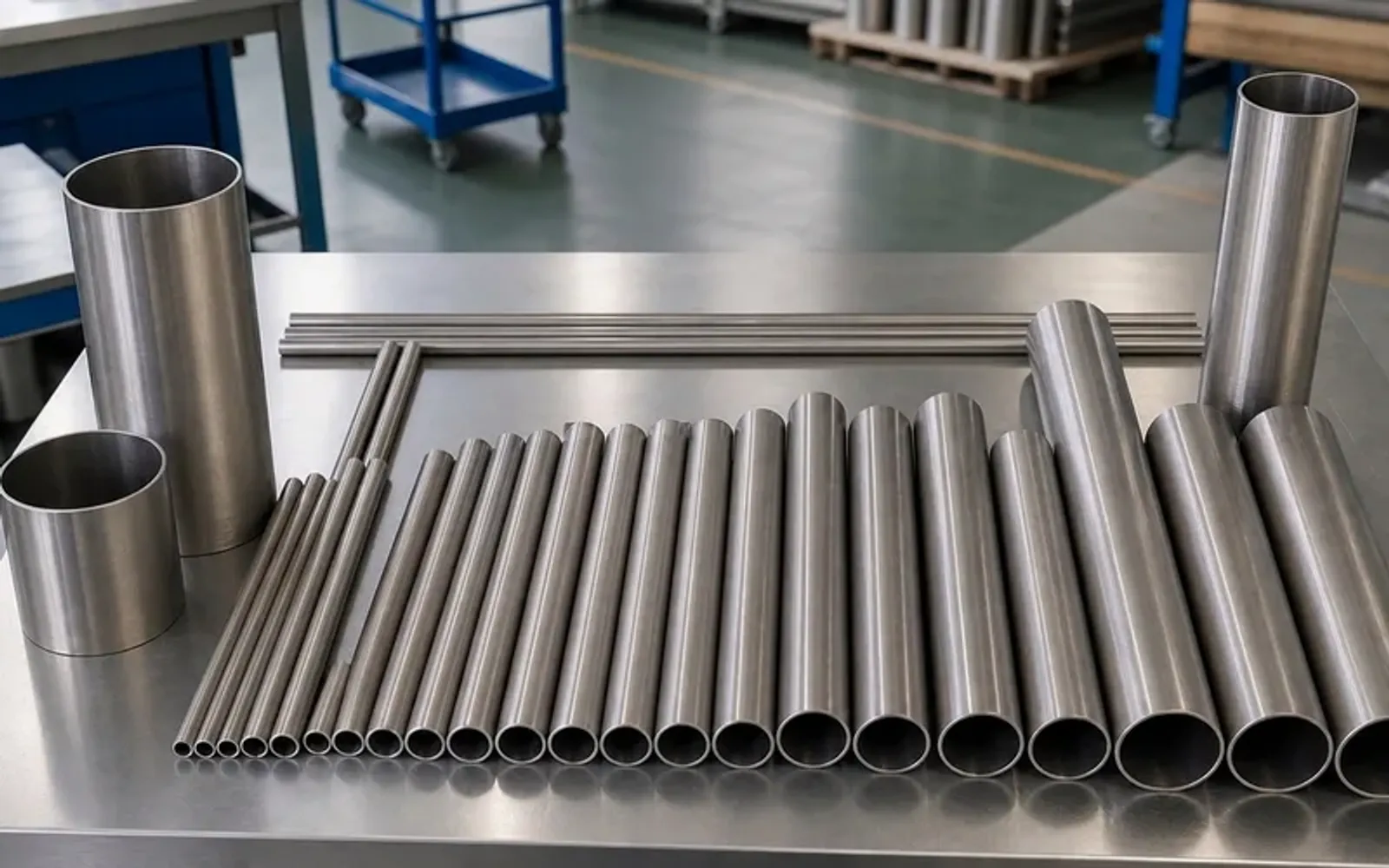
For EPC contractors building Multi-Effect Distillation (MED) desalination plants, offshore oil platforms, and chemical condensers, few commissioning failures are more expensive than a leaking titanium shell-and-tube heat exchanger. When a single ASTM B338 Grade 2 or Grade 12 tube splits during roller expansion into the tubesheet—or develops a pinhole leak three weeks after exposure to high-pressure sour brine—emergency plant shutdown costs routinely exceed $$50,000\text{ USD per day}$.
The most frustrating part for quality assurance managers is that the failed tube bundle almost always arrived with a material test certificate (MTC) stamping “100% Eddy Current Tested, 100% Ultrasonic Tested, 100% Hydrostatic Tested — Qualified.”
Here is how sub-standard workshops can manipulate non-destructive testing (NDT), and what buyers should check to verify leak-tightness.
1. The Three Hidden Shortcuts in Low-Cost Titanium Tube Workshops
Producing seamless cold-rolled titanium heat exchanger tubes (such as $\Phi 19.05 \times 0.889\text{ mm}$ or $\Phi 25.4 \times 1.24\text{ mm}$ in lengths up to $15\text{ meters}$) requires high-precision LD-series multi-roller cold pilger mills, ultra-long vacuum annealing furnaces, and automated offline inspection benches. Small workshops that quote $15% \text{ to } 20%$ below rational mill cost survive by cutting three invisible corners:
[Shortcut 1: The "Paper" Hydrostatic Test]
• Standard: 100% tube-by-tube water fill, air purge & ≥5–10s pressure hold
• Workshop Shortcut: Only 5% spot-checked (or skipped); MTC falsified as 100% Pass
                 │
[Shortcut 2: Single Eddy Current Without Ultrasonic (UT)]
• Standard: Dual ET (ASTM E426) + Rotational UT (ASTM E213) with notched calibration tube
• Workshop Shortcut: Fast ET pass only; longitudinal inner-wall pilgering seams go undetected
                 │
[Shortcut 3: Outsourced Vacuum Annealing Contamination]
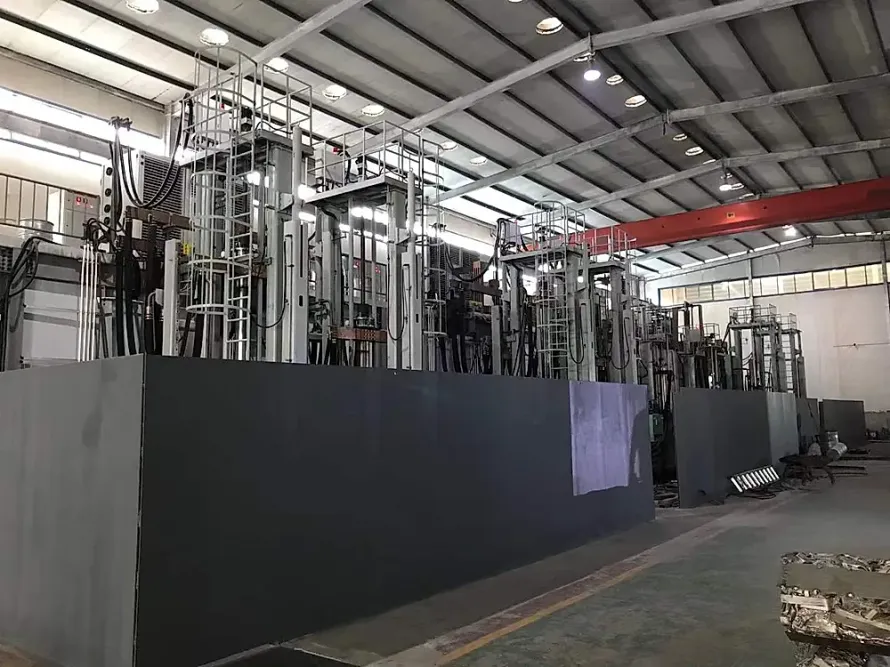
• Standard: Dedicated long vacuum furnace (<0.05 Pa) with argon fast-cooling
• Workshop Shortcut: Shared commercial furnace; poor vacuum creates brittle tube-end alpha case
Shortcut 1: Skipping Full-Length Hydrostatic Pressure Dwell
Under ASTM B338, each tube must withstand an internal hydrostatic pressure calculated by:
$$P = \frac{2St}{D}$$
where $S$ is the allowable fiber stress, $t$ is wall thickness, and $D$ is outside diameter—held for a minimum of 5 seconds without seepage. However, purging trapped air bubbles from a $12\text{-meter}$ small-bore tube and clamping high-pressure urethane end-seals takes considerable cycle time. Workshops lacking automated multi-head hydrostatic benches routinely test 10 tubes out of a 500-tube crate, leaving micro-fissures to burst during field hydro-testing.
Shortcut 2: Relying on Eddy Current Alone (Missing Longitudinal Seams)
During cold pilgering over a tapered mandrel, minor die scoring or lubrication breakdown creates hairline longitudinal inner-diameter (ID) seams.
- Eddy Current (ET per ASTM E426) induces circumferential currents that are highly sensitive to short pits and through-wall pinholes, but physically insensitive to shallow, continuous longitudinal laps running parallel to the tube axis.
- Only Rotational Ultrasonic Testing (UT per ASTM E213) firing shear waves at $45^\circ$ angles around the circumference can reliably catch longitudinal ID/OD micro-cracks and wall eccentricity before the tube leaves the mill.
Shortcut 3: Tube-End Cracking from Outsourced Annealing
Cold-pilgered titanium tubes work-harden rapidly and require intermediate and final bright vacuum annealing. When a small workshop outsources $12\text{-meter}$ tubes to a third-party heat-treater whose furnace seals leak slightly at $680^\circ\text{C}$, the tube ends absorb interstitial oxygen and hydrogen. The tube passes straight-line dimensional checks, but the moment a boilermaker inserts a mechanical roller expander to flare the tube into the tubesheet, the embrittled tube end splits longitudinally.
2. The 4-Stage Zero-Leak Inspection Matrix for ASTM B338 Tubes
At Titanium Seller, no heat exchanger or condenser tube lot is cleared for export crating until it passes our four-stage physical verification protocol:
| Inspection Stage | Target Defect Caught | ASTM B338 Minimum Requirement | Titanium Seller Consortium Charter Standard |
|---|---|---|---|
| 1. Dual NDT (ET + Rotational UT) | Pinholes (ET) + Longitudinal ID/OD pilgering seams & wall eccentricity (UT) | ET or UT (often customer-selected single method) | Mandatory 100% Combined ET (ASTM E426) + UT (ASTM E213) on every tube |
| 2. Calibration Reference Tube | Drift in sensor sensitivity over long shifts | Standard notch & drilled hole calibration | Re-calibrated every 2 hours using same-heat reference tube with $0.076\text{ mm}$ ID/OD notches |
| 3. 100% Full-Length Hydrostatic Test | Structural weak spots, weld-seam micro-leaks | 5-second minimum pressure hold | 100% individual tube test with $\ge 10\text{-second}$ digital pressure-curve logging |
| 4. Pneumatic Underwater + Mechanical Destructive Sampling | Micro-porosity & tube-end roller expansion ductility | Flattening & flaring test per lot | Underwater $0.6\text{ MPa}$ air-bubble check + Flattening, Flaring & Reverse-Bend per heat |
3. Buyer’s 4-Point Field Audit Checklist Before Shipment Release
Whether you send a third-party inspector or rely on the supplier’s quality engineers, demand these four pieces of physical evidence before paying the balance on any titanium tube or pipe order:
- Inspect the Physical Reference Standard Tube (Calibration Tube): Ask the mill to show the exact ASTM E213/E426 calibration tube matching your order’s OD and wall thickness, complete with EDM-machined longitudinal notches and through-holes. Have the operator run this calibration tube through the NDT line on video—if the alarm and paint-marker do not trigger on every single pass, the NDT certificates are worthless.
- Download the Digital Hydrostatic Pressure Strip Charts: Modern automated hydrostatic benches log a timestamped pressure curve for every tube tested. Verify that the hold time reached $\ge 10\text{ seconds}$ at the specified test pressure (typically $7.0 \text{ to } 17.2\text{ MPa}$) with zero pressure decay.
- Verify Tube-End Flaring Rings and Hydrogen Content ($\text{H} \le 0.008%$): Request high-resolution photos of the destructive flaring and flattening rings cut from both ends of the annealing furnace load, alongside ONH gas analyzer printouts confirming hydrogen pickup is strictly below $80\text{ ppm}$ ($0.008%$).
- Check Internal Bore Cleanliness and End-Capping: Residual pilgering lubricant carbonizes during welding if not properly degreased. Ensure tubes undergo ultrasonic alkaline degreasing, nitric-hydrofluoric pickling (per ASTM B600), deionized water rinsing, and individual plastic end-capping before seaworthy plywood boxing.
Sourcing mission-critical ASTM B338 seamless or welded titanium condenser tubes? Contact our engineering team to request sample NDT calibration videos, digital hydrostatic logs, and partner-network pricing.