Humanoid robotic architectures face extreme structural constraints. Package space is tight.
Across platforms like Tesla Optimus, Boston Dynamics Atlas, and emerging commercial bipedal platforms, joint actuators and dexterous hands account for more than half of total chassis weight. Early prototypes relied heavily on aerospace-grade 7075-T6 aluminum for motor casings, harmonic drive flanges, and structural housings. Weight reduction stalled.
Aluminum components encounter fundamental physical boundaries.
When bipedal robots perform deep squats, jump, or endure sudden drop impacts, frameless torque motors and planetary reducers generate severe alternating loads. Under repeated cyclic stresses, 7075-T6 exhibits persistent micro-crack vulnerability. Hardware engineering teams are now migrating critical structural housings to Grade 5 (Ti-6Al-4V) and extra-low interstitial Grade 23 (Ti-6Al-4V ELI) titanium alloys. In our humanoid robotics titanium solutions, this metallurgical transition directly governs operating life under high shock. Durability increases substantially.
1. Physical Property Divergence: Specific Strength and High-Cycle Fatigue Limits
Compact packaging remains the top actuator design metric. Millimeters matter.
The density of 7075-T6 aluminum is $2.81\text{ g/cm}^3$, with an ultimate tensile strength of $570\text{ MPa}$ and a specific strength of $203\text{ (N}\cdot\text{m)/kg}$. Its vulnerability lies in cyclic endurance. At $10^7$ cycles, smooth 7075-T6 specimens exhibit a fatigue limit of only $160\text{ MPa}$, and notched values drop below $90\text{ MPa}$. A humanoid walking at 1.5 to 2.0 Hz accumulates tens of millions of stress cycles within months of continuous testing. Fatigue failure is catastrophic.
Titanium alloys deliver superior fatigue properties.
Mill-annealed Grade 5 titanium has a density of $4.43\text{ g/cm}^3$, yield strength $\ge 828\text{ MPa}$, tensile strength $\ge 895\text{ MPa}$, and specific strength exceeding $202\text{ (N}\cdot\text{m)/kg}$. When solution treated and aged (STA) or duplex spheroidized, tensile strength reaches $1100\text{ MPa}$, driving specific strength past $248\text{ (N}\cdot\text{m)/kg}$. Grade 5 achieves fatigue endurance limits of $510\text{ MPa}$ to $620\text{ MPa}$. The strength gains are evident.
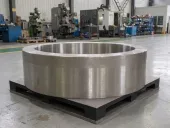
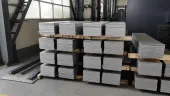
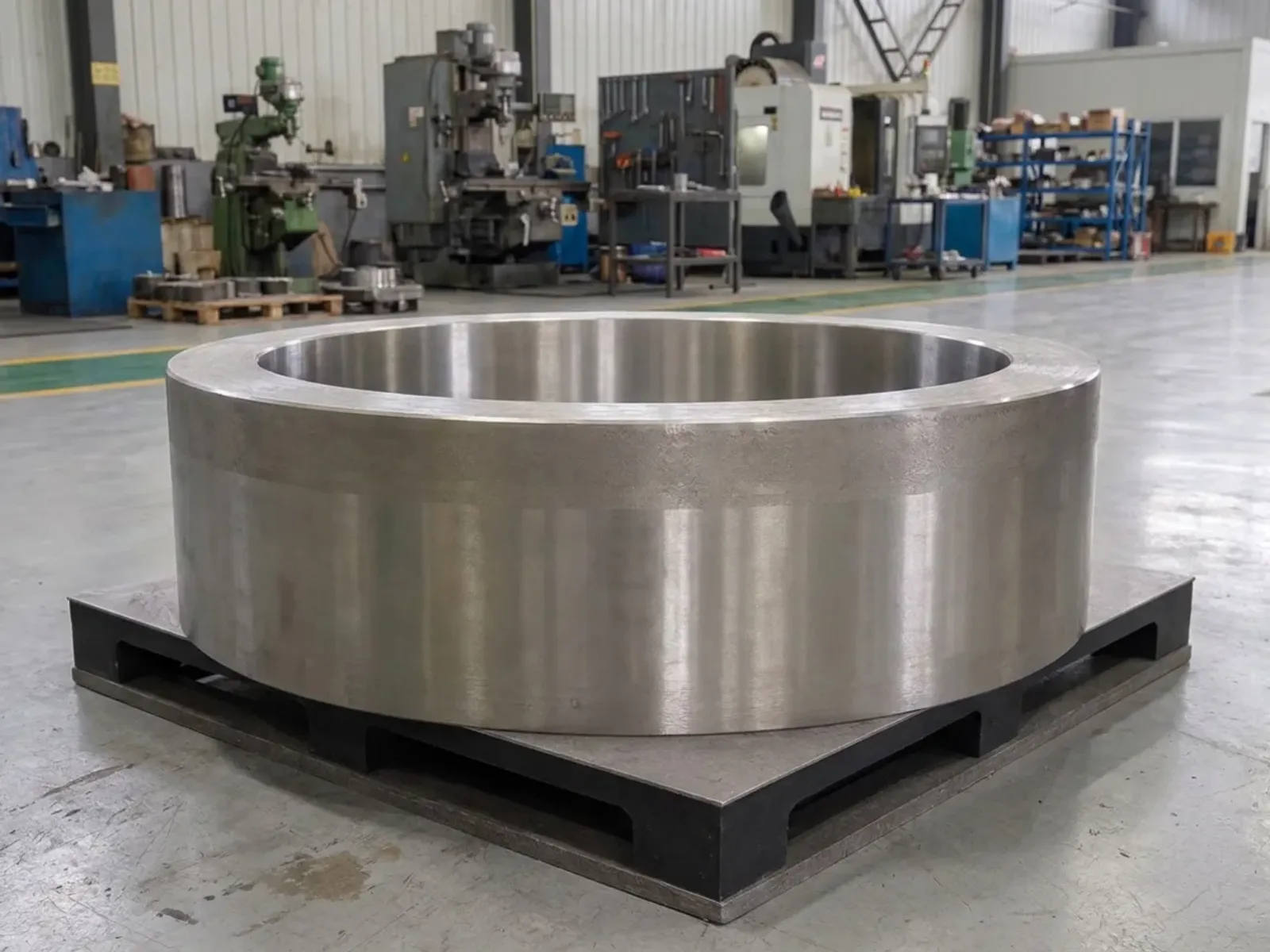
Certified partner facilities supply robot hardware builders with duplex spheroidized and STA-treated Gr5 and Gr23 ELI precision titanium bars and contoured ring forgings. Specific strength exceeds 240. Empirical data confirms that switching to titanium eliminates micro-cracking during emergency reverse braking. It allows housing wall thickness to drop from 2.5 mm down to 1.0 mm to 1.2 mm, reducing actuator outer diameter by 8% to 12% and freeing internal volume for windings and planetary roller screws. The envelope shrinks measurably.
| Material Grade & Temper | Density ($\text{g/cm}^3$) | Yield Strength $R_{p0.2}$ ($\text{MPa}$) | Tensile Strength $R_m$ ($\text{MPa}$) | Fatigue Limit ($10^7$ cycles, $\text{MPa}$) | Modulus $E$ ($\text{GPa}$) | CTE ($10^{-6}/\text{K}$) | Failure Risks & Procurement Criteria |
|---|---|---|---|---|---|---|---|
| 7075-T6 Aluminum | 2.81 | 505 | 570 | 160 | 72 | 23.4 | Notch sensitivity, fatigue cracking during braking, bearing preload drift |
| Grade 5 (Ti-6Al-4V Annealed) | 4.43 | 828 | 895 | 510 | 110 | 8.6 | Balanced ductility, springback control required, high impact absorption |
| Grade 5 (Ti-6Al-4V STA Aged) | 4.43 | 1000 | 1100 | 620 | 114 | 8.8 | High specific strength, suited for high-torque rotary shells and harmonic flanges |
| Grade 23 (Ti-6Al-4V ELI Low Interstitial) | 4.43 | 795 | 860 | 530 | 110 | 8.6 | Oxygen $\le 0.13%$, high fracture toughness, chosen for hollow planetary roller screw shafts |
2. Six-Axis Force-Sensor Diaphragms: Why Ultrathin Titanium Foil Excels
Dexterous hands demand precise tactile feedback. Accuracy is critical.
Finger tips and wrist assemblies house multi-axis force/torque sensors. The flexure diaphragm material dictates measurement resolution and signal fidelity. Traditional industrial load cells rely on 17-4PH stainless steel or beryllium copper. Yet in compact fingertip sensors, stainless steel is too stiff to register micronewton-level deflections, while beryllium copper suffers gradual elastic drift. Material selection is vital.
Ultrathin titanium foil provides exceptional elastic energy storage.
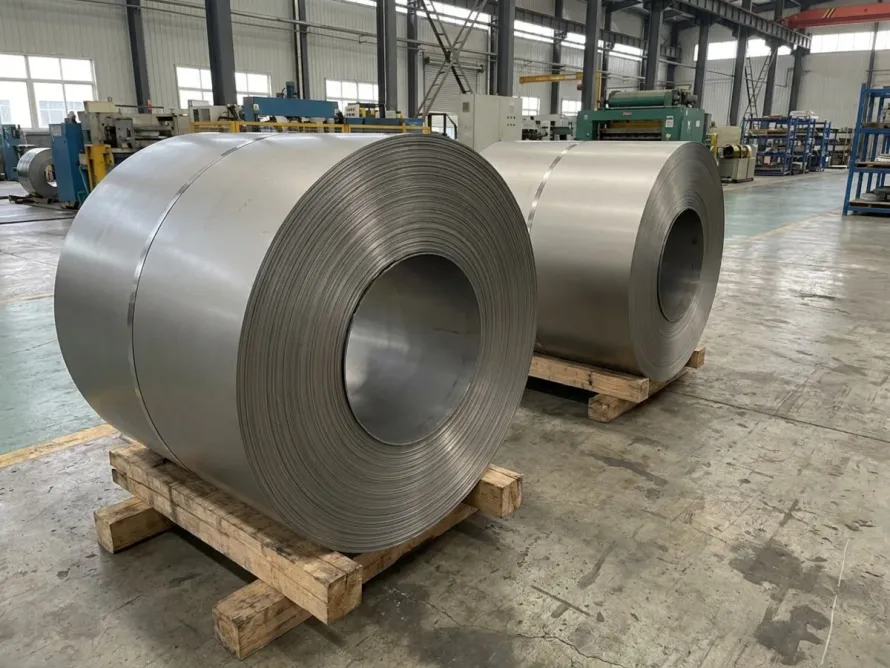
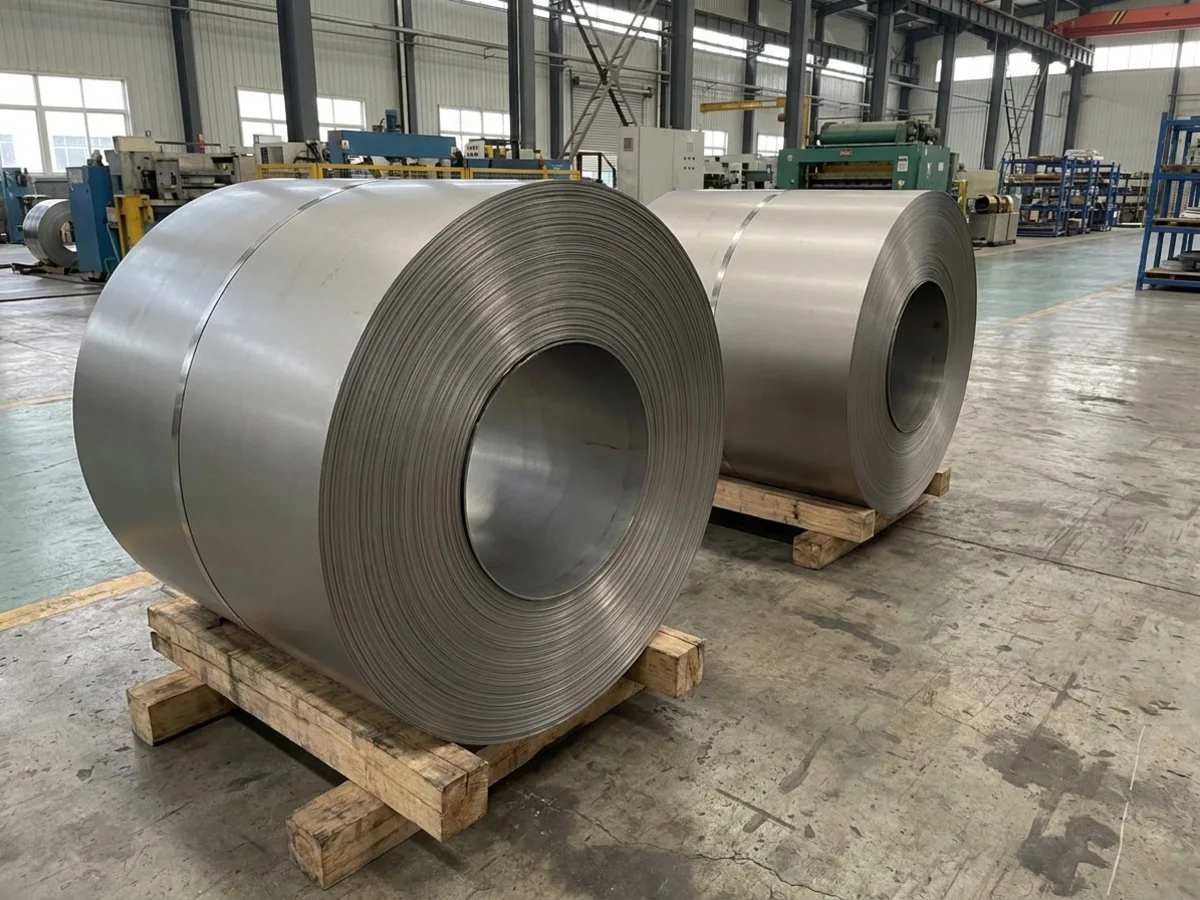
Precision strip partner facilities run 750 mm 20-high Sendzimir cold-rolling mills alongside horizontal bright annealing lines, cold rolling $0.015\text{ mm}$ to $0.10\text{ mm}$ Gr5 and Gr1 precision titanium foils with thickness tolerances within $\pm 0.001\text{ mm}$. Testing on dexterous hand tactile sensors confirms:
First, minimal mechanical hysteresis. Within small elastic strain envelopes, internal damping in titanium is exceptionally low. Loading and unloading curves match within 0.03% FS, eliminating false contact triggers.
Second, high ratio of elastic limit to yield strength. Ultrathin Gr5 foil withstands millions of cyclic grasping motions without permanent plastic deformation. Repeatability remains steady.
Third, thermal expansion stability. Titanium has a coefficient of thermal expansion of just $8.6 \times 10^{-6}/\text{K}$, minimizing zero-point thermal drift caused by adjacent motor heat. Sensor readings stay reliable.
3. Thermal Expansion Matching and Reducer Bearing Bore Stability
Motor operation inevitably generates heat. Fit precision is paramount.
Frameless torque motors operating under continuous duty reach winding temperatures between 80°C and 100°C. Aluminum housings expand at $23.4 \times 10^{-6}/\text{K}$, whereas harmonic drive flexsplines and precision thin-section bearings made of GCr15 bearing steel expand at $12.0 \times 10^{-6}/\text{K}$. The thermal expansion gap is severe.
Differential expansion destabilizes bearing clearances.
At high temperatures, the aluminum bore expands outward faster than the steel outer race, causing press-fit loosening and angular runout. In sub-zero conditions, the aluminum casing contracts aggressively, pinching bearings and driving frictional torque upward. Motion becomes erratic.
Titanium displays a thermal expansion coefficient of $8.6 \times 10^{-6}/\text{K}$ to $8.8 \times 10^{-6}/\text{K}$. This closely tracks bearing and alloy tool steels. Across freezing outdoor conditions or intense indoor testing, fits between the titanium housing and steel bearings remain stable within micron-level tolerances. Tooth mesh accuracy is preserved.
4. Procurement Engineering: Thin-Wall Machining and Stock Specification
Titanium strain-hardens rapidly during cutting. Process controls must be strict.
When sourcing raw materials or custom parts for robot actuator programs, engineering leads should apply these three rules:
Specify surface and heat-treat condition explicitly. Housings are best turned from centerless-ground bars held to h8 or h9 diameter tolerances. Heavy-duty actuator output flanges require triaxial upset-and-draw forging to eliminate mechanical anisotropy. Structural consistency is assured.
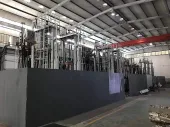
Mandate vacuum stress-relief annealing. Thin-wall cylindrical shells warp when residual stresses release during rough boring. Raw billets must undergo 600°C vacuum annealing before finishing. Stress relief is essential.
Verify ultrasonic inspection and equiaxed microstructure. Hollow planetary roller screw shafts in Gr23 ELI should pass AMS 4928 ultrasonic inspection to eliminate high-density inclusions. Microstructures must feature uniform, fine equiaxed $\alpha + \beta$ grains. Flaw detection cannot be skipped.
Engineers can evaluate component mass using our engineering weight tools. Prior to volume production, submit CAD models for a complimentary pre-RFQ drawing and specification audit to review DFM guidelines directly with partner facility factory metallurgists. Upfront reviews prevent costly delays.