In structural design for aerospace ground support, chemical autoclaves, and subsea pressure housings, mechanical design engineers frequently run Finite Element Analysis (FEA) simulations. When the solver indicates a critical stress threshold requiring a minimum wall of 6.3 mm, an engineer instinctively rounds up to a clean 7.0 mm for a safety factor. Similarly, calculations yielding 8.2 mm or 10.1 mm routinely become 9.0 mm or 11.0 mm callouts on manufacturing prints.
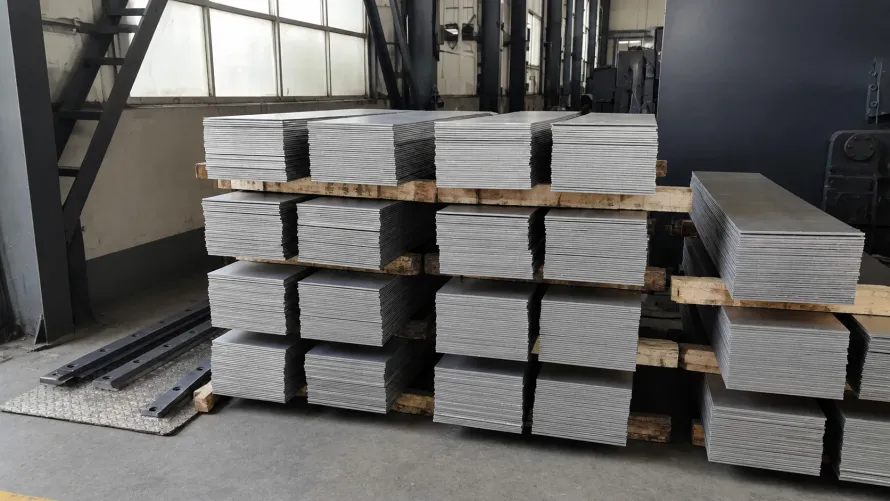
To procurement managers and seasoned manufacturing directors, however, these numbers immediately trigger red alerts. Despite global stockists holding thousands of tons of ASTM B265 / AMS 4911 titanium plates, virtually no tier-1 warehouse keeps 7mm, 9mm, 11mm, or 13mm in off-the-shelf inventory.
Specifying these odd thicknesses transforms what should be a routine 48-hour procurement into an expensive, protracted multi-week manufacturing nightmare. Here is the operational reality of titanium plate production and how adopting Design for Sourcing (DFS) protects project budgets.
1. The Mill Economics: Why Rolling Schedules Enforce Even Increments
Titanium hot rolling mills operate on strict thermal-mechanical schedules. Changing the roll gap on heavy 2-high or 4-high reversing blooming and breakdown mills requires recalibrating hydraulic AGC (Automatic Gauge Control) cylinders, heating furnace setpoints, and roller runout tables.
A mill rolling campaign typically runs several hundred tons per roll setup. To maintain economic throughput:
- The Industry Standard Even Matrix: Foundries and distributors across China, Europe, and the US synchronize around even-millimeter benchmarks: $4.0, 6.0, 8.0, 10.0, 12.0, 14.0, 16.0, 20.0, 25.0, 30.0\text{ mm}$.
- Roll-Gap Setup Downtime: Reconfiguring a rolling stand for a non-standard 7.0mm or 11.0mm thickness introduces 3 to 12 hours of setup downtime and high warm-up slab losses.
- Dead Inventory Risk: If a mill rolls excess 7mm stock and the buyer defaults, that material sits in warehouses indefinitely. Even thicknesses, by contrast, can be re-allocated to aerospace shims, heat exchanger tube sheets, or petrochemical flanges within days.
2. The Buyer’s Dilemma: Custom Mill Heat vs. Subtractive Skinning
When a purchase order with a 7.0mm or 9.0mm requirement reaches the procurement desk, the buyer is trapped between two penalizing choices:
[Design Spec: 7.0mm Titanium Plate]
                 │
      ┌──────────┴──────────┐
      ▼                     ▼
[Path A: Custom Mill Rolling]   [Path B: CNC Face-Milling]
• Lead Time: 35–45 Days       • Lead Time: 5–7 Days
• MOQ: 1,000–2,000 kg         • Raw Material: Buy 8.0mm In-Stock
• High Per-Kg Setup Premium   • Scrap Loss: 12.5% Milled Into Chips
                              • Subcontract Machining: $15–$25/sqm
Path A: Custom Single-Heat Rolling
- The MOQ Barrier: A titanium ingot weighs between 3 and 10 metric tons. Even for small roll-bonded test heats, mills enforce a Minimum Order Quantity (MOQ) of at least 1,000 to 2,000 kg. If your project only requires three plates (150 kg), you must pay for the full production run.
- The 45-Day Schedule: The slab must be queued for vacuum reheating, rough rolled, pack rolled, vacuum descaled, flattened, and ultrasonic tested. Lead time expands from 3 days to 5–7 weeks.
Path B: Buying 8.0mm Plate and Face-Milling
- 12.5% Material Waste: The buyer purchases standard 8.0mm plate and sends it to a gantry milling center to machine 1.0mm off the surface (0.5mm per side to maintain symmetrical residual stresses).
- High Scrap Differential: Solid Grade 5 titanium plate costs $25–$35/kg, whereas dry titanium machining chips sell back to recyclers at only $4–$6/kg. You are paying virgin plate prices for material that ends up in a vacuum swarf bin.
- Risk of Warpage: Removing 1mm across a large plate ($1500\times 3000\text{ mm}$) relieves internal skin rolling stresses, frequently introducing plate bow or oil-canning that requires secondary stretch-leveling.
3. Cost & Delivery Comparison: 7mm vs. 8mm Engineering Choice
Consider a chemical project requiring 5 units of Grade 2 reactor baffle plates ($1500\times 3000\text{ mm}$):
| Procurement Parameter | Specifying 7.0 mm (Custom / Milled) | Specifying 8.0 mm (Standard Stock) | Cost / Schedule Variance |
|---|---|---|---|
| Material Availability | Zero warehouse stock | Small quantities from stock where available | Immediate dispatch |
| Procurement Lead Time | 35–45 days (or 7 days with milling) | 48–72 hours | Saved 4 to 6 weeks |
| Total Weight Billed | Billed as 8mm plate (709 kg) + milling | Billed as 8mm plate (709 kg) | Equivalent raw material base |
| Secondary Machining Fee | $1,800 – $2,500 (Gantry face-milling) | $0.00 | 100% machining cost eliminated |
| Scrap Scraping Loss | ~88 kg titanium turned into chips | Zero chip loss | Zero raw material waste |
| Residual Stress Warpage | High risk due to asymmetric skinning | Zero risk (Mill stress-relieved annealed) | Zero secondary straightening |
| Structural Safety Factor | 1.00 (Designed minimum) | +14.3% higher structural safety reserve | Superior fatigue / burst margins |
4. Design for Sourcing (DFS): The 3 Golden Rules for Titanium Mechanical Designers
- Adopt the Even-Thickness Standard Matrix: Always align initial CAD models with standard commercial gauges: 2, 3, 4, 5, 6, 8, 10, 12, 14, 16, 20, 25, 30 mm. Note that between 1mm and 6mm, single-millimeter steps (like 3mm and 5mm) are standard sheet sizes; above 6mm, only even-millimeter plates are universal stock items.
- Round Up, Not Down: When stress analysis demands 6.4mm or 8.2mm, rounding up to 8.0mm or 10.0mm costs substantially less in both total invoice dollars and project lead time than insisting on 7.0mm or 9.0mm.
- Consult Inventory Before Print Sign-Off: Through our partner network, sourcing engineers can check available plate stock and its heat/lot records before releasing final manufacturing prints.