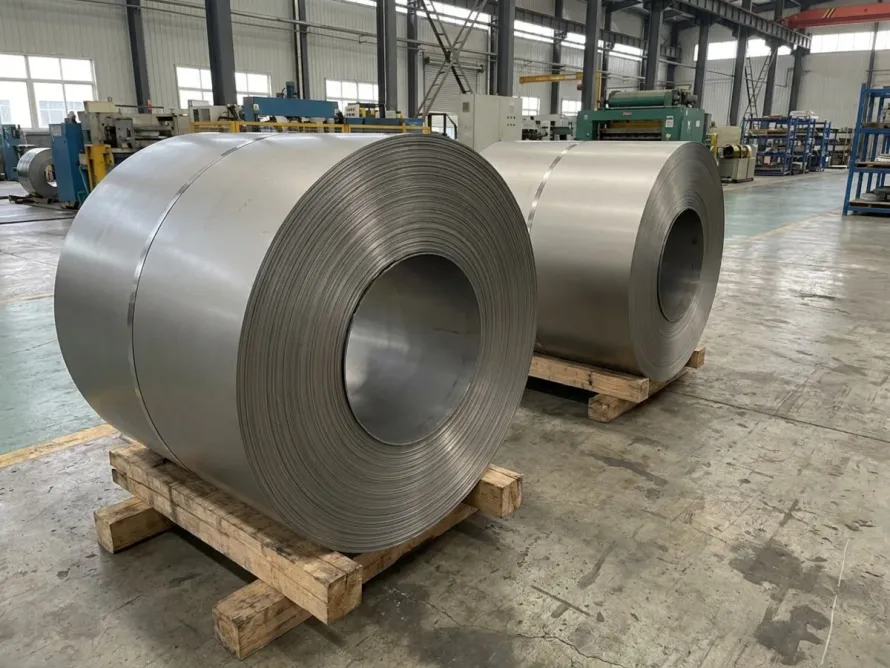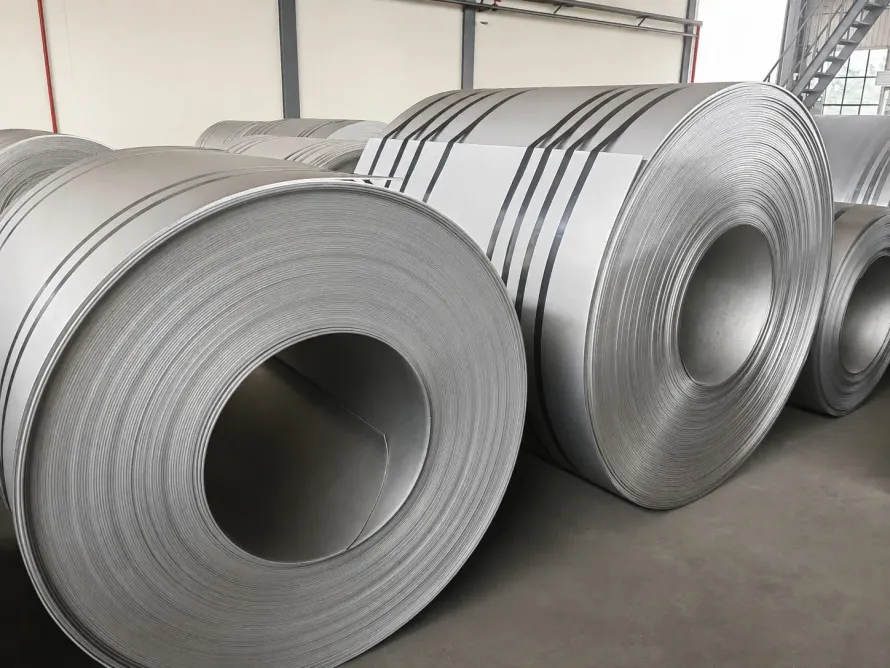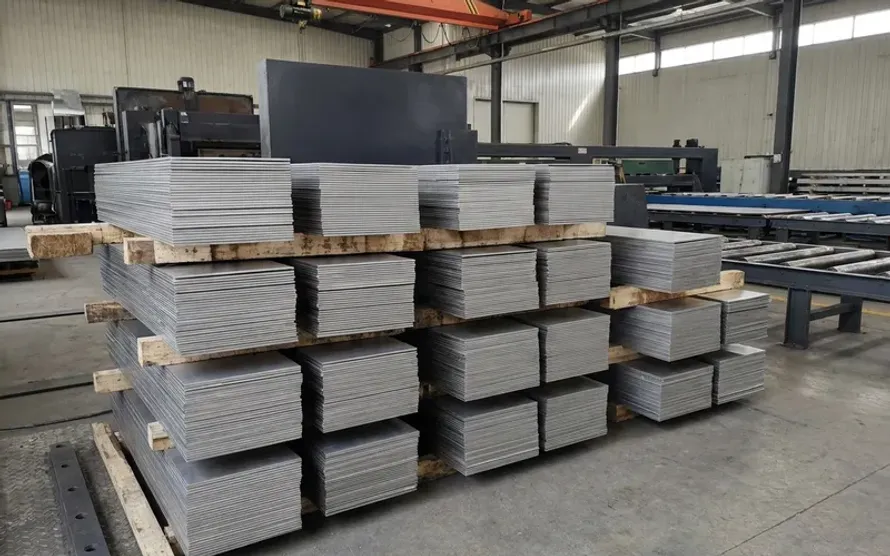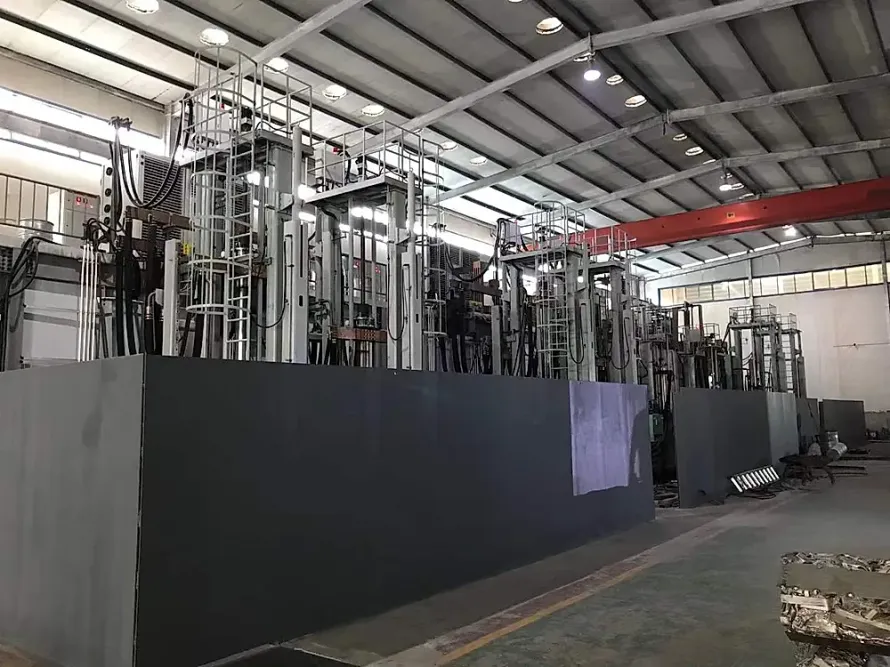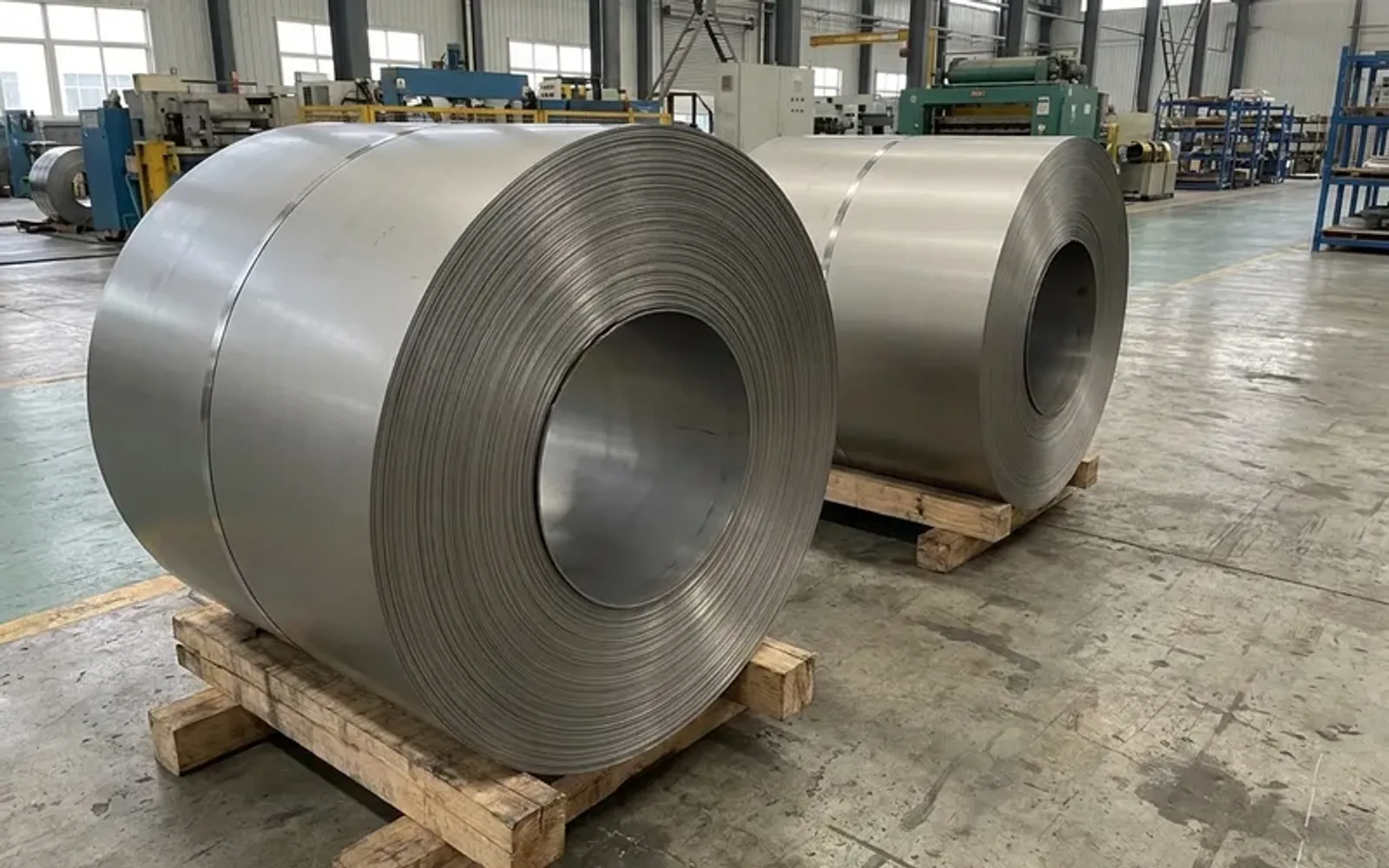
Across hydrogen PEM water-electrolyzer bipolar plates, foldable smartphone hinge backplates, high-fidelity acoustic speaker domes, and humanoid robotics tactile force-sensor diaphragms, hardware engineers are pushing past standard sheet-metal gauges. The recurring procurement question is straightforward: how thin can cold-rolled titanium foil actually be produced at industrial scale, and which tolerance, flatness, and annealing parameters must be locked in when specifying down to $0.005\text{ mm}$ ($5\ \mu\text{m}$)?
First-time buyers often place orders citing only ASTM B265 Grade 1 or Grade 2 at micro-gauges, unaware that conventional 4-high rolling mills hit a physical minimum-gauge wall at $0.02\text{ mm}$ ($20\ \mu\text{m}$). Drawing directly from production data on the two $750\text{ mm}$ 20-high Sendzimir reversing cold mills at our partner facilities, this guide breaks down the metallurgical and dimensional rules for sourcing $5\ \mu\text{m}$ to $150\ \mu\text{m}$ titanium foil.
1. Why Conventional Cold Rolling Stops at 20 μm—and How 20-High Sendzimir Mills Reach 5 μm
At room temperature, commercially pure titanium and alpha-beta titanium alloys have a hexagonal close-packed (HCP) crystal structure with limited slip systems, rapid work hardening, and an elastic modulus roughly half that of steel ($\sim 105\text{ GPa}$). As strip thickness drops during cold rolling, the contact arc between the work rolls undergoes elastic flattening. Once work-roll flattening equals the strip thickness, increasing hydraulic cylinder pressure only deforms the rolls elastically without thinning the metal—a physical barrier known as the minimum rollable gauge.
- Conventional 4-High / 6-High Mill Limit ($\ge 0.02\text{ mm}$): Standard cold mills use work rolls $120\text{ mm}$ to $250\text{ mm}$ in diameter. In routine foil production, 4-high and 6-high stands bottom out around $0.02\text{ mm}$ ($20\ \mu\text{m}$), requiring frequent intermediate anneals and edge trimming that leave overall coil-to-foil yield between 50% and 80%.
- 750 mm 20-High Sendzimir Cluster Physics (Down to $0.005\text{ mm} / 5\ \mu\text{m}$): Our 5μm 20-high Sendzimir ultra-thin titanium foil line uses a 1-2-3-4 pyramidal roll cluster: two miniature work rolls are supported by four first-intermediate rolls, six second-intermediate rolls, and eight heavy backing shafts housed inside a monoblock steel casting. Because miniature work rolls create an ultra-narrow bite angle, specific roll separating force drops dramatically. Paired with closed-loop X-ray/laser Automatic Gauge Control (AGC) and axial roll-crown adjustment, the mill cold-rolls Grade 1 and Grade 2 titanium foil down to $0.005\text{ mm}$ ($5\ \mu\text{m}$) at coil widths up to $640\text{ mm}$, locking thickness tolerance within $\pm 0.001\text{ mm}$ ($\pm 1\ \mu\text{m}$).
[Hot-Rolled & Pickled Titanium Mother Coil: 2.5–3.0 mm]
        │
        ▼
[Pre-Rolling + Controlled HNO3-HF Pickling (HNO3:HF ≥ 7:1, H Pickup < 10 ppm)]
        │
        ▼
[750 mm 20-High Sendzimir Reversing Precision Cold Rolling]
 • Miniature work-roll bite angle + 8-shaft monoblock rigid backing
 • Closed-loop AGC gauge control: down to 0.005 mm (5 μm), tolerance ±0.001 mm
        │
        ▼
[Horizontal High-Vacuum Bright Annealing Line (BA Finish)]
 • Zero acid-pickling hydrogen embrittlement; equiaxed grain size ASTM 9–11
        │
        ▼
[22-Roll Precision Tension Leveler + Micro-Burr Slitting]
 • Eliminates residual rolling stress; flatness ≤ 2 I-units for zero laser-cut curl
2. Engineering Specification Matrix Across Four High-Value Applications
Writing “ASTM B265 Grade 1 Foil” on a purchase order without application-specific grain size, flatness, and temper controls is the primary cause of stamping splits and laser-cutting warpage. Compare the four dominant ultra-thin foil specifications produced at our partner facilities:
| Target Application | Recommended Grade & Gauge | Thickness & Flatness Tolerance | Surface Finish & Microstructure | What Goes Wrong When Unspecified in RFQ |
|---|---|---|---|---|
| Acoustic Tweeter Domes & Rupture Discs | Grade 1 / Zr7020.005–0.025 mm (5–25 μm) | Thickness $\pm 0.001\text{ mm}$ 100% darkroom pinhole-free | Vacuum Bright Annealed (BA) or custom Cold-Worked (1/2H–Full Hard) | Gauge drift $>2\ \mu\text{m}$ shifts acoustic resonant frequency ($f_0$) and burst pressure |
| Humanoid Robot Dexterous-Hand Force Sensors | Grade 5 / Grade 10.015–0.10 mm (15–100 μm) | Thickness $\pm 0.0015\text{ mm}$ Flatness $\le 2\text{ I-units}$ | Dual-stage stress-relieved BA finish (high elastic limit, zero creep hysteresis) | Residual rolling stress causes zero-point signal drift over $10^7$ tactile loading cycles |
| Foldable Smartphone Hinges & 3C Chassis | Grade 2 / Grade 50.02–0.08 mm (20–80 μm) | Flatness $\le 2\text{ I-units}$ Slit edge burr $\le 3\ \mu\text{m}$ | 22-roll tension leveled + BA mirror/matte ($\text{Ra} \le 0.10\ \mu\text{m}$) | Untensioned coil curls into a saddle shape immediately after UV laser micro-cutting |
| PEM Electrolyzer & Fuel-Cell Bipolar Plates | Grade 1 (Low-Fe / Low-O)0.05–0.15 mm (50–150 μm) | Thickness $\pm 0.003\text{ mm}$ Max width $640\text{ mm}$ | Fine equiaxed grains ASTM 9–11 Elongation $A_{50} \ge 35%$, $\text{Ra} \le 0.15\ \mu\text{m}$ | Coarse grains (ASTM 5–6) cause orange-peel thinning and micro-channel cracking during hydroforming |
3. Three Shop-Floor Procurement Rules for Ultra-Thin Titanium Foil
Rule 1: Specify Vacuum Bright Annealed (BA) Below 0.5 mm—Avoid Wet Acid Pickling
On $0.3\text{ mm}$ to $3.0\text{ mm}$ cold-rolled titanium sheet, a ratio-controlled $\text{HNO}_3\text{-HF}$ pickling bath is used to keep hydrogen pickup low while creating a matte surface for catalyst or adhesive interlock. Below $0.5\text{ mm}$—and especially between $0.005\text{ mm}$ and $0.10\text{ mm}$—the specific surface-area-to-volume ratio is so high that wet acid pickling risks microscopic etching pits and rapid hydrogen embrittlement. Always specify Horizontal Vacuum Bright Annealed (BA) finish for micro-foil to guarantee a mirror-clean oxide-free surface ($\text{Ra} \le 0.15\ \mu\text{m}$) and hydrogen content safely below $0.010\text{ wt%}$.
Rule 2: Separate Deep-Drawing Soft Temper from High-Springback Hard Temper
- For PEM Bipolar Plates and Micro-Channel Heat Exchangers: Hydroforming and progressive die stamping demand maximum isotropic formability. Specify fully recrystallized vacuum bright annealing with ASTM E112 grain size 9 to 11 and elongation $A_{50} \ge 35%$.
- For Acoustic Diaphragms, Medical Shims, and Robotic Strain Gauges: High acoustic velocity and elastic recovery require controlled cold work. Specify the exact post-rolling temper (1/4 Hard, 1/2 Hard, or Full Hard plus low-temperature stress relief) rather than defaulting to standard ASTM B265 annealed condition.
Rule 3: Multi-Metal Sendzimir Capability & Ocean-Transit Core Protection
Alongside commercially pure titanium and Ti-6Al-4V foil, the same two $750\text{ mm}$ 20-high Sendzimir lines cold-roll nuclear and chemical-grade zirconium foil (Zr702/Zr705 down to 0.01 mm) and high-purity nickel strip (Ni200/Ni201) for specialized corrosion and acoustic stacks. Because $5\ \mu\text{m}$ to $50\ \mu\text{m}$ foil edges are highly vulnerable to handling dents, every export coil is wound onto rigid phenolic/epoxy cores, suspended on EPE cushion cradles to keep the coil OD off the crate floor, vacuum-sealed in moisture-barrier foil bags, and shipped in ISPM-15 reinforced plywood boxes.
4. Verify Your Foil Gauge, Flatness & Slitting Callout Before Ordering
If you are qualifying ultra-thin titanium strip or foil for hydrogen electrolyzers, foldable consumer electronics, acoustic transducers, or robotic tactile sensors, use our titanium weight and coil-length calculator to estimate coil weight and linear footage. To validate your drawing tolerances or request sample swatches with full material test certificates (MTCs) (including grain-size and ONH gas reports), submit your specifications through our RFQ & Complimentary Drawing Audit page and select 0.005mm (5μm) 20-High Rolled Titanium Foil.