Representative component geometry only; these parts are not presented as AM medical devices or FDA test specimens.
FDA’s new regulatory science tool gives medical-device teams seven percentile-based material models for hot-isostatically-pressed additively manufactured Ti-6Al-4V. The models are useful inputs for finite-element sensitivity analysis: they let a team test how the same device geometry responds across a broad range of observed tensile behavior. On their own, they do not establish device-specific design allowables, a fatigue model, or proof that a particular printer, build orientation and post-process will reproduce a selected percentile.
That distinction changes how the tool should enter a verification plan. Use the seven curves to expose conclusions that depend on optimistic material behavior. Then close the gap with process- and device-specific evidence before treating any FEA result as a design limit or submission conclusion.
What the seven models actually contain
FDA identifies the tool as RST26OP10.01, published on 24 August 2026. It contains seven quasi-static isotropic models at the 1st, 15.9th, 25th, 50th, 75th, 84.1st and 99th percentiles. The source data pool comprised 223 tensile tests on HIPed AM Ti-6Al-4V from seven manufacturers. The specimens were axial tensile coupons built in the Z direction, with multiple builds represented for each vendor.
Each model combines an elastic modulus with a tabulated true-stress versus plastic-strain curve for multilinear isotropic hardening. FDA’s user manual applies a Poisson’s ratio of 0.36 to all seven models. The table below shows three anchor points from the manual; the stress value is the table entry at zero plastic strain, not a universal design allowable or a substitute for the full curve.
| Percentile model | Elastic modulus, MPa | True stress at plastic strain 0, MPa |
|---|---|---|
| 1st | 117,885 | 816.7 |
| 50th | 131,436 | 977.6 |
| 99th | 137,683 | 1,054.2 |
The percentile labels therefore describe positions within the pooled tensile dataset. They do not assign a quality grade to a machine, powder lot, supplier or finished device.
Why a percentile curve is not a device-specific design allowable
The tool’s intended purpose is to simulate a range of possible mechanical responses. That makes it valuable early in design: a team can run the same load case with a lower, median and upper response instead of hiding material variability behind one nominal curve.
But the pool is not the manufacturing history of a specific device. FDA states that a material model derived from the AM system used to make the device may more closely reflect that process. The agency also warns that a catalog model may be more or less conservative than behavior observed for the seven vendors. Selecting the 1st-percentile curve is therefore not automatically equivalent to choosing a conservative allowable for every geometry, process or failure mode.
This is an engineering inference from FDA’s stated scope and limitations: the curves can define a sensitivity envelope, but process qualification, material characterization and device verification still have to establish which inputs and acceptance criteria apply to the actual product.
The boundaries FDA states explicitly
The models were derived from Z-direction axial tensile coupons, and FDA says the dataset could not cover all AM and post-processing variables. Compression may differ from tension. The models target monotonic loading and have not been tested for cyclic loading, fatigue, unloading, creep, stress relaxation or high-temperature conditions.
Those boundaries are not minor footnotes. A fatigue-driven implant analysis cannot convert these monotonic tensile curves into fatigue evidence by adding a safety factor. A contact or buckling problem with important compressive behavior should assess whether separate compression evidence is needed. High-temperature or time-dependent dwell conditions may require corresponding evidence. The missing variable should be named in the verification plan rather than buried in a generic “material model uncertainty” statement.
The regulatory boundary is equally clear. FDA’s catalog says these tools do not replace FDA-recognized standards or qualified Medical Device Development Tools. RST26OP10.01 has not been qualified as an MDDT, and FDA has not evaluated its suitability for any specific context of use. Teams considering it in a submission can request feedback through the Q-Submission Program.
Use the tool as a sensitivity envelope, then close the device-specific gap
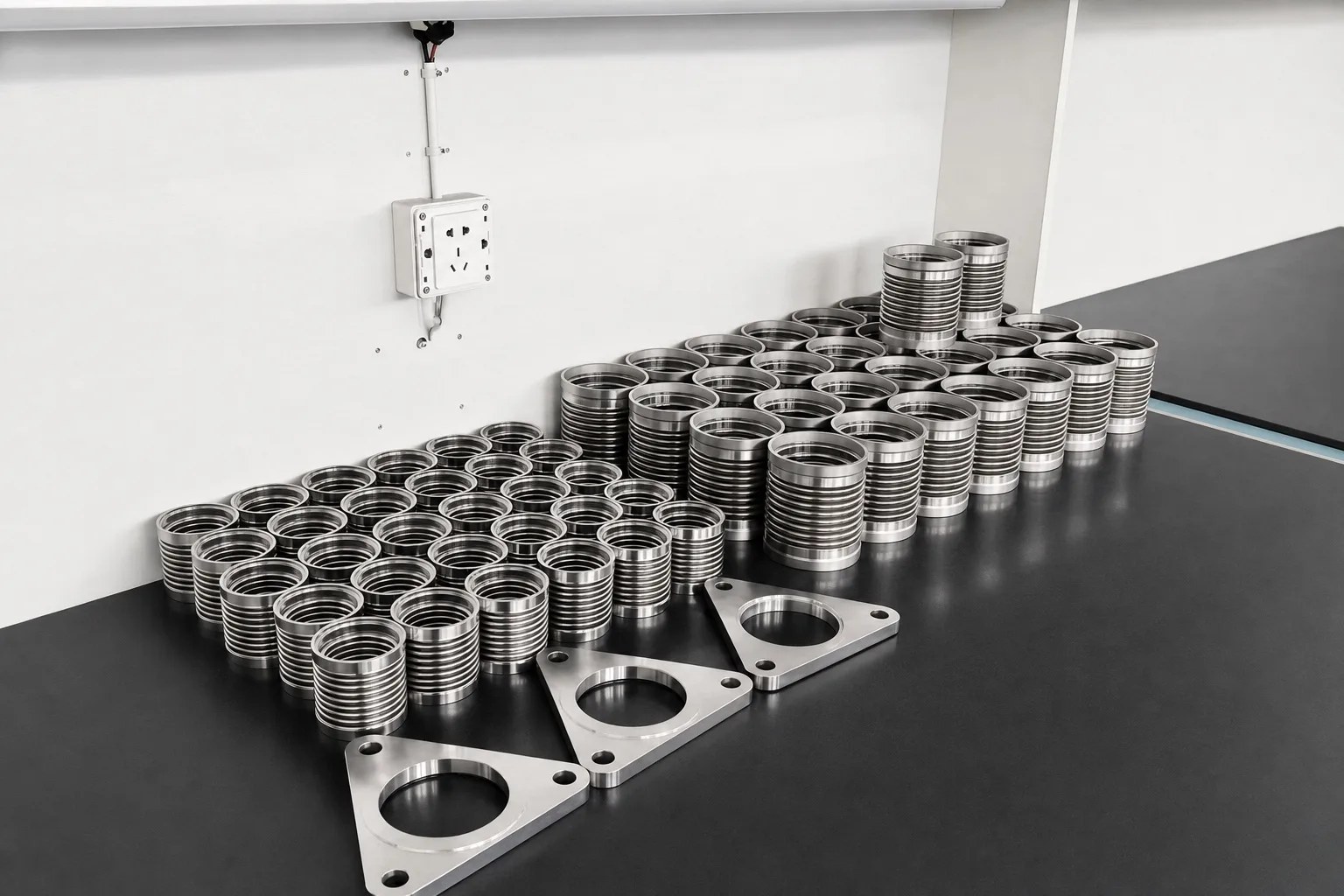
Representative component-batch context; this is not an FDA test set or an identified AM medical-device lot.
A practical workflow is to start with the load case, not with a favorite percentile. Identify the response that drives the decision—yielding, permanent deformation, contact force, fixation stability or another measurable outcome—and run enough percentile models to see whether the conclusion changes. If every relevant model leads to the same decision, the analysis is less sensitive to the pooled tensile variability. If the decision flips, the model choice is a verification risk that needs stronger material evidence or a design change.
Next, map each uncovered limitation to a specific evidence source: build orientation and process parameters, HIP cycle, heat treatment, specimen location, surface condition, tensile and compression characterization, fatigue or cyclic data, and any temperature-dependent behavior. Not every device needs every test, but each claimed use of the simulation needs a traceable basis.
Finally, document the exact FDA model, software implementation and curve data used. The manual notes that FEA packages can handle material models differently, so the imported table, format and software handling should be checked. The useful outcome is not “FDA supplied the material property.” It is a transparent record showing where FDA’s pooled models supported sensitivity analysis and where device-specific evidence supported the final conclusion.
Sources
- U.S. Food and Drug Administration, Additively Manufactured Titanium – 6 Aluminum – 4 Vanadium Material Models, RST26OP10.01; published 24 August 2026; accessed 29 September 2026.
- U.S. Food and Drug Administration, User Manual: Additively Manufactured Titanium – 6 Aluminum – 4 Vanadium Material Models, RST26OP10.01; accessed 29 September 2026.