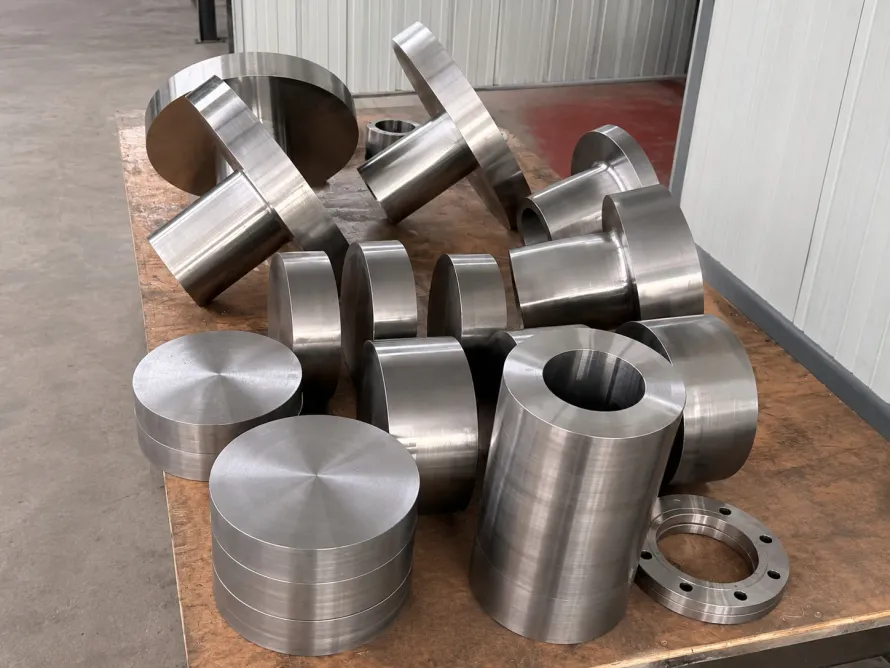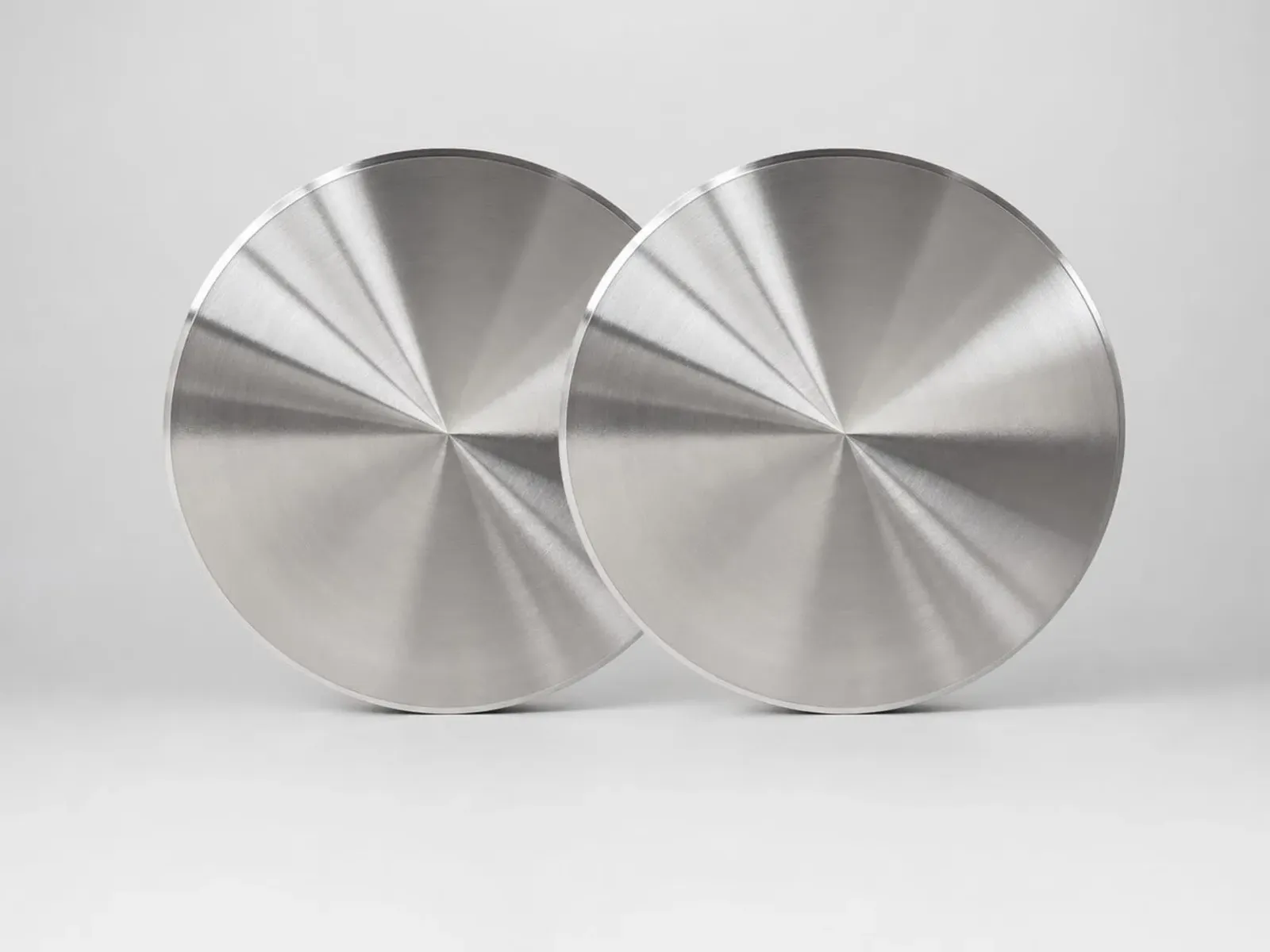
Generic disc-form illustration; not a specimen from the cited study or a dental abutment.
The same cleaning tool can leave different results on titanium and zirconia. In a 2019 laboratory study by Huang and colleagues, a titanium curette produced the highest measured roughness and one-hour bacterial adhesion on polished Grade IV titanium discs. Zirconia showed no significant differences between treatment groups for either measure. For abutment manufacturers, the useful comparison is therefore the tool and the material—not the instrument name alone.
Four cleaning tools, two materials
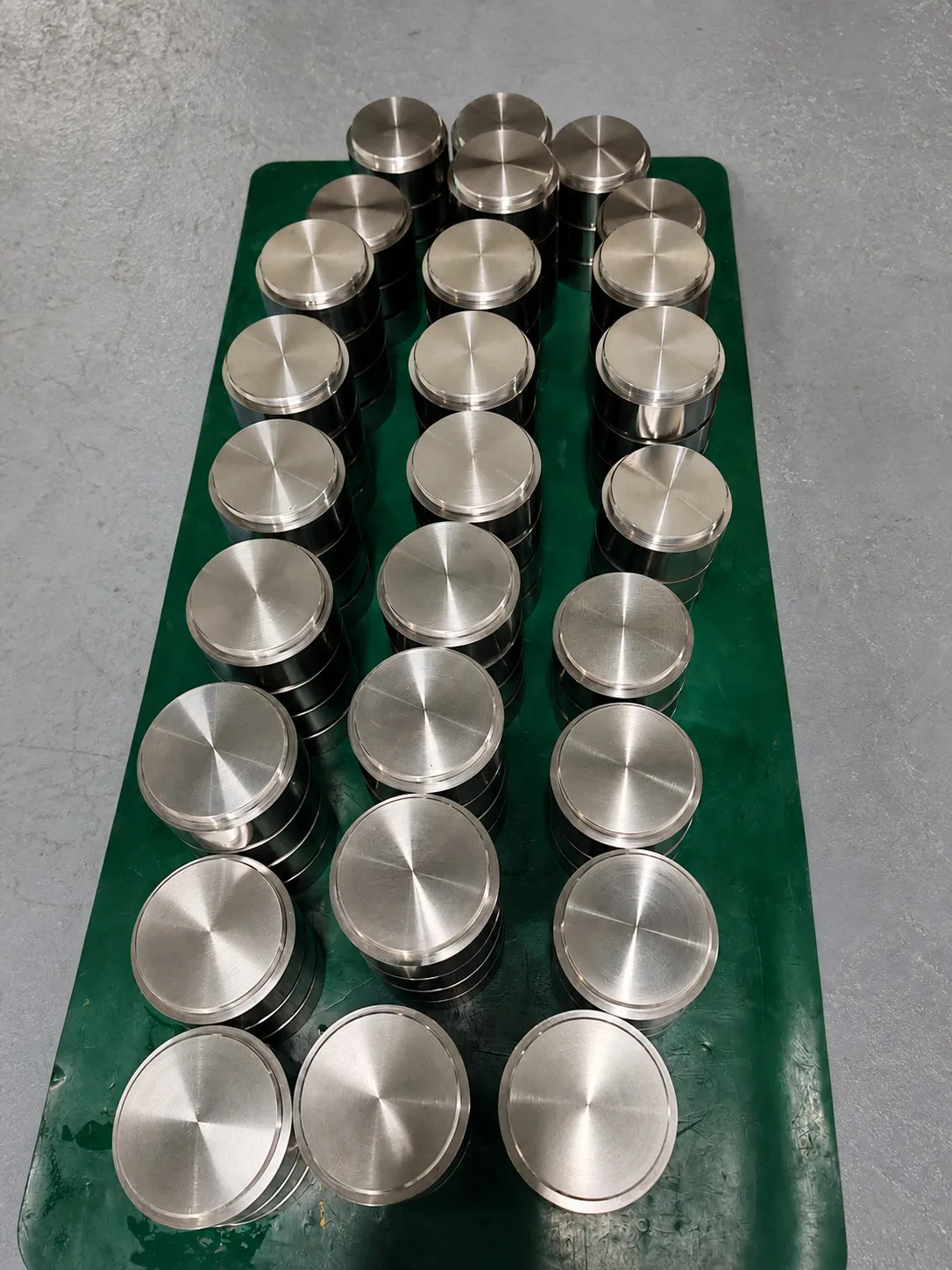
Similar disc geometry does not establish material identity or an equivalent cleaning response.
The researchers prepared 60 commercially pure Grade IV titanium discs and 60 yttria-stabilized zirconia discs. Each material was divided into five groups: titanium curette, carbon-fibre-reinforced plastic curette, ultrasonic scaler with a carbon-fibre tip, glycine air polishing, and an untreated control. One trained periodontist performed the treatments.
Not all 60 discs entered every measurement. Each material–treatment group supplied three samples for roughness and six for bacterial adhesion: five for optical-density quantification and one for microscopy. After instrumentation, the discs were rinsed and sonicated in 75% ethanol to remove debris; ultraviolet disinfection preceded the bacterial test. The adhesion result describes these prepared surfaces, not an immediate post-cleaning clinical condition.
Where the titanium results differed
| Treatment on titanium | Reported surface observation | One-hour bacterial adhesion |
|---|---|---|
| Titanium curette | Deep linear marks; highest mean roughness, significantly above the other groups. | Highest optical-density measure of adhered Streptococcus mitis. |
| Plastic curette | Relatively shallow, sparse marks. | No significant difference from the ultrasonic, air-polished or control groups. |
| Carbon-fibre ultrasonic tip | Linear marks over much of the surface. | No significant difference from the plastic-curette, air-polished or control groups. |
| Glycine air polishing | Morphology resembled the untreated control. | No significant difference from the plastic-curette, ultrasonic or control groups. |
The contrast between the microscopy and bacterial measurements matters: visible marks did not produce a statistically distinct adhesion result for every tool. Nor did a control-like appearance make air polishing a demonstrated infection-prevention treatment. On zirconia, neither roughness nor adhesion differed significantly across the five groups; that is not proof of equivalence under every condition.
What this means for an abutment specification
For a team assessing a polished titanium surface, the titanium-curette result is a specific reason to examine that instrument–surface pairing more closely. Evidence from zirconia would not resolve the titanium question. Likewise, an ultrasonic result belongs to the tested carbon-fibre tip and settings, not to every ultrasonic instrument.
The central limit is exposure: this was one treatment followed by a one-hour, single-strain adhesion assay. The authors warn that repeated cleaning could accumulate surface changes, but did not measure that accumulation or patient outcomes. If a proposed maintenance claim concerns repeated use, the next useful evidence is repeated-cycle testing on the actual abutment finish—not another general statement that a tool is suitable for implants.
The authors report National Yang-Ming University Hospital grant support and no conflicts related to the paper’s subject matter or materials.
Sources
- Huang, Hung and Huang, Surface changes and bacterial adhesion on implant abutment materials after various clinical cleaning procedures, Journal of the Chinese Medical Association, August 2019; accessed 28 September 2026. Methods §§2.1–2.5, Results §§3.1–3.4, Discussion.