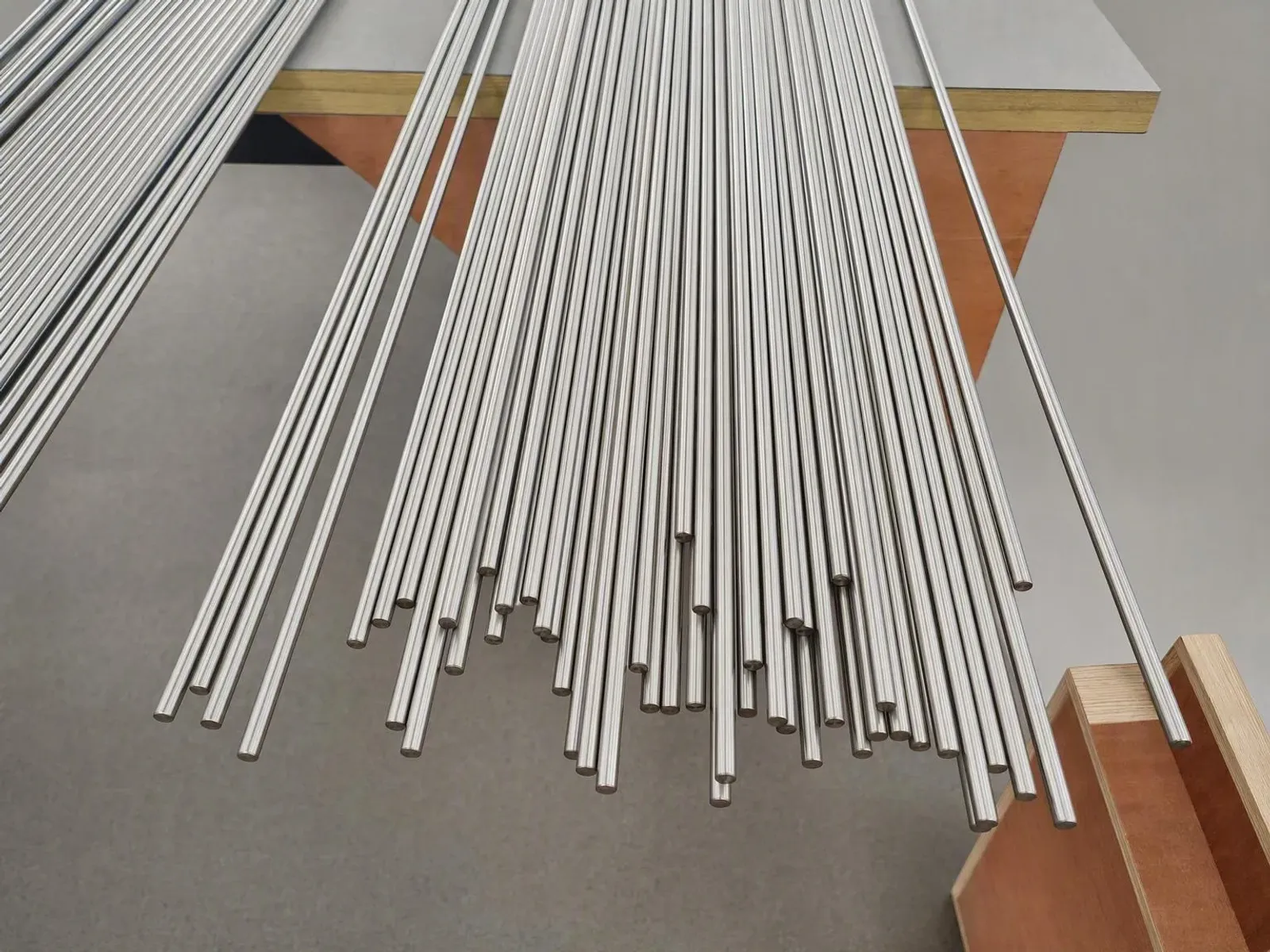
Generic titanium rod stock; this is not a coated study specimen or implant.
No. A new study found that five-day survival rose from 20% to 45% when infected Galleria mellonella larvae received flucloxacillin-loaded rather than unloaded PAA/PAH-coated titanium rods. That is a useful proof-of-concept signal, but it is not a clean causal test of infection-triggered coating efficacy. The antibiotic may have started leaving the coating during bacterial pre-incubation, and the study did not demonstrate equal pre-implant bacterial loads for the loaded and unloaded rods.
For implant-surface engineers and preclinical reviewers, the result supports a better-controlled follow-up experiment. It does not yet support a clinical effect size, a device qualification claim or a validated manufacturing process.
What the study actually tested
The specimens were 4 mm Ti-6Al-4V Grade 5 rods with a diameter of 0.8 mm. Their anodized surface carried a 24-cycle poly(acrylic acid)/poly(allylamine hydrochloride), or PAA/PAH, multilayer. Flucloxacillin was added to the PAA solution for the loaded version.
The in-vitro release test compared pH 5.1 with pH 7.3. More flucloxacillin was released in the acidic medium, while a smaller amount was detectable under neutral conditions. The authors also observed release at the first 30-second measurement and described the profile as an initial burst followed by sustained release. This evidence supports pH-dependent release; it does not prove that release begins only after infection.
For the implantation comparison, rods were exposed to Staphylococcus aureus for 30 minutes, washed and implanted into larvae. Each experimental group used ten larvae, and the experiment was repeated six times. Survival was followed for five days. The loaded infected-rod group reached 45% survival at day five versus 20% for the infected coated rods without flucloxacillin.
The result mixes treatment with starting bacterial burden
The central causal problem appears before implantation. The authors note that flucloxacillin could already have been released during the rod-incubation step. If that early release reduced bacterial adhesion, the loaded rods may have entered the larvae with fewer viable bacteria than the unloaded rods.
The paper reports 2.59 ± 0.45 × 10³ colony-forming units per rod for the PAA/PAH-coated rods without flucloxacillin. It does not establish the same starting count for the loaded infected rods. The comparison can therefore reflect two effects at once: possible antibiotic delivery after implantation and a lower infectious challenge at implantation.
This does not make the survival observation meaningless. It changes what the observation can answer. The full loaded-coating protocol was associated with better larval survival. The experiment did not directly isolate release after implantation or show how much of the difference came from delivery inside the host.
Dose and chemical identity are also unresolved
The coating recipe used 75 mg of flucloxacillin in 150 mL of PAA solution, but the drug amount loaded onto each rod was not precisely quantified. The release study measured drug in the surrounding medium, not a controlled per-rod dose before implantation.
Chemical stability adds another limit. The authors say degradation under acidic conditions at 37 °C cannot be excluded and call for stability-indicating analysis such as HPLC. Biological activity was present during relevant time windows, but that does not identify the intact-drug fraction, degradation profile or dose delivered by each implanted rod.
The next causal experiment should therefore measure three linked quantities for every group: flucloxacillin loaded per rod, chemically intact drug released over time, and viable bacteria per rod immediately before implantation. Loaded and unloaded infected rods should begin with matched CFU distributions. These controls would remove the present dose, identity and starting-load ambiguities; proving infection-triggered delivery would still require an appropriate non-responsive control or direct evidence of local pH and release after implantation.
Why the larval model is an intermediate screen

Generic titanium samples illustrating the device-qualification gap beyond a short rod model.
Galleria mellonella provides an in-vivo host with innate immune responses and supports rapid comparison of implant-associated infection concepts. In this study it captured an acute five-day response with ten larvae per group and six experimental repeats. That is more informative than an in-vitro release curve alone.
It is still not a mammalian chronic-infection model. The larvae lack an adaptive immune system, and the paper itself says the model is unsuitable for chronic or immunologically mediated implant infections. The study also did not establish long-term coating stability, osseointegration or performance in a mammalian implant-infection model.
The appropriate stage gate is therefore narrow. Preserve the coating as a candidate for controlled preclinical development. Before device qualification, separately verify coating durability, sterilization effects, long-term release, osseointegration and mammalian chronic-infection performance. The last two priorities are explicitly named by the authors; the others are engineering recommendations for translating a coated rod into a repeatable device process. A survival difference in larvae can prioritize that work; it cannot replace it.
Sources
- S. Menke et al., Antimicrobial efficiency of pH-responsive PAA/PAH-coated and flucloxacillin loaded titanium implants in the Galleria mellonella model, Drug Delivery and Translational Research, published September 30, 2026; accessed October 2, 2026.