Generic repeated disc-shaped units. These are not specimens from the cited study; similar form alone does not establish a reference value or release status.
The new Ti–TiH₂ study supports a candidate route for hydrogen-analysis reference specimens, but it does not yet assign a reference value. The paper did measure hydrogen concentration by inert-gas fusion; those experimental results are not an assigned reference value backed by a release uncertainty. The useful result is narrower and more practical: under the paper’s powder, SPS and measurement conditions, the model predicted hydrogen concentration with about 6.7% mean absolute percentage error (MAPE), four-position GD-OES variation stayed near 3% for the 680–920 °C compacts, and both prediction and positional results worsened at 1040 °C. A laboratory should treat those as three separate decisions—process-model validation, specimen screening and material release—not as one qualification result.
The model window is not the material qualification
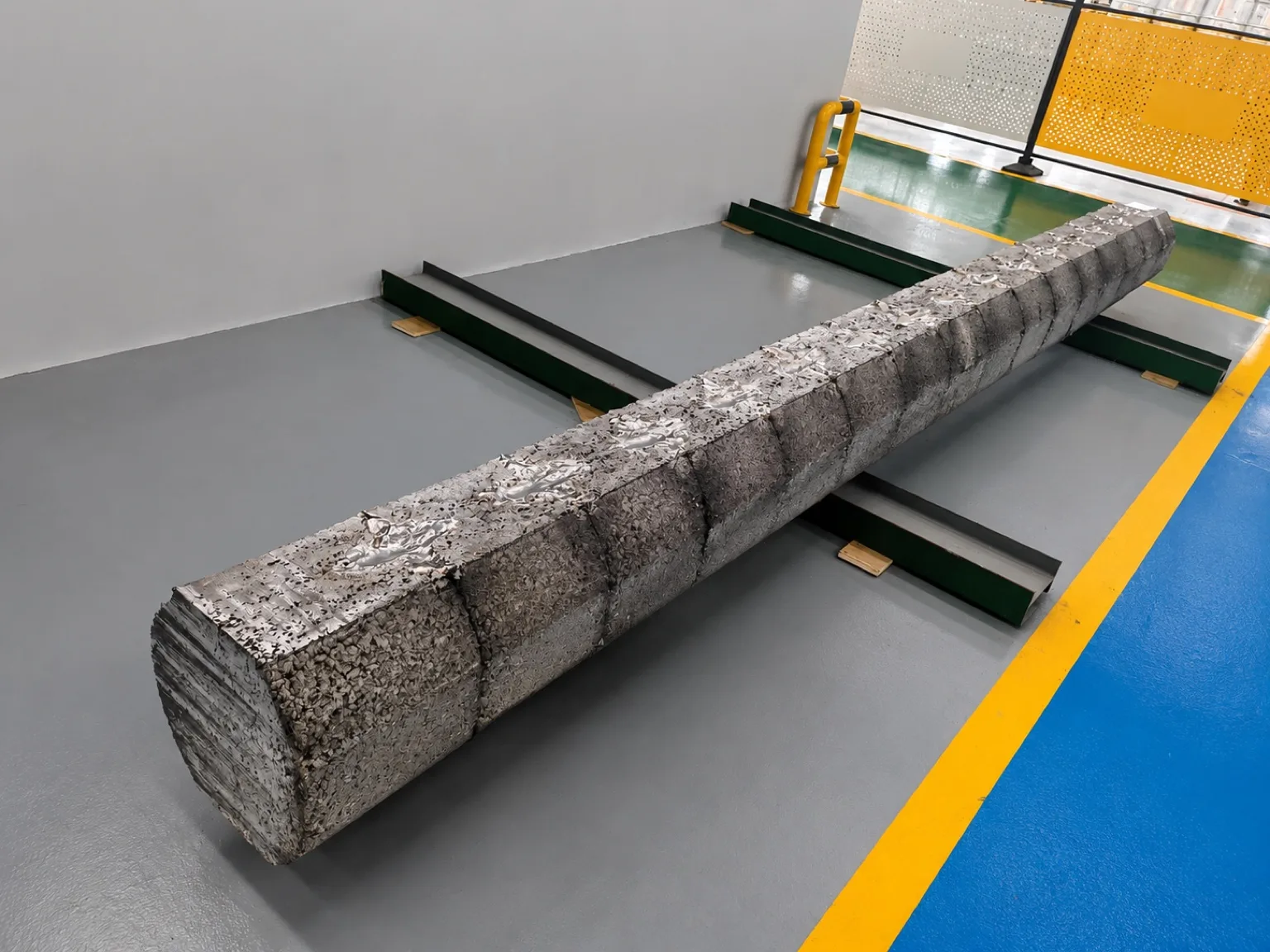
Generic rough metal form. Surface appearance does not establish composition, process-model transfer, analytical homogeneity or release status.
The authors trained random-forest models on a small dataset and evaluated them with leave-one-out cross-validation. They reported MAPE of about 0.75% for density and 6.7% for hydrogen concentration. Those figures describe how the models performed against the study data; they are not the uncertainty of an assigned hydrogen value.
The verification conditions make that distinction visible. The team used 8 g powder mixtures, 45 µm titanium powder, 150 µm titanium-hydride powder, a nominal initial hydrogen content of 10,000 mg/kg and a 20 mm graphite SPS die. The temperature checks included 680, 800, 920 and 1040 °C, and 50 MPa was an untrained pressure condition.
At 920 °C, the hydrogen-concentration prediction error was 8.2%, slightly above the model’s overall 6.7% MAPE. At 1040 °C, the error increased significantly; the paper explicitly identifies the limit of extrapolation. That does not create a universal 1040 °C rejection rule. It shows that this model should not be carried beyond its verified powder, equipment and process domain without new data.
Four-position RSD is screening evidence, not a full homogeneity statement
The study also measured H/Ti emission ratios by glow-discharge optical emission spectroscopy (GD-OES). For four positions on each compact and the 240–600 s sputtering interval, the inter-position relative standard deviations were 3.1%, 3.0%, 3.2% and 4.7% at 680, 800, 920 and 1040 °C, respectively.
This is useful evidence because it tests whether the hydrogen-related signal changes across the measured positions. It is not the same as establishing a hydrogen mass-fraction value for every unit in a batch. The reported RSD is tied to an emission ratio, four positions, the selected sputtering window and the individual verification compacts. It does not by itself measure between-unit variation, between-batch variation or change during storage.
The 1040 °C compact again marks the edge of the current evidence. Its positional RSD rose to 4.7%, while the paper reported higher outer-region C/Ti ratios, suggesting localized carbon enrichment, together with coarser α-Ti. The authors did not reduce that result to one cause; they discuss carbon interaction, hydrogen release, densification and microstructural evolution as possible contributors. A release rule should therefore use measured performance, not assume that temperature alone explains every deviation.
Use a three-layer release decision
For a quantitative hydrogen reference programme, the study and NIST definitions support a practical three-layer release framework:
| Decision layer | What the current study supports | What this application should establish for release |
|---|---|---|
| Process-model validation | Model error under the reported training and four verification conditions | A frozen domain for powder lots, particle sizes, hydrogen range, SPS equipment and process settings, plus new verification when that domain changes |
| Specimen screening | Density, hydrogen measurements and four-position GD-OES variation on the experimental compacts | A defined measurand and intended use, representative sampling, between-position and between-unit evidence, and acceptance rules |
| Reference-material release | Potential use as hydrogen-analysis reference specimens | An assigned property value appropriate to the intended use, homogeneity and stability evidence, uncertainty, instructions and change control; certification additionally requires metrological traceability and a certificate |
NIST defines a reference material as sufficiently homogeneous and stable for specified properties and fit for an intended measurement use. A certified reference material goes further: it is characterized by a metrologically valid procedure and accompanied by a certificate providing the property value, associated uncertainty and a statement of metrological traceability. The paper does not claim that package. Its wording—“potential use as reference specimens”—is appropriately earlier-stage.
What a hydrogen-analysis laboratory can do next
First, define the intended use. A compact used to tune an SPS process is not automatically suitable for instrument calibration, method validation or a multi-laboratory control programme. Each use can require a different property definition and uncertainty target.
Second, freeze the production domain before widening it. Record powder identities and lots, particle-size distributions, nominal hydrogen, mixing, die and punch materials, atmosphere, heating profile, pressure, hold time and equipment. A new powder lot, hydrogen level, die geometry or furnace is a model-transfer question, not a clerical change.
Third, separate model verification from value assignment. Use an appropriate hydrogen method to assign the property value, then design homogeneity and stability studies around the smallest unit that will be supplied and the period and conditions of use. Compare positions, units and batches; do not convert the study’s four-position GD-OES RSD directly into a certificate uncertainty.
The practical conclusion is positive but bounded. Ti–TiH₂ compacts now have peer-reviewed process-development evidence and measurable within-compact consistency across several conditions. The next advance is not a more confident label. It is a release design that connects a specified hydrogen measurand, the intended analytical use, representative material units and an uncertainty and traceability chain.
Sources
- ISIJ International, “Prediction and evaluation of density and hydrogen content in sintered titanium–titanium hydride alloys using random forest for improved hydrogen analysis”, advance published 13 October 2026; accessed 15 October 2026.
- NIST, “SRM Definitions”, current definitions of reference material and certified reference material; accessed 15 October 2026.