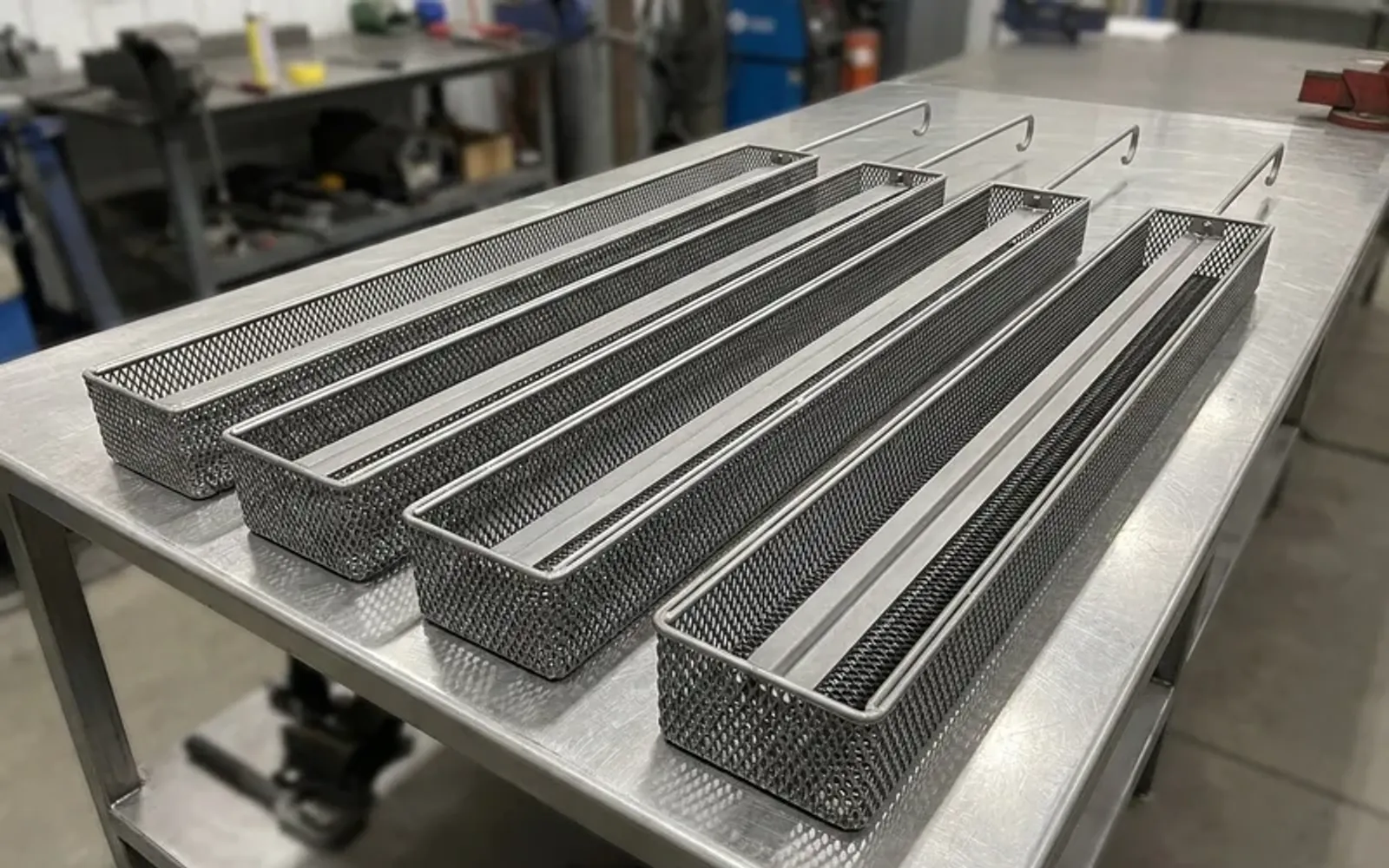
Quick Answer: For 90% of nickel, copper, zinc, and tin electroplating lines, specify ASTM B265 Grade 2 titanium for the basket frame, solid bottom plate, and double-hook busbar hanger (for structural rigidity under load), paired with Grade 1 or Grade 2 diamond expanded mesh sized to your anode geometry (3×6 mm to 4.5×9 mm for S-rounds/balls; 2×3 mm for fine pellets/chips). Never exceed 0.6 A/mm² on unclad solid titanium hooks, and strictly exclude free fluorides from the bath.
Selecting the wrong mesh gauge or undersizing the hook cross-section on a titanium anode basket leads to bulging basket walls, hot busbar contacts, uneven cathode deposit thickness, and premature weld failure. This procurement guide details the exact metallurgical, dimensional, and electrical rules engineers use to lock down electroplating basket drawings.
1. Grade 1 vs. Grade 2 Titanium for Anode Basket Construction
Both Grade 1 (UNS R50250) and Grade 2 (UNS R50400) are commercially pure alpha titanium grades that develop an insulating TiO₂ film when anodically polarized in sulfate or chloride plating electrolytes. Because that film blocks current flow directly from the titanium into the bath, electricity transfers exclusively through contact points into the soluble nickel or copper media loaded inside the basket.
| Engineering Parameter | Grade 1 Titanium (UNS R50250) | Grade 2 Titanium (UNS R50400) | Fabrication Impact on Anode Baskets |
|---|---|---|---|
| Min Yield Strength (0.2%) | 170 MPa | 275 MPa (+62% stiffer) | Grade 2 resists wall bowing under 30–80 kg anode loads |
| Min Tensile Strength | 240 MPa | 345 MPa | Better resistance to hook bending during crane hoisting |
| Min Elongation | 24% | 20% | Grade 1 stretches more cleanly into tight mini-expanded mesh |
| Electrical Resistivity | ~0.42–0.56 µΩ·m | ~0.52–0.56 µΩ·m | Nearly identical; hook cross-section governs heating |
| Optimal Basket Component | Fine expanded mesh inserts, deep-drawn chutes | Hooks, side channels, solid bottom, standard mesh | Hybrid Gr2 frame + Gr1 fine mesh is common for chip baskets |
Selection Rule: Always specify Grade 2 for the load-bearing side channels, solid bottom pan, top loading chute, and hooks. Only specify Grade 1 for fine, thin-gauge mini-mesh panels where tight cold-expansion forming is needed.
2. Expanded Diamond Mesh Size vs. Soluble Anode Media
The basket wall must maximize electrolyte circulation and ion diffusion (~55–68% open area) while retaining dissolving anode metal until complete consumption. Undersized apertures starve the anode surface and raise cell voltage; oversized apertures drop partially dissolved slivers into the anode bag or tank floor.
| Soluble Anode Material | Typical Media Dimension | Recommended Mesh Type & Aperture (SWD × LWD) | Sheet Thickness | Typical Open Area |
|---|---|---|---|---|
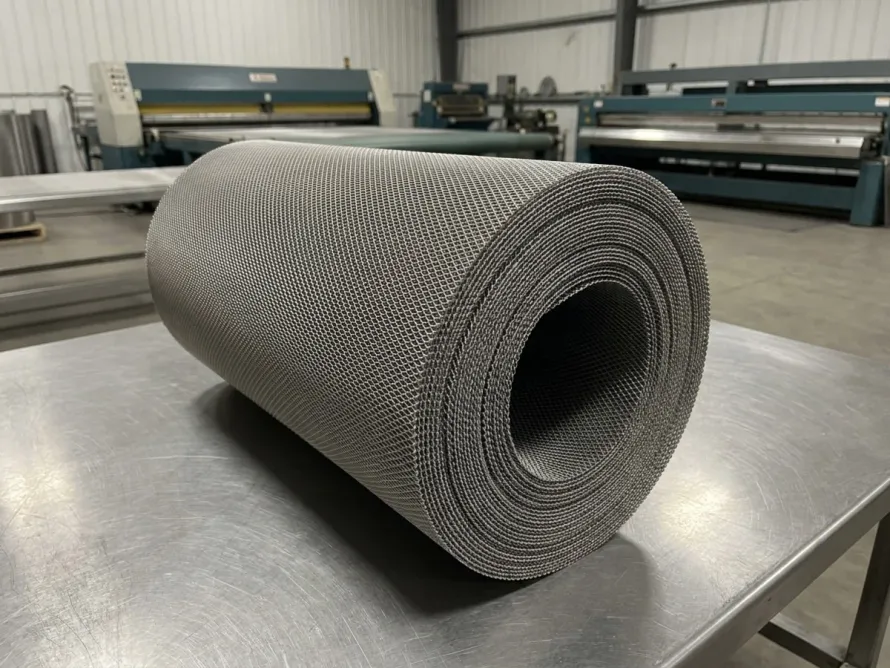
| Nickel S-Rounds / Crowns / Buttons | 15–28 mm diameter | Standard diamond expanded: 3×6 mm to 4.5×9 mm (3/16” × 1/2”) | 0.8–1.2 mm | 60%–68% |
| Copper Phosphorized Balls / Nuggets | 20–50 mm diameter | Heavy diamond expanded: 4.5×9 mm to 6×12 mm | 1.0–1.5 mm | 62%–70% |
| Small Nickel Squares / Pellets / Chips | 4–12 mm fragments | Mini-expanded mesh: 2×3 mm or 2×4 mm | 0.6–1.0 mm | 45%–55% |
| Ultra-Fine Scraps / Heavy Deep Baskets (>1500 mm) | Mixed fine chunks | Perforated titanium sheet (3.0–5.0 mm round holes) | 1.0–1.5 mm | 35%–45% |
For deep plating tanks exceeding 1,200 mm length, specify internal horizontal titanium stiffening bands spaced every 300–400 mm and a 1.5–2.0 mm solid titanium bottom pan (25–50 mm high) to trap anode sludge before it settles directly onto the polypropylene anode bag.
3. Hook Current-Carrying Capacity & Avoiding Overheating
Titanium’s electrical conductivity is only ~3.1% of pure copper (IACS). Undersized hooks are the most common failure point in high-current bright nickel and PCB copper tanks, causing dark blue thermal oxidation at the busbar contact and voltage drops across the tank.
- Solid Grade 2 Titanium Hooks (Standard Duty): Size the cross-section at 0.45–0.65 A/mm² for the exposed section above the electrolyte. For example, a single
6 mm × 25 mm(150 mm²) solid titanium hook safely carries 70–95 A continuously; dual hooks (2 × 6 × 25 mm) safely carry 140–190 A. - Copper-Cored Titanium-Clad Hooks (High-Amperage Duty >200 A): When individual baskets run at 200–600 A, specify explosion-bonded or drawn Ti-clad copper bar hooks with a full-circumference TIG-welded titanium cap at the lower liquid-line interface so corrosive mist never reaches the copper core.
- Knife-Edge Contact Geometry: Specify a 45° twisted or square-bar knife-edge hook that bites cleanly through oxide film on the round copper anode busbar, plus a top-welded titanium reinforcement gusset to prevent hook fatigue.
4. Electrolyte Compatibility & Maintenance Checklist
- Safe Electrolytes: Watts nickel, nickel sulfamate, bright acid copper sulfate, acid zinc, stannous sulfate tin, and gold/silver neutral baths (operating below titanium’s anodic breakdown voltage of 9–12 V in chloride-bearing baths).
- Forbidden Chemicals: Hydrofluoric acid (HF), fluoborates, silicofluorides, and fluoride-catalyzed hexavalent chrome baths immediately attack titanium. Switch to coated MMO titanium anodes only when insoluble anode processes apply, or use zirconium/lead-alloy fixtures in fluoride baths.
- RFQ Specification Checklist: When requesting a quote for custom titanium mesh or anode baskets, provide: (1) Basket width × thickness × submerged depth (mm); (2) Busbar OD and hook drop height; (3) Target amperage per basket; (4) Anode media size (rounds, squares, pellets); and (5) Whether polypropylene anode bags and top loading chutes are required.