Type something to search...

Porous titanium spacecraft

Aerospace and Defense
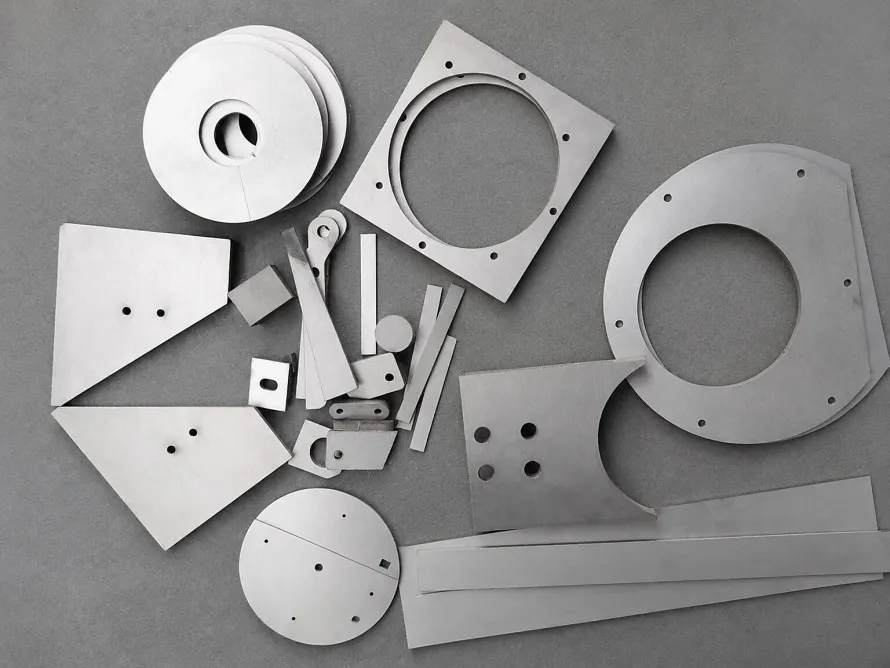
Machined titanium forms show how geometry and material distribution can become functional variables when a space structure must survive service but demise during re-entry.
By Jason/ On 20 Jul, 2026

Titanium’s Space Advantage Now Depends on How Predictably It Fails

Titanium has long won spacecraft work by surviving conditions that defeat lighter or less stable materials. A recent European research presentation turns that advantage upside down: for some satellite structures, the material must remain dependable through launch and orbital service, then degrade predictably during atmospheric re-entry. That is more than a design curiosity. It changes what a buyer would need to specify, validate and control when procuring titanium for a “design for demise” application. Strength, stiffness and dimensional accuracy remain necessary, but they no longer describe the complete product function. End-of-life destruction becomes a second performance envelope.At ESA’s Clean Space Days 2026, researchers from the German Aerospace Center (DLR) presented two routes intended to make titanium more demisable: additively manufactured material with controlled, adjustable porosity, and functional coatings applied to solid titanium to promote degradation under re-entry heating. The work was presented on June 30, after manufacturing trials, mechanical characterization and plasma wind-tunnel testing. The result is still research evidence, not a broadly qualified titanium product class. Its procurement value lies in showing how a property usually treated as a defect, weakness or surface modification can become a controlled system function. Space-debris rules create a reverse materials problem Most material selection asks whether a component will survive its operating environment. Design for demise adds the opposite question: if a spacecraft re-enters without a tightly controlled impact corridor, will its hardware ablate sufficiently to avoid dangerous surviving fragments? ESA explains that its updated debris-mitigation policy and guidelines require safe disposal planning, shorten the maximum time for new missions in protected low-Earth orbits after end of life from 25 years to five, and call for standardized assessment of casualty risk from re-entering objects. ESA also identifies high-melting-point materials such as titanium among those whose fragments can survive re-entry. That creates a genuine material trade-off. Titanium can offer specific strength, stiffness and high-temperature capability during the mission. The same thermal stability can make uncontrolled re-entry harder to render harmless. Replacing titanium with aluminum may improve demisability but can surrender performance elsewhere. The DLR work asks whether the conflict can be engineered rather than accepted. Porosity and coatings become performance-bearing specifications The DLR team reported stable manufacture of porous titanium geometries and reliable application of the coating route. Plasma wind-tunnel campaigns at the von Karman Institute compared porous and coated specimens with conventionally manufactured and fully dense additively manufactured titanium; both approaches showed enhanced demisability. The porous route is especially relevant to titanium-product definition. Mechanical properties decreased predictably as porosity increased, while low-porosity samples remained comparable to conventional titanium, according to the presentation abstract. That creates a design variable—but not a free one. A buyer cannot order “porous titanium” as if porosity were a single catalogue grade.The controlled state would need to identify porosity fraction, distribution, topology, local density and build orientation, plus the additive process window and post-processing route that create them. If a coating supplies the demise function, the relevant definition shifts to coating chemistry, thickness, coverage, adhesion, substrate condition and the thermal mechanism by which degradation is initiated. In both cases, conventional conformance remains only one half of the evidence. A part can meet its delivery inspection and still lack proof that its end-of-life behavior matches the system model. A five-stage lifecycle envelope for titanium space parts Procurement teams can translate the research into a lifecycle envelope with five linked stages. 1. Launch survival Define static, vibration, shock and interface loads for the exact component. Porosity or a demise-promoting coating cannot be accepted independently of the margins needed during launch. 2. Orbital service Control the effects of thermal cycling, vacuum, radiation, atomic oxygen, contamination and long-duration loading where applicable. The demise feature must not become a premature service-life degradation path. 3. Break-up and heat exposure Identify when the structure is expected to separate, what orientations and heating histories are credible, and which geometry or coating features initiate the intended response. A material coupon cannot represent this stage without a system-level boundary. 4. Fragment demise Connect plasma-test or model outputs to fragment mass, shape and casualty-risk calculations. “Improved demisability” is comparative evidence; procurement needs an acceptance definition tied to the mission assessment. 5. Manufacturing reproducibility Freeze and monitor the parameters that carry both structural and demise performance. Supplier, machine, powder, build layout, heat treatment, machining allowance, porosity map or coating route changes may require re-analysis even when conventional dimensions and tensile results remain acceptable.The five stages prevent a common error: validating the space hardware and its re-entry behavior as two unrelated projects. The same controlled material state has to satisfy both. The qualification unit is no longer just the alloy and drawing ESA’s Design for Demise Guidelines and its current debris-mitigation framework place end-of-life behavior inside spacecraft engineering. The recent titanium work suggests a matching change upstream. For these applications, the qualification unit becomes the alloy, manufacturing route, spatial material architecture, component geometry and mission-specific re-entry model together. That has practical consequences for supplier changes. An alternate additive machine that produces the same nominal porosity may distribute it differently. A machining change may remove a designed thin section. A coating supplier may meet thickness limits while changing the thermal response or coverage at edges. Standard incoming inspection will not necessarily detect a broken demise function. The correct conclusion is not that porous or coated titanium is ready to replace aluminum across satellite structures. The cited work demonstrates feasibility and comparative improvement on specimens and a representative bracket; it does not establish universal flight qualification, production scale or mission-independent acceptance limits. It does establish a new buying logic. When controlled degradation is part of the product function, durability and failure cannot be specified separately. Titanium’s future advantage in demisable spacecraft will depend on whether suppliers and design authorities can reproduce both sides of the lifecycle envelope—and prove that the transition between them occurs only when intended.

Ready to Start Your Project?

Get factory-direct pricing on titanium products. No minimum order.

Get a Free Quote
Quick Inquiry