Type something to search...

Powder bed fusion inspection data

Manufacturing and Technology
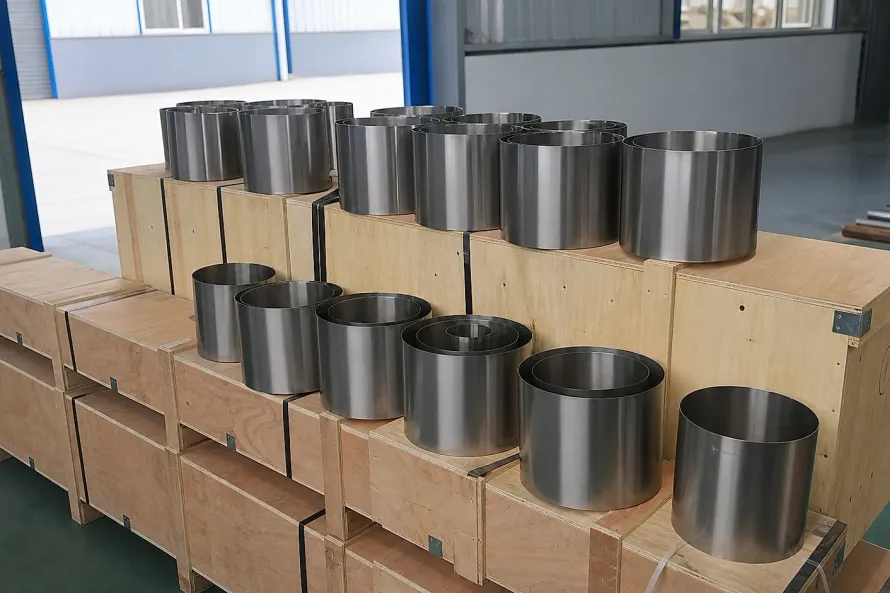
Titanium cylindrical parts staged on export crates, illustrating why AM buyers need batch identity and release data before acceptance.
By Jason/ On 28 Jun, 2026

ISO/ASTM 52951 Turns Titanium AM Buying Into a Data-Package Release Question

A new additive-manufacturing data standard gives titanium buyers a useful signal, but not because it makes any printed titanium part automatically acceptable. The more important change is practical: AM part acceptance is becoming a data-package question. China's national standards portal records ISO/ASTM 52951:2026 as published on 2026-06-24, and ISO lists the standard as Additive manufacturing - Data - Data packages for AM parts. For buyers of titanium components, especially in aerospace, medical, energy, pressure equipment, and precision machinery, that language matters because the risk rarely sits in the alloy name alone. It sits in whether the part can carry a connected record from design intent to release. The standard should not be read as a shortcut to approval. Public catalogue pages do not disclose the full paid standard text, and they do not certify a supplier, part number, machine, powder lot, or customer application. Its value for titanium procurement is different: it clarifies the kind of evidence discipline buyers should expect when AM moves from trial geometry to deliverable part. Why a data package is now part of the product Titanium AM is often sold through words such as lightweight, near-net shape, short lead time, and design freedom. Those words are useful only after the release path is clear. A Ti-6Al-4V bracket, sleeve, housing, implant blank, pressure component, or machined preform is not accepted because the build was successful on a machine. It is accepted because the buyer can connect the material, process, inspection, and exception records to the exact part being shipped. That is the product-hotspot collision created by ISO/ASTM 52951:2026. The news is not that titanium AM suddenly has a universal paperwork form. The news is that the standards system is making the data package more visible as an acceptance object. For buyers, the delivered item is no longer only a geometry plus a material certificate. It is a geometry plus a controlled evidence file. A useful titanium AM data-package-to-release file should connect at least seven layers:Layer Buyer question Release risk if missingDesign basis Which drawing, revision, tolerance set, and functional boundary was built? The record may describe a different design state than the shipped part.Material and feedstock identity Which alloy, powder or wire lot, reuse state, and chemistry basis entered the build? Correct alloy naming can hide uncontrolled feedstock changes.Machine and build record Which machine, parameter set, orientation, nesting, and build ID produced the part? A good test coupon may not represent the delivered geometry.Process monitoring data What in-process signals were collected, retained, reviewed, and linked to the build? Monitoring becomes decoration if exceptions are not tied to release decisions.Post-processing route What heat treatment, HIP, stress relief, machining, finishing, or cleaning followed the build? Mechanical and dimensional evidence can drift from the as-built state.Inspection and imperfection record Which NDT, CT, metrology, surface, and defect-language records apply? Defects may be named without a clear acceptance boundary.Acceptance and change control Who accepted, who conceded, what changed, and what triggers requalification? A shipment can look compliant while carrying unresolved exceptions.Imperfection language is not the same as acceptance The data-package story becomes stronger when read beside adjacent standards. ISO lists ISO/ASTM 52948:2026 for classification of imperfections in powder bed fusion parts. Standards listings also identify ISO/ASTM 52953:2025 for registration of process-monitoring and quality-control data, while ISO/TC 261 lists ISO/ASTM TR 52958:2026 on in-situ coaxial photodiode monitoring for lack-of-fusion flaw generation in metal PBF-LB. For titanium buyers, the practical lesson is that defect vocabulary, monitoring data, and acceptance are related but separate. A supplier may be able to classify an imperfection. A machine may capture process signals. A report may show in-situ monitoring traces. None of that, by itself, answers whether the part is releasable for a pressure boundary, aerospace bracket, medical blank, semiconductor fixture, or high-cycle rotating component. The release decision needs a bridge: which imperfection terms are used, which inspection method can detect them, which limit applies to the part family, which exception was reviewed, and which change would force a new qualification step. Without that bridge, buyers can receive more data without receiving more confidence. What should change in titanium supplier comparison The strongest supplier comparison is no longer "same alloy, same printer type, same price." Two suppliers may both quote Ti-6Al-4V and powder bed fusion, but they can represent very different risk if one can link build records, monitoring data, post-processing, NDT, and concessions into one release package while the other treats those files as separate attachments. That matters in export titanium buying because many orders pass through distributors, machining shops, and application-specific quality teams. When a printed preform is later machined, heat treated, inspected, packed, and documented for cross-border shipment, the AM build record must still remain connected to the final product identity. If the link breaks, the buyer may have a pile of correct documents that no longer describe the same part. The most useful buyer questions are therefore specific:Does the quote define the data package, or only the alloy and geometry? Are build ID, feedstock lot, machine state, post-processing route, and inspection records tied to the shipped serial, lot, or batch? Are imperfection classifications tied to acceptance rules, not only listed as technical vocabulary? Are process-monitoring records reviewed against a release rule, or merely stored? Which change in feedstock, parameter set, build layout, heat treatment, machining, or inspection would require buyer notification or requalification?The buyer framework: data-package-to-release file For titanium products, the reusable framework is simple: do not evaluate AM evidence as a stack of isolated PDFs. Evaluate it as a data-package-to-release file. That file should start with the part boundary: drawing, revision, service condition, and acceptance basis. It should then follow the material into the process: alloy identity, feedstock history, machine state, parameter set, build position, and monitoring record. It should continue after the build through heat treatment, HIP if used, machining allowance, final dimensions, surface condition, NDT or CT evidence, cleaning, packaging, and certificate wording. Finally, it should show exceptions, concessions, and change-control triggers in language the buyer can audit. This framework does not make AM paperwork heavier for its own sake. It prevents the most common procurement mistake: treating the most advanced part of the process as the whole quality story. In titanium AM, the printer is only one stage. The accepted product is created by the connection between build data, post-processing, inspection, and release authority. The clearest conclusion from ISO/ASTM 52951:2026 is therefore cautious but useful. Titanium buyers do not need to wait for every AM standard to settle before improving supplier questions. They can already ask whether a supplier's data package is complete enough to support the exact part, route, inspection boundary, and release decision being quoted. The supplier that can answer that question is offering more than a printed titanium shape. It is offering traceable acceptance evidence.

Ready to Start Your Project?

Get factory-direct pricing on titanium products. No minimum order.

Get a Free Quote
Quick Inquiry