Type something to search...

Titanium delivery evidence

Aerospace and Defense
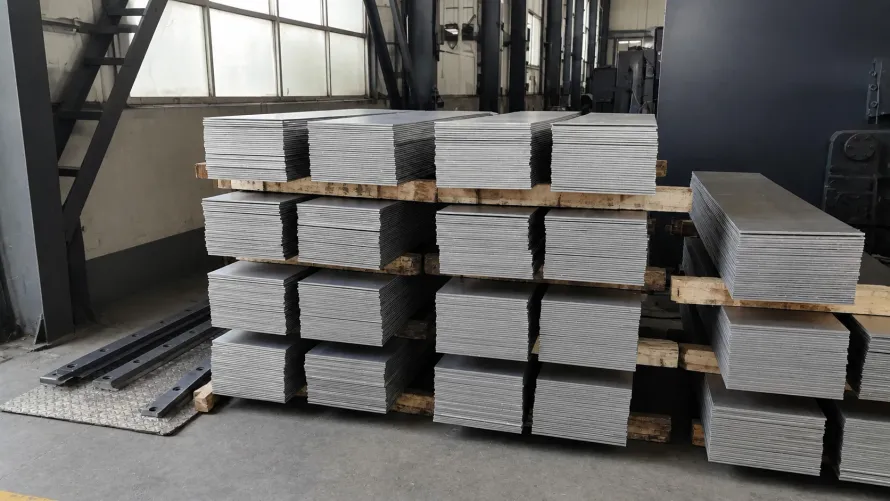
Stacked titanium plates in a workshop, illustrating why aerospace-linked buyers need product-form capacity reserved before release dates are trusted.
By Jason/ On 12 Jun, 2026

Aircraft Backlogs Show Why Titanium Buyers Need a Capacity-Reservation File

The latest aircraft backlog data is not just an airline or airframer story. It is a schedule-risk signal for buyers of aerospace-linked titanium bars, plates, sheets, forgings, billets, tubes and machined components.On June 3, 2026, Aerospace Global News reported that Airbus and Boeing had 16,683 commercial aircraft on backlog at the end of April, citing ADS commercial aerospace market information. ADS estimated that this represented about 12 years of work for the global aerospace industry at current projected production rates. A week later, Forecast International reported that Airbus delivered 81 aircraft during May and Boeing delivered 60, leaving both manufacturers with more than a decade of production coverage. For titanium buyers, the useful conclusion is not that every titanium product is suddenly short. The better conclusion is narrower: when aircraft demand runs far ahead of near-term production, approved titanium capacity becomes a schedule asset. A quote for material is no longer enough. Buyers need evidence that the specific product form, process route, inspection path and release date have been reserved. Backlog Is Not The Same As Released Titanium Capacity Aircraft backlog creates long visibility, but it does not automatically create released titanium parts. Aerospace programs consume titanium through controlled product forms and approved routes. The order book must move through mill products, forgings, machining, special processes, inspection, customer approval, documentation and logistics before it becomes deliverable hardware. That distinction matters because titanium is not a single interchangeable input. ATI's long-term Boeing titanium agreement, announced in 2025, named long products such as ingots, billets, rectangles and bars, as well as flat-rolled products including plate, sheet and coil. Those are different capacity lanes. A buyer waiting for sheet cannot automatically use bar stock. A machined part that requires a forged input cannot be covered by available plate. A near-net-shape preform cannot replace a legacy route unless the application and approval basis allow it. The same discipline applies at the market level. The USGS 2026 titanium summary reported that the majority of U.S. titanium metal use was in aerospace, with other uses including armor, chemical processing, marine hardware, medical implants and power generation. It also reported no U.S. titanium sponge metal production in 2025 and 100% net import reliance for titanium sponge metal. Those facts make titanium structurally important to aerospace supply chains, but they still do not convert aircraft backlog into a product-form guarantee. The buyer risk sits between those two facts: strong aircraft demand on one side, and product-specific release capacity on the other. What Changes For Titanium Procurement When an order book stretches across many years, titanium buyers should stop treating delivery dates as simple calendar promises. A delivery date is only credible if it is backed by a reserved path through the supplier's actual constraint points. For titanium plate, that path may include rolling capacity, thickness range, surface condition, ultrasonic inspection, flatness control, cutting and packaging. For bar and billet, it may include melt history, heat treatment, straightness, diameter tolerance, machining allowance, testing and certificate wording. For forgings and machined components, it may include input material identity, die or route availability, rough machining, final machining, NDT, dimensional evidence, first article status and customer-specific release rules.The most common procurement mistake is to ask only whether the supplier has material. In a tight aerospace cycle, the sharper question is whether the supplier has reserved the right combination of material, process capacity, inspection capacity and documentation capacity for the buyer's part. That is especially important for distributors and export buyers. A distributor may show available titanium stock, but the buyer still needs to know whether the stock is eligible for the required specification, whether it can be cut or machined in time, whether third-party testing is available, whether certificates match the program's wording, and whether the route can survive customer review. A processor may quote a forged blank, but the buyer still needs to know whether heat treatment and ultrasonic inspection are reserved, not merely available in theory. The Capacity-Reservation File The practical response is a capacity-reservation file. It should sit beside the purchase order, drawing package and material certificate. Its purpose is to connect the commercial promise to the operational path that makes the titanium product releasable.Evidence layer Buyer question Records to requestProduct form What exact titanium form is being reserved? Bar, billet, plate, sheet, tube, forging, preform or machined component description; grade; size range; specification basisApproved route Which route is allowed for this application? Melt or mill route, forging or machining route, customer approval boundary, substitute-route limitsCapacity owner Who controls the constrained step? Mill, forge, processor, heat treater, machining shop, NDT provider, packer or exporterSchedule hold Which dates are actually reserved? Production slot, heat treatment date, inspection window, document review, packing date and shipment handoffInspection release What proves the product can leave the supplier? Mechanical test, chemistry, UT or other NDT, dimensional report, surface inspection and nonconformance closureDocumentation package What will the buyer receive with the shipment? MTR, certificate of conformity, traceability record, packing list, export documents and customer-specific wordingChange trigger What forces re-approval or schedule reset? New input lot, route change, subcontractor change, inspection method change, drawing revision or late split shipmentFallback boundary What is the approved alternative if capacity slips? Alternate size, alternate source, partial release, substitute product form or requalification requirementThis file is not bureaucracy for its own sake. It prevents a visible stock photo, a broad aerospace claim or a generic certificate from being mistaken for a controlled delivery path. Available Stock Can Still Miss The Aircraft Clock The June data shows why this matters. Airbus' own orders and deliveries page listed 81 May deliveries, 379 May gross orders and 262 deliveries for 2026 to date. Forecast International's May analysis put Airbus backlog at 9,247 aircraft and Boeing backlog at 6,758 aircraft as of May 31. Those figures point to demand visibility, but also to a production system where monthly execution still matters. For titanium suppliers, that means capacity credibility is becoming a sales and quality issue at the same time. A supplier that can show reserved process slots, clear inspection ownership and stable certificate wording may be easier for a buyer to trust than a supplier with larger generic inventory but vague release control. For buyers, the opposite is also true. A low price or quick verbal promise can become expensive if the order waits behind heat treatment, NDT, machining, customer review or export documentation. The risk is not always that titanium is unavailable. The risk is that releasable titanium is not available in the required form, route and window. Alternative Routes Need The Same Discipline Aircraft backlog also encourages buyers to consider alternative sourcing routes: near-net-shape preforms, additive manufacturing, different mill sources, distributor stock, split shipments or partial machining before final approval. Some of these routes can reduce waste or shorten one step. None should be treated as a shortcut around evidence. If a forged block is replaced by a near-net-shape preform, the buyer needs to know the approved baseline, material data, inspection method, machining allowance and customer acceptance boundary. If distributor stock is substituted for planned mill material, the buyer needs traceability, age, surface condition, test coverage and certificate wording. If a supplier proposes a different approved source, the buyer needs to know whether the source is approved for the exact product family and application, not only for titanium in general. Backlog pressure rewards flexibility, but only controlled flexibility. The Buyer Takeaway The aircraft market is sending a clear signal: demand visibility is strong, but delivery execution remains the hard part. For titanium products, that shifts the buyer's best question from "Do you have material?" to "What capacity has been reserved for my approved route?" A professional answer should connect the product form, route, capacity owner, schedule hold, inspection release, document package, change trigger and fallback boundary. Without that file, the buyer has a quote. With it, the buyer has a verifiable delivery path. That is the practical meaning of the current backlog for titanium procurement. The aircraft order book is long. The titanium evidence file has to be specific.

Ready to Start Your Project?

Get factory-direct pricing on titanium products. No minimum order.

Get a Free Quote
Quick Inquiry