Type something to search...

Titanium substitution envelope

Manufacturing and Technology
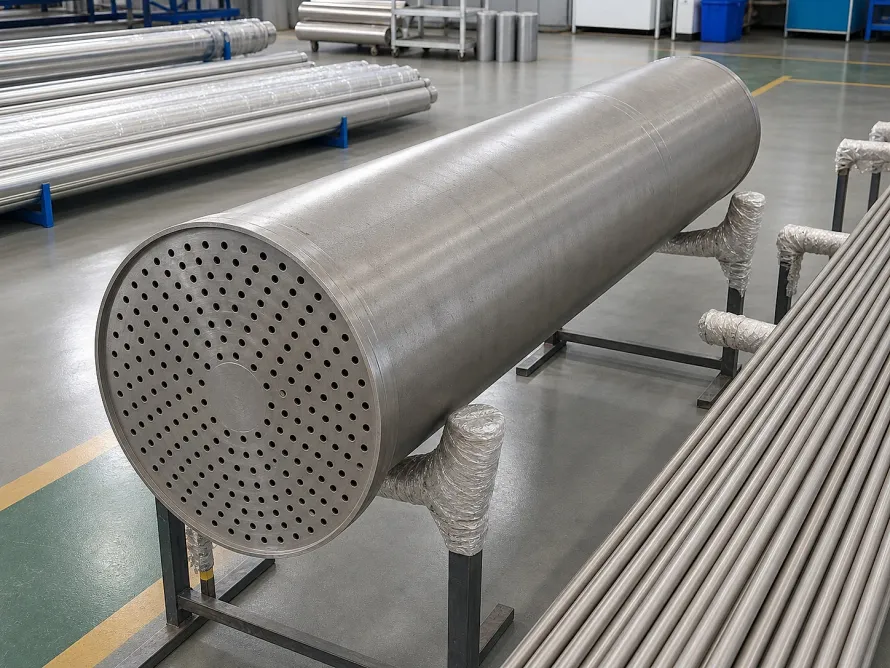
Titanium tube-sheet and heat-exchanger component in a clean workshop, showing why service environment and release evidence matter when buyers compare steel AM and titanium routes
By Jason/ On 22 Jun, 2026

SSAB's Steel AM Powder Pushes Titanium Buyers to Define the Substitution Envelope

SSAB's early-June move into commercial-scale additive-manufacturing steel powder is not a titanium story on its face. The Swedish steelmaker said on June 3, 2026 that it will expand its Oxelosund powder facility, with production planned to ramp up from the first quarter of 2028 and capacity targeted at about 350 tonnes per year. On June 15, it also introduced Armox 500 AM Powder, a protection-grade steel powder presented at Eurosatory for geometry-driven armor components.For titanium buyers, the development matters for a narrower reason. High-strength steel powder gives engineers another route for complex, weight-conscious, protective or structural parts. It does not erase titanium's role in aerospace, chemical processing, marine hardware, power generation, medical implants, or other severe-service uses. It does make one procurement question harder to avoid: where exactly does titanium remain the right material, and what evidence proves that boundary? That question is more useful than asking whether steel additive manufacturing will "replace" titanium. Replacement language is too broad. A buyer approving a pipe spool, tube sheet, sensor housing, bracket, machined sleeve, fastener, implant component, or pressure-boundary part does not buy a metal category in the abstract. The buyer accepts a material, geometry, process route, inspection package, service environment, and release rule together. What Changed In The Adjacent Market SSAB's official release says the Oxelosund expansion is intended to support commercial-scale additive-manufacturing steel powder output. The company describes AM as moving beyond prototypes and spare parts toward a production complement in defense, automotive, and engineering. A related SMS group announcement says the new gas atomization plant is designed for clean, spherical powders and reproducible output at industrial scale. The Armox 500 AM launch adds the application signal. SSAB says the powder is intended for protective structures where conventional armor plate is not optimal, including housings, hinges, external equipment protection, lattice or honeycomb structures, and components that benefit from design-for-additive-manufacturing freedom. Metal AM Magazine's June 17 coverage framed the launch around armor applications and the move from plate limitations toward geometry-enabled protection. That is a real product-development signal. It means advanced steel suppliers are not only selling plate, bar, and fabricated components; they are also trying to shift some applications into powder, geometry, and local or flexible production. Titanium suppliers and buyers should read that as a competitive route signal, not a direct material verdict. Why It Touches Titanium Product Decisions Titanium's commercial value has never depended on being the strongest metal in every comparison. It is used where the combination of strength-to-weight ratio, corrosion resistance, thermal stability, compatibility requirements, fatigue behavior, process history, and approved release evidence fits the job. USGS's 2026 titanium summary lists titanium metal uses across aerospace, armor, chemical processing, marine hardware, medical implants, power generation, and other applications; those fields do not all value the same property. That is why high-strength steel AM creates a substitution-envelope question. In a protected vehicle external housing, the engineering problem may prioritize ballistic behavior, geometry, cost, lead time, and repairability. In a heat exchanger, chloride-containing chemical service may push the decision toward corrosion and cleanliness evidence. In a medical or aerospace component, the buyer may care less about the headline material family than about validated process history, traceable lots, inspection route, and change control.The more capable AM steel becomes, the less persuasive a generic titanium claim becomes. "Grade 5 titanium is light" is not a release argument. "This tube, plate, machined component, or forged blank meets the service envelope, inspection route, documentation requirement, and change-control rule for the buyer's application" is closer to an answer. The Substitution-Envelope File A substitution-envelope file is a buyer framework for deciding whether titanium, high-strength steel AM, aluminum, nickel alloy, stainless steel, or another route can carry the same functional responsibility. It should not be a marketing comparison chart. It should be an evidence file.Envelope Question Why It Matters Evidence To Ask ForFunction and failure mode A protective housing, pressure part, tube sheet, implant interface, and machined bracket fail in different ways. Load case, damage mode, geometry boundary, design assumption, and allowed repair or replacement rule.Service environment Titanium often earns its place through corrosion, temperature, cleanliness, biocompatibility, or weight limits rather than raw strength alone. Media chemistry, temperature range, galvanic contact, fatigue exposure, cleanliness requirement, or regulatory boundary.Manufacturing route AM steel powder, wrought titanium, forged titanium, machined bar, and welded tube assemblies carry different process risks. Feedstock identity, route map, heat treatment or post-processing, machining allowance, surface condition, and change log.Inspection and testing The route is not released until the buyer can verify the part actually meets the required condition. Dimensional report, NDT method, chemistry and mechanical test record, pressure or leak evidence, surface inspection, and lot traceability.Release boundary A successful demonstration, supplier capability, or material datasheet is not the same as acceptance for a specific shipped part. MTR or MTC, certificate wording, customer approval status, revision control, packaging condition, and nonconformance rule.This framework keeps the steel news useful without overreading it. SSAB's announcement can show that AM steel is moving toward more serious applications. It cannot prove that a titanium tube sheet, marine fitting, aerospace machined part, or medical component should be redesigned. That decision belongs inside the envelope. What Titanium Suppliers Should Change In Their Evidence Titanium suppliers do not need to answer every competing-material announcement with a claim that titanium is superior. The better response is to make the buyer's decision easier to audit. For mill products, that means tying grade, melt route, product form, dimensional tolerance, surface condition, inspection, and certificate language to the exact application boundary. For machined components, it means preserving the chain from bar, plate, forging, or tube into machining route, drawing revision, inspection result, and packaging. For welded or pressure-related products, the file needs weld procedure, shielding and cleanliness control, NDT, pressure or leak evidence, and post-work handling. For titanium additive manufacturing or powder-metallurgy routes, the burden is even closer to the SSAB signal. Buyers should separate powder quality from printed-part release. Powder morphology, flowability, chemistry, oxygen control, reuse rule, machine parameters, heat treatment, surface finishing, inspection, and final certificate language all sit inside the release boundary.The main commercial risk is not that buyers suddenly abandon titanium. It is that buyers compare material options using incomplete files. A high-strength steel AM route may look attractive on geometry and lead time, while a titanium route may win on corrosion, mass, service history, or approval continuity. Without a shared evidence structure, the comparison becomes a price quote against a datasheet. The Defensible Conclusion SSAB's powder expansion and Armox 500 AM launch show that high-performance material competition is becoming more route-specific. Steel, titanium, aluminum, and nickel alloys will not compete only as generic material families. They will compete as approved combinations of material, process, geometry, inspection, delivery, and release evidence. For titanium buyers, the practical answer is to define the substitution envelope before asking for quotes. If the part's value depends on corrosion resistance, low mass, validated service history, biocompatibility, heat exposure, or a customer-approved titanium route, the evidence file should say so. If the same function can be carried by high-strength steel AM or another route, the buyer should require equivalent proof, not just a lower unit price or a faster lead-time claim. The strongest titanium suppliers will not treat competing-material news as a threat to dismiss. They will use it to sharpen the release file: what the product is, how it was made, where it can serve, what was inspected, and where substitution stops.

Ready to Start Your Project?

Get factory-direct pricing on titanium products. No minimum order.

Get a Free Quote
Quick Inquiry