Type something to search...

Defense titanium

Aerospace and Defense
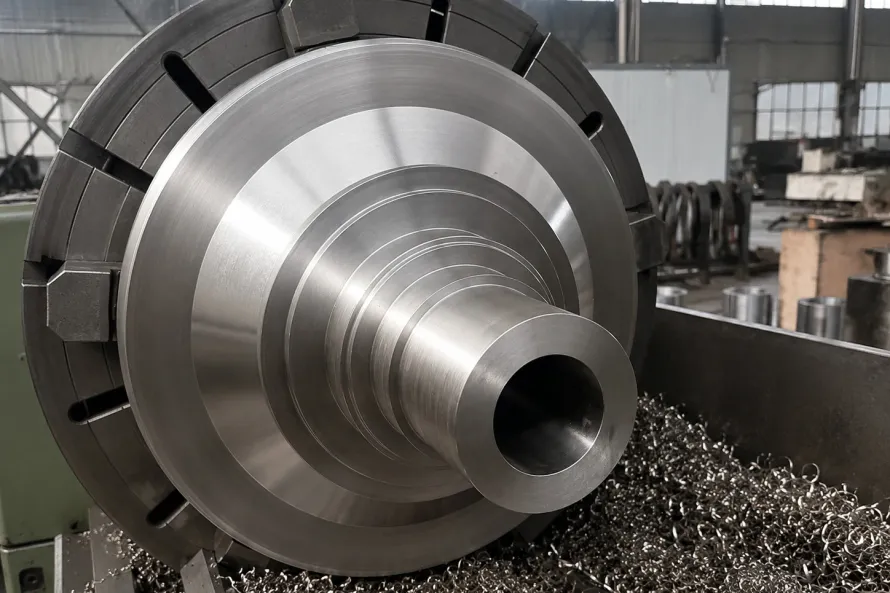
Large machined titanium component on a lathe, illustrating why submarine-adjacent parts need mission-envelope qualification evidence.
By Jason/ On 13 Jun, 2026

Norsk's Submarine Contract Shows Why Titanium Buyers Need a Mission-Envelope File

The latest titanium additive-manufacturing contract is not only a supplier-development story. It is a reminder that submarine-adjacent titanium parts cannot be judged by alloy grade, production route or supplier credential alone. They need evidence that the part fits the mission environment it is expected to survive.On June 11, 2026, Norsk Titanium announced that it had received nearly $4.2 million in a contract investment from the Office of the Assistant Secretary of War for Industrial Base Policy in support of the Defense Industrial Base Expansion, Development, and Growth Enterprise, known as DIB-EDGE. The announcement says DIB-EDGE is focused on next-generation manufacturing capabilities for U.S. maritime and submarine industrial capacity, and that the investment funds Rapid Plasma Deposition, or RPD, development over the 18-month term of the contract. That is a strong signal for titanium buyers, but it is also easy to read too broadly. The announcement does not identify the exact submarine components, alloy grades, acceptance standards or production volumes. The useful buyer conclusion is narrower: when titanium moves toward submarine and maritime work, the evidence file must expand from "qualified process" to "qualified mission envelope." Submarine Work Changes The Qualification Question Titanium is attractive in marine and defense applications because it can combine strength, corrosion resistance and weight reduction. But a submarine environment changes the approval question. A part may need to survive seawater exposure, pressure-related loading, vibration, fatigue, shock, galvanic interfaces, restricted inspection access, long maintenance intervals and strict configuration control. For a buyer, that means the first question is not simply whether the supplier can make a titanium part. It is whether the product form and process route have been qualified for the specific duty that the part will see. A machined titanium fitting, a forged or near-net-shape preform, a tube assembly and a structural bracket do not carry the same evidence burden. One part may be judged by dimensional repeatability and fatigue behavior. Another may need corrosion exposure data, weld or joining evidence, pressure-boundary review, non-destructive examination and installation-interface control. A third may be acceptable in one location but not in a more critical area of the vessel. This is why the phrase "highly critical applications" matters. It does not remove the need for proof. It raises the standard for proof. Qualification Is Not One Credential Norsk's recent announcements show how layered qualification has become. On May 29, 2026, the company announced Nadcap accreditation for additive manufacturing at its Plattsburgh operations. That matters because Nadcap is a special-process accreditation path used by aerospace and defense supply chains to evaluate process control, repeatability and traceability. But Nadcap is not the same as part release. It can reduce the audit burden and improve confidence in the manufacturing system, but the buyer still has to connect the credential to the part number, product form, route, drawing, inspection plan, environmental exposure and approval authority. The same lesson appears in a different market. On June 2, 2026, Norsk and Airbus announced a cooperation and research agreement to industrialize and qualify RPD for high-criticality structural titanium parts. That work includes titanium wire qualification, process validation and standardization. The details are aerospace-specific, but the discipline is transferable: a route becomes useful to buyers only when material input, process controls, inspection basis and application boundary are tied together. Norsk also states that it has 700 MT of production capacity and that RPD printed parts are already flying on commercial aircraft. Those facts show industrial maturity. They do not, by themselves, answer whether a specific titanium part is ready for a submarine mission envelope. The Mission-Envelope File The practical response is a mission-envelope qualification file. This is not a replacement for drawings, purchase orders, material certificates or customer approval. It is the bridge that shows why those records are valid for the operating environment.Evidence layer Buyer question Records to requestMission boundary Where will the titanium part operate? Vessel area, criticality level, pressure or load role, exposure condition, maintenance interval and approval authorityMaterial form What physical form is being qualified? Wire-fed preform, billet, forging, plate, tube, fitting or machined component; alloy grade; heat or lot identityRoute lock Which route is allowed for this part? RPD route, forging route, machining route, heat treatment, surface treatment, joining route and subcontractor boundaryEnvironment evidence What proves the part fits the service condition? Corrosion, fatigue, vibration, shock, pressure, temperature, galvanic or fluid-compatibility evidence as applicableInspection release What inspection proves the part can ship? Dimensional report, NDT, surface inspection, material testing, defect acceptance criteria and nonconformance closureInterface control What must match the surrounding system? Drawing revision, mating geometry, bolt pattern, tube or pipe interface, sealing face, assembly clearance and installation torque where relevantSustainment path How will the part be repaired or replaced? Spare route, approved local manufacturing rules, technical-data transfer, maintenance release and change historyChange trigger What forces re-review? New lot, feedstock change, machine change, parameter change, route substitution, inspection method change or design revisionThe file forces a disciplined distinction. A supplier may have process capability. A part may have material traceability. A buyer may have a delivery schedule. None of those alone proves that the product fits the mission envelope. What Titanium Buyers Should Ask Now For titanium buyers outside prime defense programs, the lesson is still useful. Export distributors, marine-equipment buyers, energy-equipment purchasers and precision-machining customers often receive broad claims about aerospace or defense readiness. Those claims may be relevant, but they need to be translated into part-level evidence. For a machined titanium component, ask whether the input form, machining allowance, heat treatment, surface condition, dimensional tolerances, NDT and certificate wording are linked to the actual application. For a titanium tube or fitting, ask whether the wall, bend, end connection, weld or joining boundary, surface finish, pressure role and corrosion exposure are all inside the approved route. For a near-net-shape preform, ask whether the buyer is approving the preform route, the finished geometry, or both.The question becomes sharper when a supplier proposes an alternative route. If a part was historically forged and machined, a wire-fed preform may reduce waste or lead time. But the buyer still needs a bridge between the legacy route and the new route: material input, process envelope, heat treatment response, inspection method, defect population, machining stock, surface condition and approval boundary. That bridge should be written before the purchase order becomes a schedule problem. Maritime AM Context Is Moving, But It Does Not Remove The Gate The maritime context around this story is also moving. In the June 2026 Australia-UK Ministerial Consultations statement, ministers said the UK submarine HMS Anson completed a scheduled maintenance period in Western Australia, the first such maintenance period by a UK nuclear-powered submarine in Australia. The statement said 17 Australian businesses supported the activity, 34 locally manufactured components were produced, more than 2,500 person hours of Australian industry work were completed, and 620 hours of trilateral uniformed work supported the maintenance period. USNI News also reported that QinetiQ supported the HMS Anson maintenance period with additive-manufactured replacement parts delivered in 4 weeks after approval by the UK Submarine Delivery Group Additive Manufacturing Team. That is not a titanium-specific case, and it should not be read as one. Its value is in the workflow: reverse engineering, secure technical-data transfer, local manufacturing, approval by the responsible authority and installation during a controlled maintenance event. For titanium products, that workflow points to the same conclusion as the Norsk contract. Speed is useful only when it remains inside the approval chain. Local manufacturing is useful only when the technical data, route, inspection and configuration records remain intact. Additive manufacturing is useful only when the mission envelope is proven, not assumed. The Buyer Takeaway The June 11 contract is a strong signal that titanium AM is moving deeper into maritime and submarine industrial-base conversations. But the buyer value is not a headline about "submarine titanium." The buyer value is a better question: what evidence proves this titanium part fits its mission envelope? The answer should connect material form, route lock, environmental evidence, inspection release, interface control, sustainment path and change triggers. Without that file, a supplier credential can be mistaken for part approval. With it, the buyer can separate manufacturing capability from mission-ready release. That distinction is where professional titanium procurement now has to live.

Aerospace and Defense
F-35 April 2026 Three Actions: FY27 Budget for 85 Jets + $177M Test-Aircraft Contract + Israel Order → US Military Titanium Forging Demand Stretches, Hitting the 2028-2029 Domestic Forging Capacity Window
By Jason/ On 04 May, 2026

F-35 April 2026 Three Actions: FY27 Budget for 85 Jets + $177M Test-Aircraft Contract + Israel Order → US Military Titanium Forging Demand Stretches, Hitting the 2028-2029 Domestic Forging Capacity Window

Three F-35 Actions in April 2026 In April 2026 the US Department of Defense and its allies moved heavily on the F-35 program:April 6 — Pentagon submits its FY27 defense budget request, seeking 85 F-35s: 38 F-35A (Air Force), 10 F-35B (Marine Corps), and 37 F-35C (Navy) April 23 — Pentagon and Lockheed Martin sign a $177M contract modification for three F-35 flight-science test aircraft, covering all three variants F-35A/B/C, completion April 2031 April 29 — The Israeli cabinet approves a multi-billion-dollar acquisition deal covering new F-35s and F-15IsComputing buy-weight 15-20 mt × forging fraction 30-50% per aircraft: the 85-jet FY27 budget request pulls a theoretical 380-850 mt of titanium forgings (multi-year delivery, annualized roughly 80-280 mt/year over 3-5 years); the 3 test aircraft add another 15-30 mt of direct forging demand. Allied orders contribute volume on the single-digit hundreds of metric tons order of magnitude. Single Contracts Look Modest — Cadence Is the Story US annual military titanium forging demand sits at roughly 2,000-2,500 tons; the F-35 program runs about 35-40% of that (per-airframe titanium forging content roughly 2.7-3.6 tons, current build rate about 150-180 airframes/year). The signal in three contracts within one week isn't the size of any single block, it's:NGAD / B-21 / F-47 mainline programs are not yet in batch production F-35 remains the workhorse of US military titanium forging demand through 2026-2028 Allied procurement (Israel, Singapore and others) is accelerating, keeping the F-35 line at sustained high tempoThis holds the US military titanium forging demand curve on its high plateau through 2026-2028, instead of dipping under the early "NGAD picks up where F-35 leaves off" assumption.What It Hits: The US Domestic Forging Commissioning Window US military titanium large-part forging capacity concentrates at three mills: TIMET (PCC), ATI Specialty Alloys, and Howmet Aerospace. Combined: 5-7 heavy hydraulic presses at 35,000 tons or larger, carrying the bulk of military titanium primary structure forgings. Expansion and upgrade announcements rolling out across 2024-2026 (including the RTX-led forging expansion deal and Howmet's repeated capacity announcements) commission almost entirely in 2028-2029. That timing is not an accident — heavy presses at 35,000 tons or above run 36-48 months from order to commissioning, with forging dies, supporting vacuum furnaces and alloy machining lines on a parallel 24-36 month build. So 2026-2028 is the US military titanium forging capacity gap window: new capacity not online, existing capacity already loaded up by in-service programs. What the Window Looks Like in Practice: Three Transmission Chains First, military lead times stretch. End-to-end forging-to-delivery on F-35 critical large parts (integral center bulkhead, landing-gear fittings) ran roughly 14-18 months in 2024 and is expected to run 18-24 months from 2026 onward. Lockheed Martin and Pratt & Whitney have flagged the corresponding risk in annual reports. Second, commercial aerospace Tier 2/3 titanium forging spillover. With domestic heavy press capacity prioritizing military programs, subcontracted titanium structural parts on Boeing 787 / 777X and Airbus A350 / A321XLR (especially secondary primary structure, fuselage doublers, flap linkages) shift more volume to European mills (Aubert & Duval), Japan (Kobe Steel forgings, Toho Titanium-affiliated forging) and qualified third parties. Third, chemical / marine / medical titanium forging prices face upward pressure. This is the second-order effect of commercial Tier 2/3 spillover — as Tier-1 certified shops are blocked by aerospace, non-aerospace high-compliance demand (chemical reactor titanium forgings, desalination heat-exchanger titanium tube-sheet forgings, large medical-implant titanium forgings) competes for residual capacity, with price elasticity moving up. Specific magnitudes vary by region, specification, and customer type — worth tracking actual Q2-Q3 shipment-end quotes.The Window for Chinese and Asian Titanium Forging Suppliers The military mainline aerospace channel is closed to China — no point romanticizing it. But the chemical, marine, medical, and commercial aerospace non-critical windows are opening:Chemical reactors and desalination heat-exchanger titanium tubing / tube-sheet procurement in the West sees upward order elasticity for qualified Chinese mills through 2026-2027 Medical implants on the ASTM F136 / ISO 13485 route are stable. The F-35 event doesn't directly touch them, but capacity crowd-out pushes some Western medical OEMs to look harder for supplemental supply Tier 2/3 commercial aerospace non-critical parts can flow to Chinese mills with AS9100 in hand — Baoti, Western Superconducting, Xiangtou Goldsky, Beijing Non-Ferrous and othersTitanium Seller offers Gr.5 (Ti-6Al-4V) titanium bar and forging billet, Gr.2 commercially pure titanium, titanium tube and plate, and contract machining services, covering ASTM B265/B348/B381/F136 across the certification map. The focus is chemical, marine, medical and commercial aerospace Tier 2/3 — no military involvement. Three Signals to Watch Worth tracking on the procurement, trade, and production sides:Howmet / TIMET / ATI 2026 Q2 reports — titanium business backlog year-on-year growth, the cleanest read on whether military pull-through is being booked DPA Title III 2026-2027 funding cadence for forging expansions — the Defense Production Act is the primary federal funding channel for US military titanium capacity build-out, and the disbursement timing decides whether 2028-2029 commissioning lands on schedule US sponge titanium import data (USGS / customs monthly) — if Japan-to-US sponge exports run +15% year-on-year or higher in 1H 2026, military titanium shortage is propagating upstream into spongeRelated Products & ServicesGr.5 (Ti-6Al-4V) Titanium Bar and Forging Billet — full ASTM B348 / B381 coverage Gr.23 (Ti-6Al-4V ELI) Medical Titanium — ASTM F136 / ISO 13485 route Titanium Tube, Plate and Tube-Sheet — chemical, marine, heat exchangers Contract Forging and Machining Services — Tier 2/3 non-military fast-slot booking Titanium Industry News — continuous tracking of US military titanium forging supply-demand dynamics

Ready to Start Your Project?

Get factory-direct pricing on titanium products. No minimum order.

Get a Free Quote
Quick Inquiry