F-35 April 2026 Three Actions: FY27 Budget for 85 Jets + $177M Test-Aircraft Contract + Israel Order → US Military Titanium Forging Demand Stretches, Hitting the 2028-2029 Domestic Forging Capacity Window
Three F-35 Actions in April 2026
In April 2026 the US Department of Defense and its allies moved heavily on the F-35 program:
- April 6 — Pentagon submits its FY27 defense budget request, seeking 85 F-35s: 38 F-35A (Air Force), 10 F-35B (Marine Corps), and 37 F-35C (Navy)
- April 23 — Pentagon and Lockheed Martin sign a $177M contract modification for three F-35 flight-science test aircraft, covering all three variants F-35A/B/C, completion April 2031
- April 29 — The Israeli cabinet approves a multi-billion-dollar acquisition deal covering new F-35s and F-15Is
Computing buy-weight 15-20 mt × forging fraction 30-50% per aircraft: the 85-jet FY27 budget request pulls a theoretical 380-850 mt of titanium forgings (multi-year delivery, annualized roughly 80-280 mt/year over 3-5 years); the 3 test aircraft add another 15-30 mt of direct forging demand. Allied orders contribute volume on the single-digit hundreds of metric tons order of magnitude.
Single Contracts Look Modest — Cadence Is the Story
US annual military titanium forging demand sits at roughly 2,000-2,500 tons; the F-35 program runs about 35-40% of that (per-airframe titanium forging content roughly 2.7-3.6 tons, current build rate about 150-180 airframes/year). The signal in three contracts within one week isn’t the size of any single block, it’s:
- NGAD / B-21 / F-47 mainline programs are not yet in batch production
- F-35 remains the workhorse of US military titanium forging demand through 2026-2028
- Allied procurement (Israel, Singapore and others) is accelerating, keeping the F-35 line at sustained high tempo
This holds the US military titanium forging demand curve on its high plateau through 2026-2028, instead of dipping under the early “NGAD picks up where F-35 leaves off” assumption.
What It Hits: The US Domestic Forging Commissioning Window
US military titanium large-part forging capacity concentrates at three mills: TIMET (PCC), ATI Specialty Alloys, and Howmet Aerospace. Combined: 5-7 heavy hydraulic presses at 35,000 tons or larger, carrying the bulk of military titanium primary structure forgings.
Expansion and upgrade announcements rolling out across 2024-2026 (including the RTX-led forging expansion deal and Howmet’s repeated capacity announcements) commission almost entirely in 2028-2029. That timing is not an accident — heavy presses at 35,000 tons or above run 36-48 months from order to commissioning, with forging dies, supporting vacuum furnaces and alloy machining lines on a parallel 24-36 month build.
So 2026-2028 is the US military titanium forging capacity gap window: new capacity not online, existing capacity already loaded up by in-service programs.
What the Window Looks Like in Practice: Three Transmission Chains
First, military lead times stretch. End-to-end forging-to-delivery on F-35 critical large parts (integral center bulkhead, landing-gear fittings) ran roughly 14-18 months in 2024 and is expected to run 18-24 months from 2026 onward. Lockheed Martin and Pratt & Whitney have flagged the corresponding risk in annual reports.
Second, commercial aerospace Tier 2/3 titanium forging spillover. With domestic heavy press capacity prioritizing military programs, subcontracted titanium structural parts on Boeing 787 / 777X and Airbus A350 / A321XLR (especially secondary primary structure, fuselage doublers, flap linkages) shift more volume to European mills (Aubert & Duval), Japan (Kobe Steel forgings, Toho Titanium-affiliated forging) and qualified third parties.
Third, chemical / marine / medical titanium forging prices face upward pressure. This is the second-order effect of commercial Tier 2/3 spillover — as Tier-1 certified shops are blocked by aerospace, non-aerospace high-compliance demand (chemical reactor titanium forgings, desalination heat-exchanger titanium tube-sheet forgings, large medical-implant titanium forgings) competes for residual capacity, with price elasticity moving up. Specific magnitudes vary by region, specification, and customer type — worth tracking actual Q2-Q3 shipment-end quotes.
The Window for Chinese and Asian Titanium Forging Suppliers
The military mainline aerospace channel is closed to China — no point romanticizing it. But the chemical, marine, medical, and commercial aerospace non-critical windows are opening:
- Chemical reactors and desalination heat-exchanger titanium tubing / tube-sheet procurement in the West sees upward order elasticity for qualified Chinese mills through 2026-2027
- Medical implants on the ASTM F136 / ISO 13485 route are stable. The F-35 event doesn’t directly touch them, but capacity crowd-out pushes some Western medical OEMs to look harder for supplemental supply
- Tier 2/3 commercial aerospace non-critical parts can flow to Chinese mills with AS9100 in hand — Baoti, Western Superconducting, Xiangtou Goldsky, Beijing Non-Ferrous and others
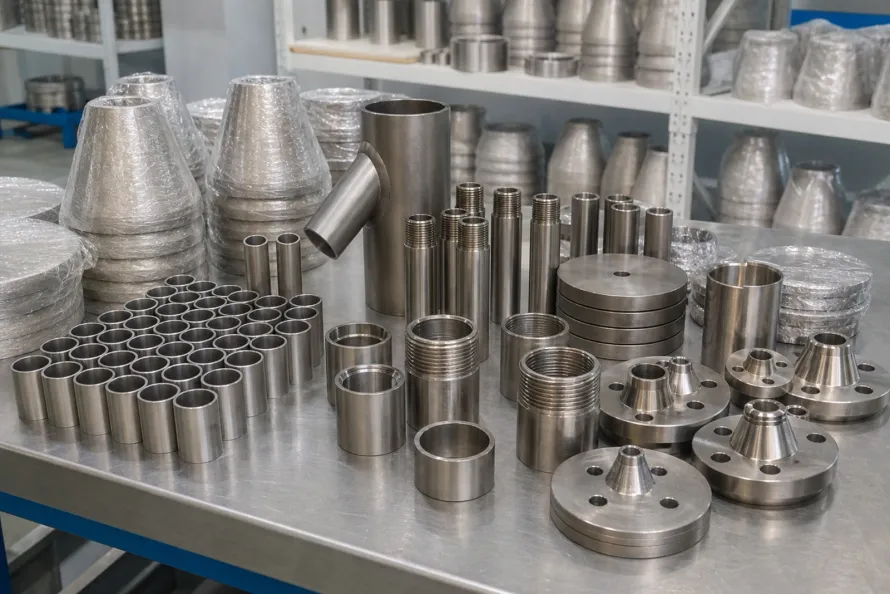
Titanium Seller offers Gr.5 (Ti-6Al-4V) titanium bar and forging billet, Gr.2 commercially pure titanium, titanium tube and plate, and contract machining services, covering ASTM B265/B348/B381/F136 across the certification map. The focus is chemical, marine, medical and commercial aerospace Tier 2/3 — no military involvement.
Three Signals to Watch
Worth tracking on the procurement, trade, and production sides:
- Howmet / TIMET / ATI 2026 Q2 reports — titanium business backlog year-on-year growth, the cleanest read on whether military pull-through is being booked
- DPA Title III 2026-2027 funding cadence for forging expansions — the Defense Production Act is the primary federal funding channel for US military titanium capacity build-out, and the disbursement timing decides whether 2028-2029 commissioning lands on schedule
- US sponge titanium import data (USGS / customs monthly) — if Japan-to-US sponge exports run +15% year-on-year or higher in 1H 2026, military titanium shortage is propagating upstream into sponge
Related Products & Services
- Gr.5 (Ti-6Al-4V) Titanium Bar and Forging Billet — full ASTM B348 / B381 coverage
- Gr.23 (Ti-6Al-4V ELI) Medical Titanium — ASTM F136 / ISO 13485 route
- Titanium Tube, Plate and Tube-Sheet — chemical, marine, heat exchangers
- Contract Forging and Machining Services — Tier 2/3 non-military fast-slot booking
- Titanium Industry News — continuous tracking of US military titanium forging supply-demand dynamics
FAQ
# How much titanium per F-35? How much demand pull from April?
# Does the F-35 use mostly Ti-6Al-4V or other grades?
# What is the state of US domestic titanium forging capacity, and why is 2028-2029 a watershed?
# What's the US localization rate for military titanium forgings? Where does sponge come from?
# What does this mean for Chinese / Asian titanium forging exports?
# What signals should buyers watch?
Need this material? Get a factory-direct quote.