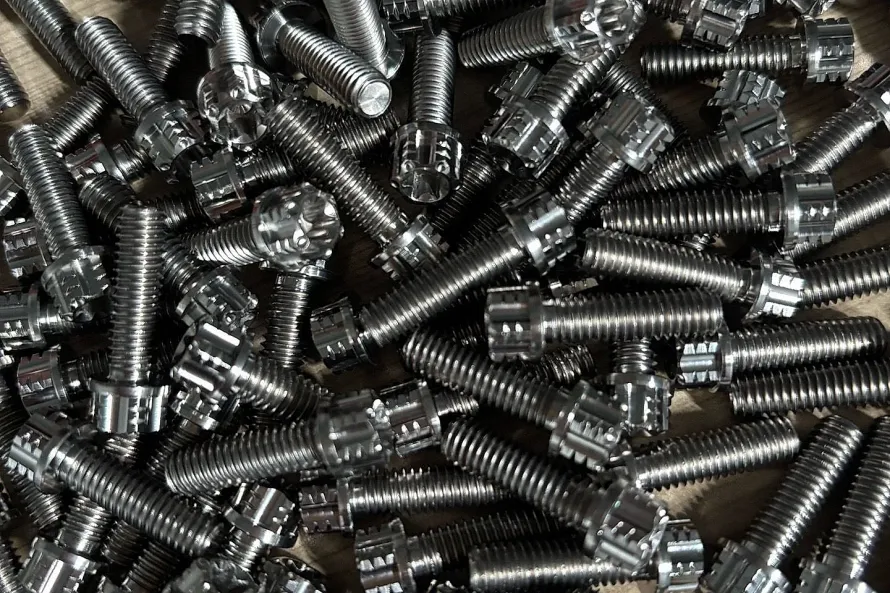
Quick Answer: Never assemble dry, bare titanium-on-titanium threaded joints at full clamp load. To eliminate thread galling on Grade 5 titanium bolts and nuts, combine rolled (not cut) threads, a dedicated anti-galling barrier (MoS₂ dry-film lubricant, PTFE coating, AMS 2488 Type II gray anodizing, or copper-free anti-seize), and adjust your tightening torque to the true lubricated nut factor (K = 0.12–0.16 instead of dry K = 0.28–0.35) so you hit 65–75% of proof load without snapping the shank.
Thread seizure (galling) is the #1 field complaint when motorsport, marine, robotics, and chemical plant engineers switch from 12.9 alloy steel or 316 stainless hardware to Grade 5 (Ti-6Al-4V) fasteners. Using a steel dry-torque chart on a lubricated titanium bolt routinely overloads the bolt by 40%+.
1. Anti-Galling Surface Treatments & Nut Factor (K-Factor) Matrix
Using the standard preload equation T = K × D × F (where T is torque, D is nominal diameter, and F is target clamp preload), the coating or lubricant you choose directly dictates safe tightening torque:
| Surface Treatment / Lubricant | Typical Nut Factor (K) | Anti-Galling Protection | Service Temp Limit | Best Engineering Fit |
|---|---|---|---|---|
| Bare Dry Ti-on-Ti (Not Recommended) | 0.28 – 0.38+ (erratic) | Poor — high seizure risk | N/A | Avoid for structural clamp loads |
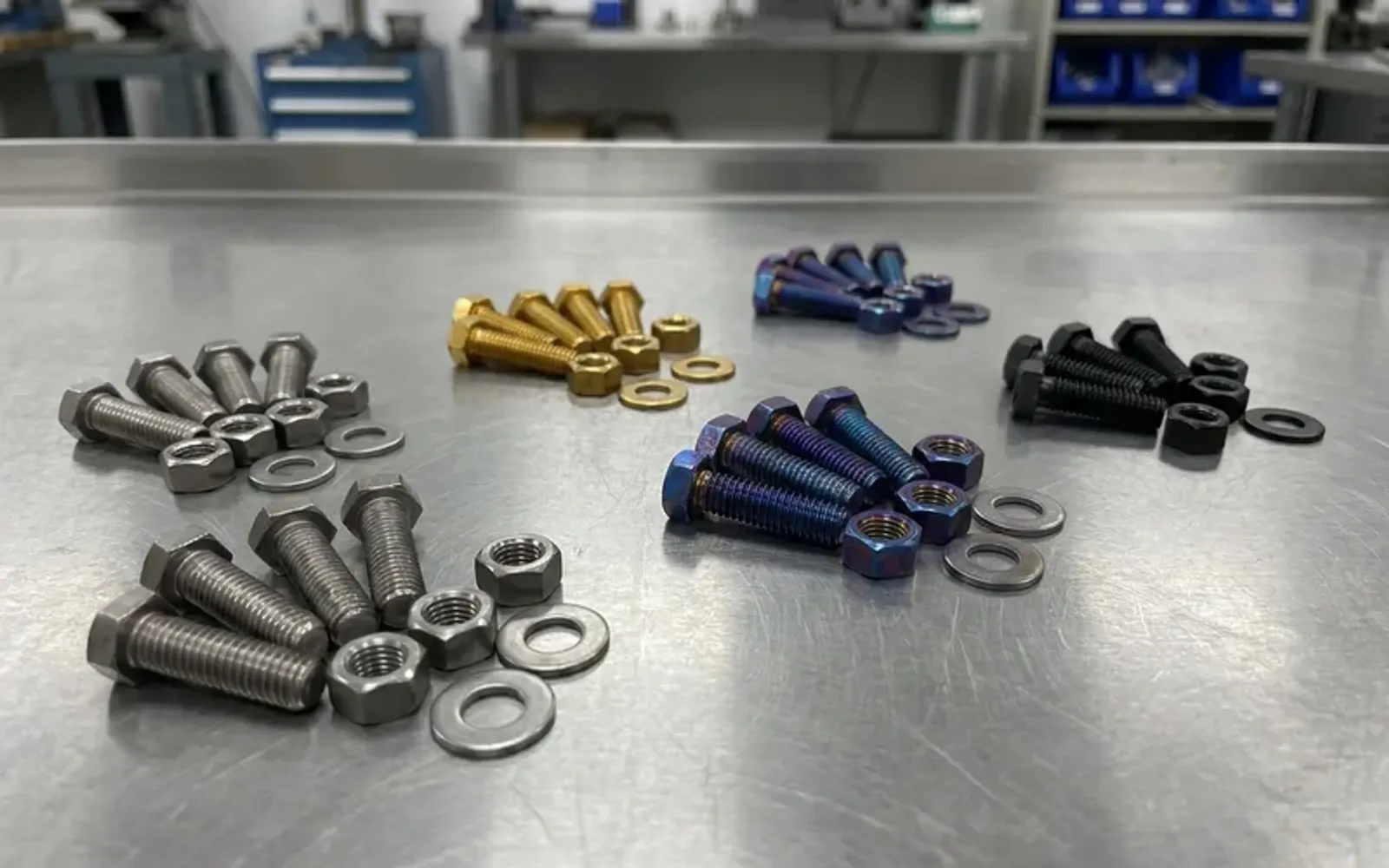
| Type III Color Anodizing (<0.15 µm) | 0.24 – 0.32 | Poor (decorative only) | 300°C | Color coding only — still requires lube |
| AMS 2488 Type II Anodizing (3–6 µm) | 0.16 – 0.22 | Good (hard dark-gray film) | 350°C | Cleanroom, robotics, hydraulic fittings |
| Dry-Film MoS₂ (AS5272 / MIL-PRF-46010) | 0.11 – 0.15 | Excellent | 350°C (air) / 600°C (vac) | Aerospace, motorsport, dry clean assembly |
| PTFE / Xylan Fluoropolymer Coating | 0.10 – 0.14 | Excellent + Chemical Seal | 260°C | Chemical plant flanges, marine & subsea |
| Nickel-Graphite / MoS₂ Anti-Seize Paste | 0.13 – 0.17 | Excellent | 400°C+ | Field maintenance, exhausts, blind holes |
| DLC / TiN PVD Coating | 0.14 – 0.18 | Very Good | 400°C+ | High-cycle reusable motorsport & medical |
2. Reference Lubricated Torque Table for Grade 5 (Ti-6Al-4V) Metric Bolts
Assumes Grade 5 rolled-thread bolts (min yield ~828 MPa, target clamp load = 65% of yield strength) lubricated with MoS₂ or nickel anti-seize (K = 0.14). Always verify mating nut/housing thread strength (especially in aluminum housings) before applying full torque:
| Metric Bolt Size | Stress Area (mm²) | Target Clamp Load F (kN) | Recommended Lubricated Torque (K=0.14) | Typical Dry Steel 10.9 Torque (For Caution) |
|---|---|---|---|---|
| M6 × 1.0 | 20.1 | 10.8 | 9.1 N·m | ~14–15 N·m (overloads lubed Ti!) |
| M8 × 1.25 | 36.6 | 19.7 | 22.1 N·m | ~35 N·m |
| M10 × 1.5 | 58.0 | 31.2 | 43.7 N·m | ~69 N·m |
| M12 × 1.75 | 84.3 | 45.4 | 76.2 N·m | ~120 N·m |
| M16 × 2.0 | 157.0 | 84.5 | 189 N·m | ~295 N·m |
3. Four Shop-Floor Rules That Eliminate Titanium Bolt Seizure
- Always Specify Rolled Threads (Not Single-Point Cut Threads): Cold thread rolling after heat treatment work-hardens the thread root, closes surface micro-tears, and lowers flank roughness to Ra <= 0.8 µm—cutting galling initiation and boosting fatigue life by 30–50%.
- Avoid Matching Identical Hardness When Possible: Pairing a Grade 5 bolt with a softer/different alloy nut (e.g., Grade 2 nut on low-load chemical joints, aluminum-bronze, or a dry-film MoS₂-coated locknut) disrupts cold-welding affinity.
- Never Use High-RPM Impact Wrenches: High rotational speed spikes frictional flash temperature on titanium’s low-conductivity surface (6.7 W/m·K) and welds threads instantly. Run titanium fasteners down slowly by hand or low-RPM controlled torque wrench.
- Ban Chlorinated Cleaners & Copper Paste Above 250°C: Degrease with acetone or isopropyl alcohol instead of trichloroethylene, and select nickel- or MoS₂-based anti-seize rather than copper paste on hot exhaust or turbine hardware.