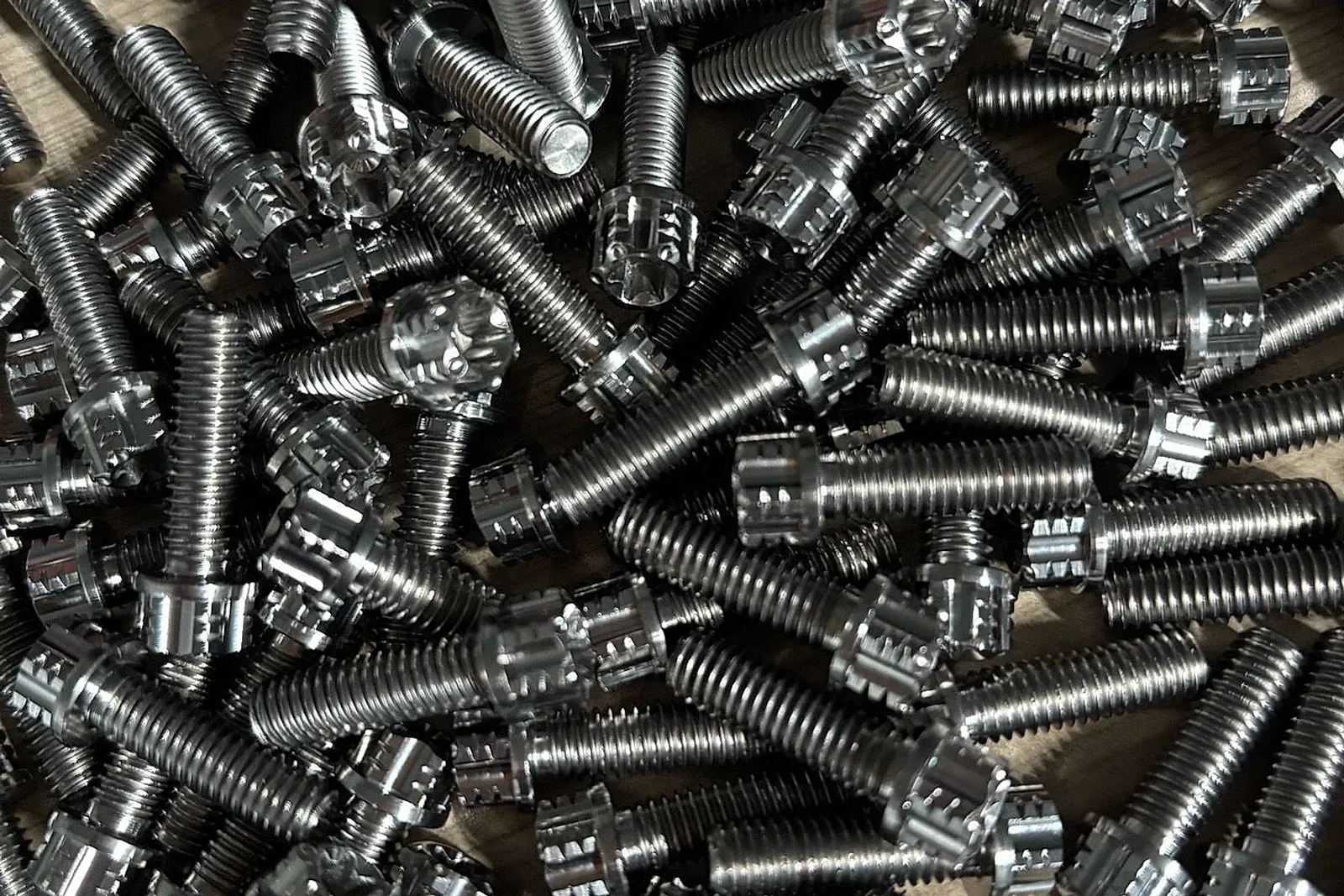
During teardown inspections of aero-engine mount brackets, heavy-lift UAV airframes, and open-wheel motorsport suspension rockers, bolted-joint failures rarely appear as mid-shank tensile overload—over 80% of catastrophic fractures initiate inside the root of the first or second engaged thread turn. Fatigue cracks start at roots. Hardware teams transitioning from alloy steel to lightweight titanium often confront a baffling paradox: bar tensile certificates clear minimum yield targets easily, yet bolts snap off after only dozens of hours under cyclic vibration.
The root cause almost always traces back to an omitted forming clause on the engineering drawing—allowing a machine shop to avoid rolling-die tooling charges by single-point turning external threads on a CNC lathe. Titanium punishes sharp notches severely. Unlike carbon steel, Grade 5 (Ti-6Al-4V) combines roughly half the elastic modulus of steel with acute notch sensitivity, multiplying cyclic tensile stress wherever a carbide insert severs longitudinal grain fibers.
As an integrated titanium supply-chain platform working with certified partner facilities for aerospace structural subcontractors, motorsport engineering teams, and precision equipment OEMs worldwide, we break down the metallurgical link between warm heading, STA heat treatment, and cold-rolled UNJ / MJ threads into enforceable procurement rules. Process discipline governs bolt life.
Grain Flow vs. Residual Stress: Why Cold-Rolled Threads Deliver ≥ 3× Axial Fatigue Life
On a quasi-static tensile testing frame, a lathe-cut bolt and a cold-rolled bolt machined from the same Grade 5 heat can post nearly identical ultimate tensile breaking loads (≥ 1,100 MPa), yet high-frequency axial tension-tension fatigue testing separates their survival cycles by orders of magnitude. Static strength masks fatigue weakness. Specialized partner fastener plants enforce three metallurgical controls on dynamic-load joints:
- Continuous Wrapped Grain Contours vs. Severed Flank Fibers: Single-point thread cutting shears chips away along a 60° flank angle, slicing straight across axial bar fibers and leaving exposed grain boundaries and microscopic tear burrs along the root; cold thread rolling plastically displaces metal at room temperature between hardened dies, forcing surface grains to flow continuously around the root contour like timber grain wrapping around a knot. Unbroken grain flow blocks cracks.
- Post-STA Cold Thread Rolling Locks Deep Compressive Root Stress: When manufacturing load-bearing fasteners from Grade 5 (Ti-6Al-4V) alpha-beta titanium alloy, thermal sequencing determines whether fatigue enhancement survives—partner lines enforce induction warm heading (forming generous under-head fillets), vacuum or inert-atmosphere Solution Treatment and Aging (STA), centerless shank grinding, and final cold thread rolling; reversing that order by aging above 500°C after thread rolling thermally relieves compressive root stresses, whereas post-STA cold rolling triples (≥ 3×) axial tension-tension fatigue life over cut threads. Compressive layers counteract cyclic pull.
- Enforcing AS8879 (UNJ) and ISO 5855 (MJ) Large-Radius Roots: Standard commercial flat-root profiles concentrate peak stress at sharp root corners; high-fatigue aerospace and motorsport prints mandate AS8879 (UNJ) or ISO 5855 (MJ) controlled root radii spanning 0.15011P to 0.18042P (where P equals thread pitch), paired with mirror-ground rolling dies that burnish root roughness down to Ra ≤ 0.4 μm. Radiused roots diffuse peak stress.
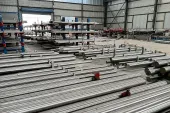
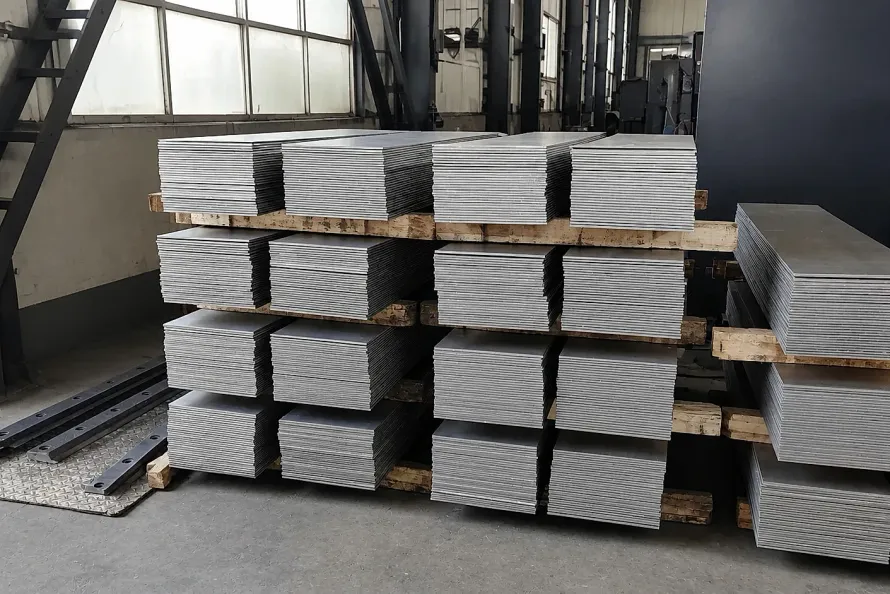
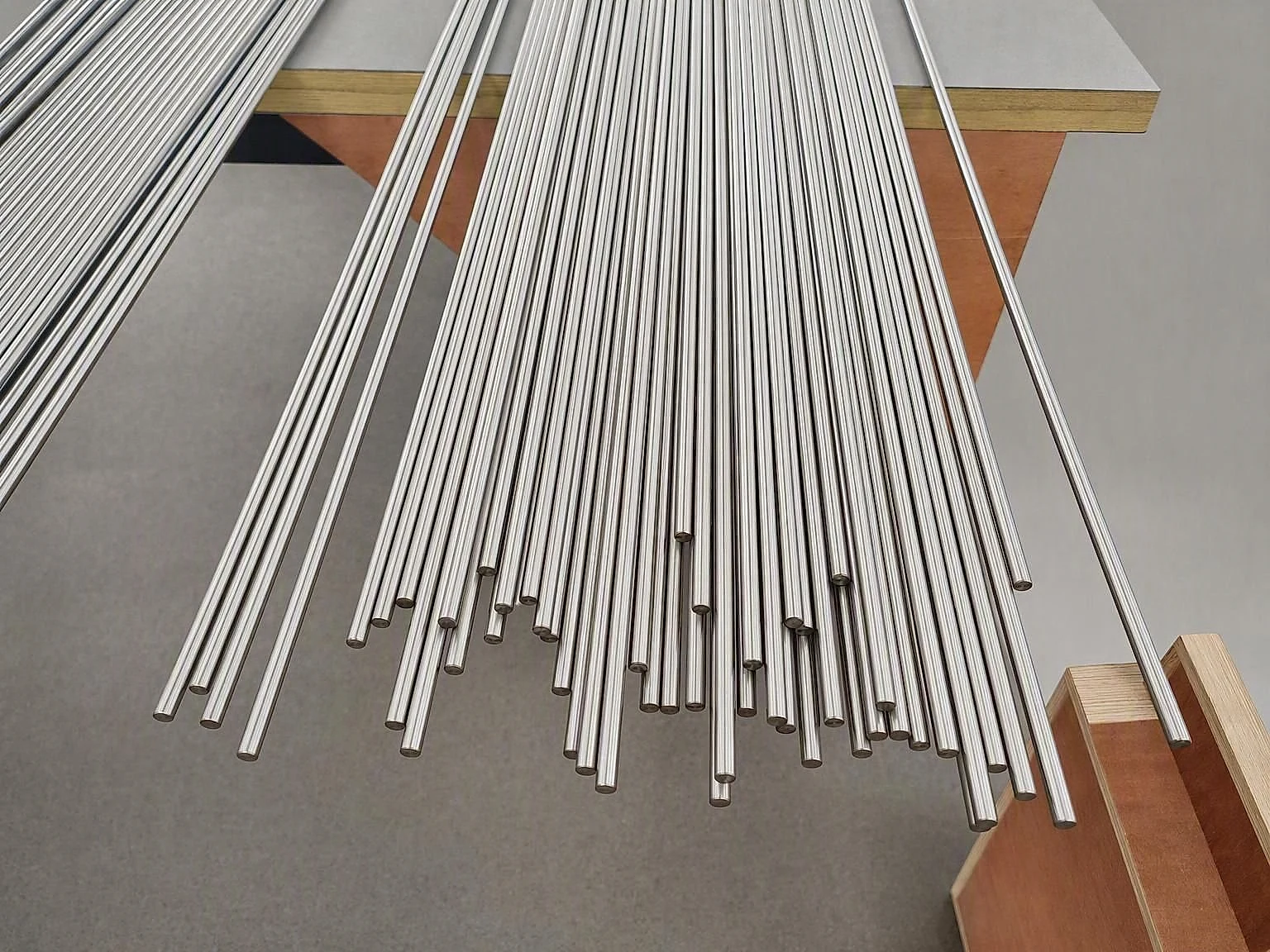 Figure 1: Precision centerless-ground Grade 5 titanium straight bar blanks staged at a certified partner facility. Holding pre-roll shank tolerances within h6 / h7 (± 0.005–0.015 mm) and straightness ≤ 0.3 mm/m prevents crest laps during chipless cold thread rolling. Tight blanks eliminate thread laps.
Upstream Feedstock Pedigree: 3× VAR Melt Cleanliness and h6/h7 Pitch-Diameter Blank Control
Why do general CNC shops frequently shatter rolling dies, fold crest laps, or split shanks longitudinally when attempting to cold-roll commercial turned titanium bar stock? Defective blanks ruin rolling runs. Cold displacement imposes extreme physical demands on upstream wire and rod metallurgy as well as micrometer-level geometry:
First, triple Vacuum Arc Remelting (3× VAR) eliminates brittle inclusions that nucleate root spalling. Under severe radial work-hardening strains inside thread-rolling dies, a single subsurface high-density inclusion (HDI) or nitrogen-stabilized hard-alpha low-density inclusion (LDI) acts as an instant fracture trigger; certified partner melt shops producing cold-heading and warm-heading titanium fastener wire and bar feedstock blend 100% Grade 0 and Grade 1 virgin titanium sponge through 3× VAR (carrying an incremental melt premium of roughly USD 0.70–2.10/kg over standard industrial heats), holding AMS 4928 / AMS 4967 interstitials within O ≤ 0.20%, N ≤ 0.05%, and H ≤ 0.0125% while driving ultra-low-oxygen specialty heats down to O ≤ 0.05%. Clean melts survive cold plastic flow.
Second, 18-stand high-speed rolling to A1 equiaxed grain plus h6/h7 centerless grinding satisfies constant-volume physics. Because cold rolling removes zero metal chips, pitch-diameter blank volume dictates final thread fill—certified partner rod lines run an 18-stand continuous high-speed mill and 14-stand tension-reducing sizing block to hold ≤ 0.15 mm hot-rolled roundness while achieving aerospace A1 fine equiaxed alpha-beta microstructure directly off the mill; multi-pass centerless grinding and ultrasonic cleaning then lock pre-roll blank diameter tolerances within h6 / h7 (± 0.005–0.015 mm) and straightness within ≤ 0.3 mm/m. Micrometer accuracy guarantees full crests.
| Engineering & QA Criterion | Cold-Rolled Threads (Post-STA Rolling) | Single-Point Cut / Die-Cut Threads | Buyer Drawing Callout & Incoming Metallographic Gate |
|---|---|---|---|
| Root Metallic Grain Flow | Continuous contours wrapping smoothly around roots | Axial bar fibers severed across 60° thread flanks | Longitudinal macro-etch audit: zero crest laps or severed flank flow |
| Root Stress & Surface Finish | Deep compressive stress; burnished Ra ≤ 0.4 μm | Tensile machining stress + tool marks (Ra 1.6–3.2 μm) | Mandate threads rolled after STA; gauge AS8879 (UNJ) / ISO 5855 (MJ) |
| Axial Tension-Tension Fatigue | ≥ 3× cycle life baseline for dynamic vibration joints | 1× baseline (prone to 1st/2nd engaged root fracture) | Ban cut threads on airframes, suspension links, con-rods & turbine flanges |
| Upstream Feedstock Pedigree | 3× VAR + A1 grain + ground h6/h7 (± 0.005–0.015 mm) | Standard 1×/2× VAR commercial bar hides internal flaws | Verify MTC melt count, O/N/H assays & 100% heat/lot traceability |
| Tooling & Batch Economics | Amortizes dedicated radiused dies; lower unit cost at scale | Zero rolling-die setup; restricted to static non-fatigue prototypes | Separate static fit-check prototypes from dynamic flight/race hardware |
Four RFQ Clauses for Specifying High-Fatigue Titanium Bolts, Studs, and Nuts
When sourcing precision aerospace, motorsport, and industrial titanium bolts and fasteners through our integrated network of partner rod-grinding mills and specialized warm-heading/thread-rolling plants, engineering buyers should lock four explicit purchase-order clauses upfront:
- Write “Warm Headed + STA + Threads Cold-Rolled After Heat Treat” Explicitly on the Print: Never state “Grade 5 M8×1.25 bolt” alone; require warm-forged heads with continuous under-head fillet flow (banning hex heads hogged directly from oversize bar), STA heat treatment, and post-heat-treat cold rolling to AS8879 (UNJ) or ISO 5855 (MJ) 0.15011P–0.18042P root radius. Explicit sequence prevents shop shortcuts.
- Match 3× VAR Alloy Specs vs. Commercially Pure Grades to Joint Duty: Specify AMS 4928 / AMS 4967 3× VAR virgin-sponge Grade 5 with h6 / h7 ground shanks on cyclic aerospace and motorsport chassis hardware; for static chemical-plant flange bolting where chloride corrosion governs over fatigue, ASTM B348 Grade 2 cold-headed fasteners balance corrosion resistance and cost. Duty-matched grades optimize budgets.
- Require Metallographic Lap Audits and Full MTC Traceability Within 2 to 5 Days: Allow 2 to 5 days after tensile, double-shear, hardness, and longitudinal root-lap metallography conclude for formal Material Test Certificate (MTC) issuance, maintaining 100% heat/lot number traceability from primary VAR ingots and centerless-ground wire lots through STA furnace loads (independent third-party re-testing can be arranged on request). Complete traceability secures part release.
- Specify Anti-Galling Surface Treatments and Partitioned ISPM 15 Export Packaging: Bare titanium threads gall under high-speed torque preload; call out anodizing, dry-film lubricants (MoS₂ / PTFE), or silver plating where required, and mandate compartmentalized poly-bagging, white EPE foam cushioning, and ISPM 15 plywood crates shipped FOB China main port to prevent thread-on-thread transit nicks. Partitioned packing protects burnished threads.
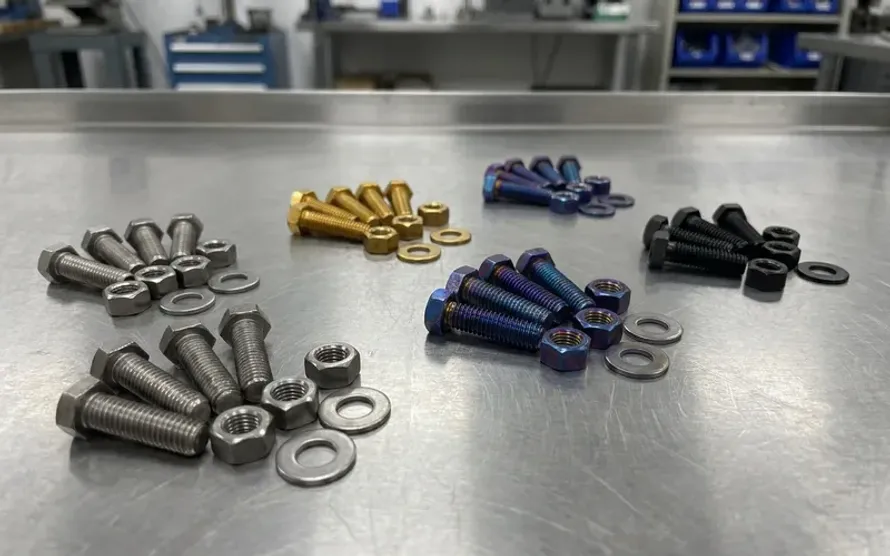
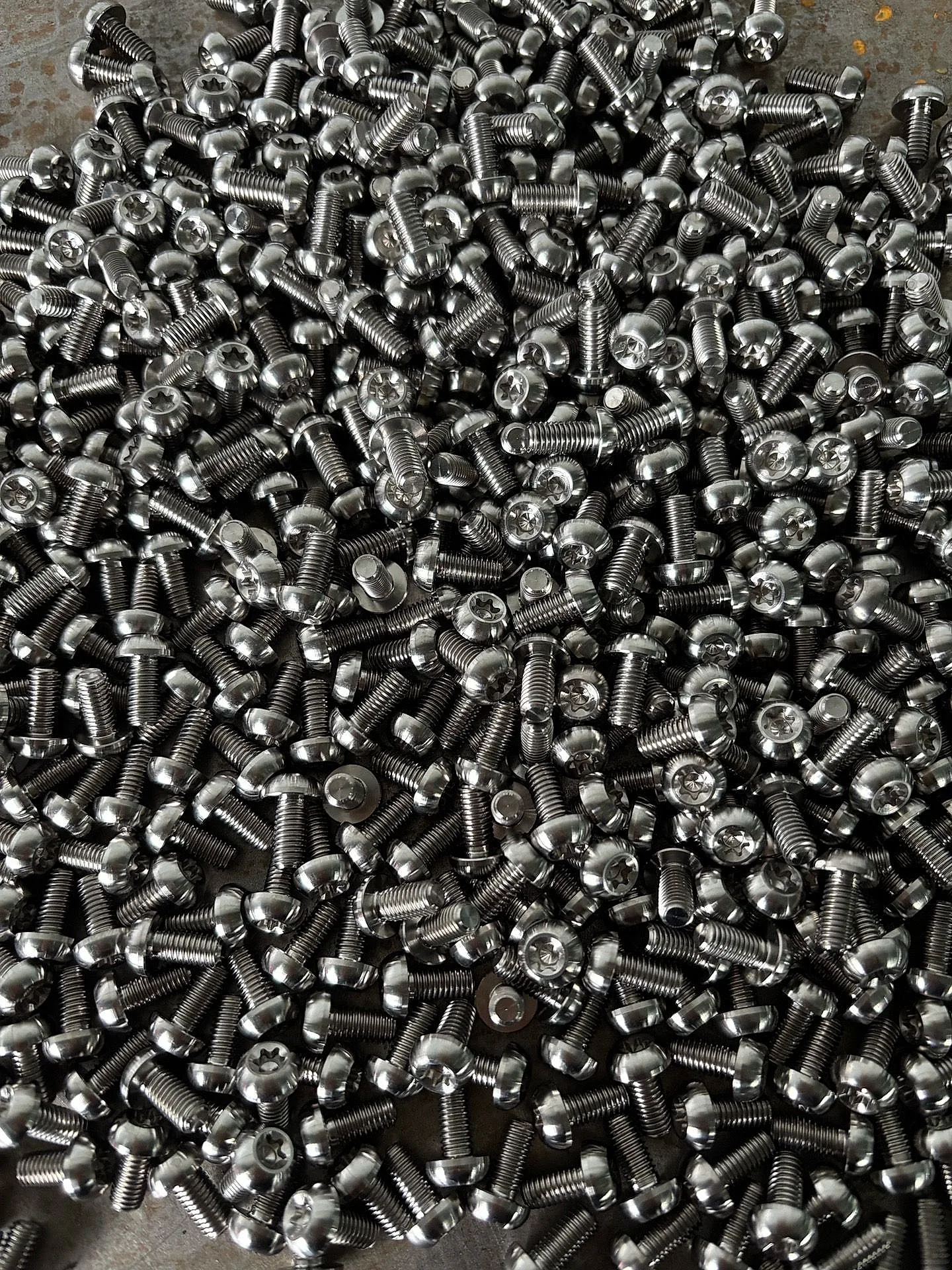 Figure 2: Production batch of warm-headed Torx-drive titanium fasteners with cold-rolled external threads staged for dimensional and optical thread-profile inspection at a specialized partner plant. Smooth burnished flanks and radiused roots resist fretting fatigue under high-frequency vibration. Burnished threads stop early fretting.
If your engineering team is qualifying high-fatigue Grade 5 (Ti-6Al-4V) fasteners or sourcing h6 / h7 centerless-ground titanium wire and bar blanks for cold thread rolling, submit your thread drawings, heat-treat specs, and batch quantities via our online RFQ and complimentary fastener specification audit portal to review redacted MTC and root-flow metallography records. Pre-RFQ audits eliminate joint failures.