Type something to search...

Airbus

Aerospace and Defense
ATI's South Carolina Mill Goes Live as Airbus Doubles Its Contract: Phase Two of Western Titanium De-Russification
By Jason/ On 26 May, 2026

ATI's South Carolina Mill Goes Live as Airbus Doubles Its Contract: Phase Two of Western Titanium De-Russification

ATI's South Carolina Mill Starts Up in May, Airbus Doubles the LTA — Phase Two of Western Titanium De-Russification Is On In May 2026, Allegheny Technologies Inc. (ATI) brought its new specialty titanium sheet mill in South Carolina into production. In the same week, Airbus disclosed that it had doubled its long-term agreement (LTA) volume with ATI, weighted toward Ti-6Al-4V aerospace sheet. This is not a coincidence. It is Phase Two of the Western titanium sheet supply chain's de-Russification. Phase One was the European procurement clear-out. On April 21, Safran announced it had completed its non-Russian titanium transition for forgings, moving billet and landing-gear forgings entirely from VSMPO-AVISMA to Ecotitanium plus its Japanese and US partners. Phase Two is the US capacity side filling in: ATI brings new aerospace sheet capacity online, and Airbus pins down the matching LTA share. Capacity-side moves are slow. Safran's transition was contract reshuffling and could close overnight. ATI's mill is a greenfield ramp — 18 to 24 months minimum. The interval between start-up and full rate is the tightest window the market will see. The US Capacity-Side Fill Is an 18-24-Month Ramp Curve The South Carolina mill is positioned for specialty titanium sheet — AMS 4911 (Gr.5 annealed sheet), AMS 4901 (Gr.2 CP sheet), AMS 4915 (Gr.5 STA sheet) and similar mainline aerospace grades. End uses are fuselage skin, firewalls, engine nacelles and center-wing-box skin parts. Aerospace sheet mill ramps have a rhythm. Year one runs small batches through first-article inspection (FAI) and customer system audits; year two is when steady tonnage starts. Boeing and Airbus supplier qualification runs through NADCAP AC7110/2 (chemical processing) plus AC7114 (NDT) plus AS9100D system audits, and every material grade has to run its own PPAP. The conclusion is clean. Through all of 2026 and the first half of 2027, Western sheet supply additions are limited. Real easing waits until 2028, when the new mill reaches steady tonnage, paired with Safran's €150M Gennevilliers press starting up in 2029. The two capacity curves only arrive together at that point.What Doubling ATI Really Means for Airbus: a Key Step in Replacing VSMPO Airbus did not disclose the doubled tonnage. The trade reading is that the new volume sits in the annual LTA framework for Ti-6Al-4V aerospace sheet and bar. Airbus has admitted in recent disclosures that Russian titanium still accounts for roughly 20% of its supply and is being drawn down. This is a different curve from Boeing's, which closed out Russian titanium back in 2022. Airbus's slower path comes down to one structural fact: Europe has no aerospace-grade titanium smelter of its own. Aubert & Duval's Ecotitanium handles titanium scrap recycling, but that is it. In the near term Airbus has to push VSMPO's vacated share onto the US (ATI/TIMET) and Japan (Toho Titanium, Osaka Titanium). Doubling the ATI book is the key step in that transfer. For Airbus, de-Russification isn't a PR exercise — it's capacity reservation. LTAs are multi-year contracts, and doubling them means Airbus has effectively locked in the matching ATI sheet tonnage for the 2027-2030 cycle. The takeaway for everyone else: through 2026-2028, Airbus sheet purchasing sits ahead of every non-aerospace buyer in the queue. ATI and TIMET spot allocations will not loosen. The Transition Window: Tier-2 and MRO Channels Open Up Primary-structure demand is locked into LTAs, but the wider market still has gaps. They sit with Tier-2/3 sub-contractors and MRO. Fuselage sub-assemblers, nacelle shops and auxiliary-system shops (APUs, hydraulic plumbing, firewall assemblies) form the Tier-2 layer. Line maintenance, module overhaul and modification-life extension (MLE) make up MRO. Both buy on spot orders and short-term contracts, not LTAs. When ATI and TIMET shift their sheet mix toward Boeing and Airbus LTAs, Tier-2 and MRO will see real spot shortages in Gr.5 titanium sheet, Gr.5 titanium bar and titanium forgings. Categories that compliant Chinese channels can carry through 2026-2028:Chemical and marine adjacencies (ASTM B265 Gr.2/Gr.7, B338 Gr.2 welded titanium tube): non-aerospace but consuming the same sheet and tube downstream. Medical implant adjacencies (ASTM F136 Gr.23 ELI): a separate certification path — Baoji and Western Titanium already hold ISO 13485. Tier-2 non-critical parts (engine bay interior trim, APU covers, outer firewall skins): secondary parts within an AS9100D system, with shorter audit cycles than primary structure. MRO overhaul parts (Gr.2 CP titanium and Gr.5 repair plate for line work): MRO shops typically self-qualify suppliers and accept mill cert plus lot traceability.View from Titanium Valley: Drawing-Based Forging RFQs from Europe Are Real Over the last 90 days, one new pattern has shown up in our Baoji inquiry queue: European buyers walking in with titanium forging drawings and asking about drawing-based custom forging. Nothing has closed yet — these are still in discussion. But the inquiry itself is the signal. Twelve months ago these RFQs did not exist. European Tier-2 buyers were still moving through VSMPO plus Aubert & Duval, asking supplier qualification questions, not channel questions. Now they ask "can the China channel make this forging to my drawing, and what's your lead time?" — a direct behavioral mapping of Phase Two de-Russification. On the supply side, the numbers are tightening too. Current AMS 4911 / 4928 / 4965 stock totals roughly 5 tonnes — enough for one or two MRO medium-batch orders. If the Airbus-doubles-ATI signal propagates through Tier-2, the next 60 days of Gr.5 titanium sheet spot may tighten further. Sponge Cost-Side Reference Asian mill spot prices on titanium sponge (current band):Grade Mainline mill-delivered range NotesGrade 0 $7.4 – 7.6 / kg Aerospace and high-end medicalGrade 1 $7.1 – 7.4 / kg Premium chemical and medicalGrade 2 $6.7 – 6.9 / kg Industrial and general chemicalThese are Asian mill-delivered prices, not Western landed. Their reference value: Asian-side raw-material cost is relatively stable. What's actually tight on the Western side is bottleneck capacity across melting, rolling and forging — not sponge feedstock. That means the 2026-2027 spread on Gr.5 titanium sheet and Gr.5 titanium forgings is set by Western midstream capacity, not by sponge volatility. What Buyers Should Actually Do Tier-1 and engine OEMs: lock in 2026-2027 annual LTAs. Do not bet on a price retreat. The ATI ramp plus the Airbus doubling will squeeze existing capacity at the same time. Western spot will not loosen. Tier-2/3 sub-contractors: bring compliant Chinese channels into the mix. Aerospace secondary parts go through compliant Chinese mills inside the AS9100D framework; chemical and marine adjacencies go via ASTM B265 / B348. Priority categories are Gr.5 titanium sheet and titanium bar. MRO: build overhaul-part inventory to 12 months. The MRO pain point is one delayed batch derailing an entire line-maintenance schedule. Through the transition window, 1.5x to 2x safety stock is cheaper than spot negotiation. Chemical, marine and medical buyers: this window is good news for you. With aerospace tightening Gr.5, Gr.2 / Gr.7 / Gr.23 ELI supply has actually loosened and bargaining position has improved. Consolidate R&D and small-batch orders through titanium CNC machining and the no-minimum-order-quantity channel. Conclusion: The Real Cadence of Phase Two De-Russification ATI starting up in May plus Airbus doubling its LTA equals Phase Two of Western titanium sheet de-Russification — under way now. But the 18-24-month ramp means the 2026-2027 transition window will stay tight. Real easing waits for ATI's full ramp in 2028, paired with Safran's Gennevilliers press in 2029. The opportunities inside that window belong to Tier-2/3 and MRO buyers — and to any supplier who can provide a compliant China channel to share the load. Related Products & ServicesService → Titanium CNC Machining — drawing-based forging inquiries from Europe are now arriving; 5-axis CNC and prototype-from-drawing in 4-6 weeks. Product → Gr.5 Titanium Sheet (AMS 4911 etc.) — roughly 5 tonnes in stock, covering Tier-2 and MRO short-term demand. Product → Gr.5 Titanium Bar (AMS 4928 etc.) — standard sizes for Tier-2 sub-contractors and MRO repair work, small-lot splits available.Related ArticlesSafran Completes Non-Russian Titanium Transition in April (De-Russification Phase One) F-35 Dual Contract Awards in April 2026 — Structural Upshift in US Military Titanium Forging Demand VSMPO Capacity Collapse from 32k to 17k Tonnes — Global Aerospace De-Russification RebalanceAbout: Titanium Seller is a supply chain platform based in Baoji, China's Titanium Valley, serving aerospace, chemical, marine and medical buyers worldwide.

Aerospace and Defense
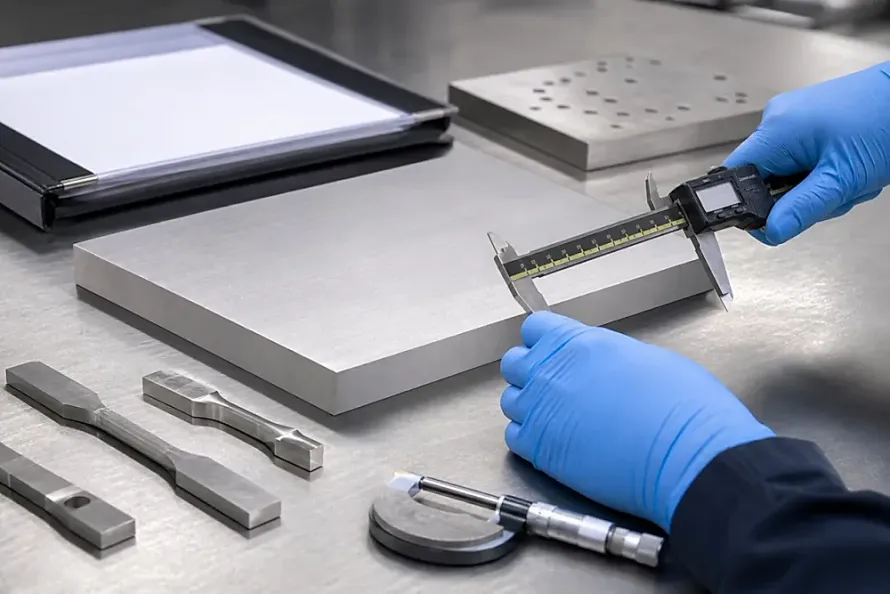
A titanium quality-control bench with plates, machined coupons, calipers and gloved inspection hands, showing how aerospace procurement depends on traceable evidence
By Jason/ On 06 May, 2026

Aerospace Orders Are Turning Titanium Procurement Into a Qualification Chain

voestalpine's new aerospace order book is not only a contract story. It is a signal about how aircraft supply chains are valuing titanium products in 2026: not as isolated bars, sheets, tubes or forgings, but as qualified material packages tied to processing, inspection evidence, certification readiness and delivery control. The Austrian steel and technology group said on April 8 that its High Performance Metals Division had secured aerospace orders worth around EUR 1 billion over five years. The agreement includes Airbus-related business and covers high-performance materials, complex forged parts and global logistics. The company said its aerospace portfolio includes bars, sections, sheets, plates and special forged parts, with titanium alloy forgings produced at Kapfenberg and high-tech titanium sheets produced at Muerzzuschlag. It also described heat treatment, surface treatment, additive manufacturing processes and a global service network as part of the division's capability set (voestalpine).For titanium processors and export buyers, the important point is not that one European supplier won a large order. The more useful signal is that aerospace customers are buying a chain of assurance. A titanium plate, bar or forged billet has limited value in aircraft programs if it is separated from the route that proves chemistry, mechanical performance, heat history, inspection status, traceability and delivery reliability. Why the Order Matters Beyond One Supplier Aerospace demand remains strong enough to keep pressure on qualified material channels. Airbus reported 9,037 commercial aircraft in its order backlog at the end of March 2026, even as Q1 deliveries fell to 114 aircraft from 136 a year earlier. The company said it was continuing its ramp-up while navigating Pratt & Whitney engine shortages (Airbus). That pattern matters for titanium because aircraft production is constrained by qualified components and inputs, not only by final assembly demand. Reuters reported in February that aviation supply constraints had become a durable operating condition, with some component and material orders stretching toward a year. In the same report, a Future Metals executive said titanium and nickel tubing lead times were still 50 to 60 weeks, far above the pre-pandemic norm of about 20 weeks (Reuters via Investing.com). Even if some lead times have improved from 2025 extremes, the procurement lesson remains: qualified titanium availability is still a planning variable, especially for tubing, forgings and precision material forms that must enter certified assemblies. The raw-material side adds another layer. The U.S. Geological Survey's 2026 titanium summary said the United States did not produce titanium sponge metal in 2025 and estimated net import reliance for sponge at 100%. It also reported estimated 2025 sponge imports of 44,000 metric tons and noted that most titanium metal use was in aerospace applications, with the rest spread across armor, chemical processing, marine hardware, medical implants, power generation and other uses (USGS). That does not mean every titanium buyer faces an immediate shortage. It does mean downstream buyers should distinguish between feedstock exposure, mill product availability and qualified component readiness. These are related, but they are not the same risk. The New Buyer Framework: Five Gates, Not One Price For titanium bars, tubes, plates, sheets and forgings, aerospace procurement increasingly works through five gates:Gate What buyers need to verify Why it mattersMaterial form Bar, tube, plate, sheet, forging, billet, wire or powder route The form determines downstream machining, forming, inspection and qualification workProcess route Melting, rolling, forging, heat treatment, machining or additive manufacturing path Process history affects mechanical properties and repeatabilityInspection evidence Chemical tests, mechanical tests, ultrasonic or other non-destructive inspection, dimensional records Aerospace programs need proof, not only supplier claimsCertification package Standards, mill test certificates, traceability, conformity documents and customer-specific approvals Documentation failure can stop an otherwise usable materialDelivery resilience Lead time, logistics, inventory discipline and alternate qualified routes Aircraft programs need predictable flow, not spot availabilityThis framework is more practical than asking whether titanium prices are rising or falling. A lower raw-material price does not solve a missing NDI record. Available plate stock does not solve a forgings bottleneck. A fast quote does not replace customer-approved process history.Additive Manufacturing Reinforces the Same Lesson The same evidence-chain logic is visible in titanium additive manufacturing. On April 13, GKN Aerospace announced an $8.4 million TITAN-AM program with the U.S. Air Force Research Laboratory to industrialize Laser Metal Deposition with Wire for large titanium aerostructures. The program is not framed only around printing parts. It focuses on process industrialization, titanium material datasets, simulation, non-destructive inspection techniques and component demonstration (GKN Aerospace; see our earlier read on TITAN-AM and the aerospace titanium qualification picture). That detail is important for traditional titanium product suppliers. Wire-fed additive manufacturing does not simply replace forged or machined products overnight. It adds another qualified route that still depends on material data, inspection methods and customer confidence. For some structural components, additive routes may reduce waste or shorten specific process chains. For many other applications, forged billet, rolled plate, tube or machined bar stock will remain the practical route. In both cases, buyers are rewarding suppliers that can explain the process route and prove repeatability. What Export Titanium Suppliers Should Take From This For export suppliers of titanium bars, tubes, plates, sheets and forgings, the commercial opportunity is not to imitate the scale of voestalpine's aerospace business. Most suppliers will not compete directly for integrated aircraft-program packages. The useful takeaway is narrower and more actionable: serious buyers are screening for evidence maturity. A supplier that sells titanium tubes into heat exchangers, plates into chemical equipment, bars into machined parts or forgings into aerospace-adjacent applications can strengthen its position by making the evidence chain easier to inspect. That means clearer grade control across Gr.1/Gr.2/Gr.5/Gr.7/Gr.12 and Gr.23 grades, more disciplined heat and batch traceability, test records that match the buyer's standard, transparent processing limits, and realistic lead-time communication. The same applies outside aerospace. Medical, chemical processing and energy buyers may not have the same program structure as Airbus suppliers, but they often care about the same titanium properties: corrosion resistance, strength-to-weight ratio, fatigue behavior, cleanliness, dimensional stability and documented compliance. When raw material supply is globally concentrated and qualified processing capacity is uneven, documentation becomes part of the product. The defensible conclusion is simple: aerospace orders are not just pulling more titanium through the system. They are pulling titanium through a more demanding qualification chain. Suppliers that can connect product form, process route, inspection evidence, certification and delivery discipline will be easier for buyers to evaluate. Suppliers that only describe titanium as available stock will look less prepared for the procurement reality now shaping high-value titanium demand.Related Products & ServicesTitanium forgings — Gr.1/Gr.2/Gr.5/Gr.7/Gr.12, AMS 4928 / ASTM B381 channels Titanium tubes — heat exchanger and aerospace-adjacent tubing with traceable mill certs Titanium sheets & plates — chemical, marine and structural plate stock Titanium bar / rod — ASTM B348 / B381 with batch traceability Titanium wire — feedstock-grade wire for AM and welding routes Special titanium alloys (Gr.5 / Gr.23 / Ti-6Al-4V ELI) — aerospace and medical-grade reference Contract machining services — finish machining, dimensional verification and inspection-friendly delivery Titanium industry news — ongoing tracking of aerospace titanium qualification, procurement and supply-chain shifts

Market and Supply Chain
EU's 20th Sanctions Package Skips Titanium Again: The Airbus-Bureaucracy Double Lock
By Jason/ On 29 Apr, 2026

EU's 20th Sanctions Package Skips Titanium Again: The Airbus-Bureaucracy Double Lock

The EU adopted its 20th Russia sanctions package on April 23. Nickel, iron ore, unrefined and refined copper, and aluminum scrap — together more than €530M of trade — were folded into the prohibition list. Titanium was excluded again. The €213.5M annual flow of Russian titanium into the EU remains untouched. That makes four consecutive packages in which titanium has been quietly sidestepped. Pull the "why" apart and what you find is not a technical oversight — it is a double lock built from Airbus dependency and bureaucratic inertia. What four sanctions rounds of titanium evasion really tell usStart with the numbers. The EU currently imports roughly €213.5M of titanium per year from Russia, which translates at 2025 physical volumes into something on the order of 8,000-10,000 tonnes of sponge plus ingot. That is not a marginal stream — it is one of the core sources of flight-critical large-format Ti-6Al-4V forging stock feeding the Airbus airframe supply chain. VSMPO-Avisma's capability in oversized Gr.5 forgings is something no Western mill has fully replicated in the past 30 years. The 17th package (April 2025) was the round where titanium came closest to inclusion. Titanium sat in the working draft until the late stages, then was pulled with the rationale "insufficient short-term substitute supply." The 18th and 19th packages, passed in July and November 2025, both excluded titanium as well. The 20th — the package that just cleared on April 23 — sidestepped it once more. One detail worth noting: every metal that has been added to the list is one Europe can already self-supply through domestic or allied capacity. Nickel comes from Canada and Indonesia, iron ore from Brazil and Australia, copper from Chile and Peru, aluminum scrap circulates inside the EU. Titanium is not on that curve. EU-domestic primary sponge capacity is essentially zero. The largest non-Russian alternative is Japan — Toho Titanium and Osaka Titanium Technologies — but their combined annual capacity of 30,000-40,000 tonnes is already split to its limit between aerospace and semiconductor demand. There is no slack to absorb the 8,000-10,000 tonnes Russia would vacate. That is the structure of the lock: as long as Airbus treats large-format Ti-6Al-4V forgings as a platform-critical input, and as long as the Japanese mills have no near-term path to expand, the EU cannot politically absorb the airframe-line shutdown risk that cutting Russian titanium would create. The other half: bureaucratic inertia The second lock is procedural. The EU sanctions mechanism runs on unanimous member-state consent shaped by reverse industry lobbying — meaning every line item passes first through the internal modeling of national OEMs. For Germany, France, and the UK (BAE remains plugged into the European aerospace system), an Airbus production cut triggered by titanium starvation would propagate down through every Tier 2 and Tier 3 link: Rolls-Royce engine lines in the UK, Safran landing gear lines in France, Premium Aerotec airframe forging lines in Germany. All of them depend on a stable Gr.5 ingot rhythm. This is the "we know it doesn't add up but we can't unwind it short-term" deadlock. EU Commission officials have stated openly in recent months that "the titanium exemption no longer reflects market reality" — but those statements live at the rhetorical layer. Translating that consensus into actual sanctions text requires 18-24 months of stress-testing non-Russian alternatives. No European titanium producer is currently positioned to enter that pre-qualification list. Worth contrasting: the United States went the other way. The Section 232 sponge tariff exemption proposal — the "Securing America's Titanium Manufacturing Act" — is moving through Congress, propping up domestic supply through tax measures and DPA funding rather than direct prohibition of Russian material. Two paths reflect two institutional logics: the US pushes endogenous supply through industrial policy, the EU preserves the status quo through member-state bargaining. The window for Chinese, Japanese, and other Asian millsWhat does the 20th package's titanium carve-out mean for Asian mills? Short term, European Tier 1 and Tier 2 buyers have no immediate trigger to switch sources. Medium term, ESG and compliance pressure is moving down the chain quietly — many European OEMs' internal audit functions are already requiring Tier 2 forge shops to provide "non-Russian titanium" provenance documentation, even where external sanctions haven't yet bitten. What we are seeing on the ground in Baoji (China's Titanium Valley) is concrete: the mills we partner with already hold EN9100 / AS9100 aerospace quality system certifications. Direct export workflows into Europe are still being built out, but cargo flow into European end-users via Hong Kong / Singapore freight forwarder channels has been climbing steadily over the past six months. That is a more reliable progressive signal than any political statement — customers vote with their feet, ahead of the sanctions text. The qualification bottleneck is not product capability, it is EASA Form 1 and EN9100 documentary traceability. When European aerospace OEMs accept titanium they are not only checking ASTM B348 / AMS 4928 chemistry — they require an unbroken OEM-qualified audit chain at every heat number. Building that compliance vocabulary properly takes 12-18 months of system alignment. Mills that get this in place early will hold first-mover position when the EU's 21st or 22nd package finally folds titanium into the prohibition list — and that window will arrive — sometime in 2027. We currently hold roughly 50 tonnes of aerospace Ti-6Al-4V Gr.5 titanium rod and forging stock, in diameters Φ20-200 mm. Inquiry frequency from European-direction buyers (including indirect channels via intermediaries) has visibly stepped up this week. That curve doesn't need a formal EU sanctions trigger to start. It already has. Checklist for buyers and compliance officers If you are planning aerospace titanium procurement for 2026-2027, three things to do right now: First, lock "non-Russian titanium + complete heat-number traceability + EN9100/AS9100 qualification" into your RFQ template as a hard requirement. This is the compliance trajectory the EU will move from voluntary to mandatory over the next 12-24 months. Second, push your single-source share below 50%. Today, Russian + Japanese titanium combined still represents 70%+ of supply at most European Tier 2 forge shops. That is structurally fragile. Onboarding one qualified mill from each of Japan, China, and North America gives you redundancy when 2027 sanctions actually trigger — without an airframe line stoppage. Third, treat physical inventory availability as a qualification advantage. The real signal from the 20th package's titanium carve-out is "no near-term enforcement," but compliance audits will move first. Suppliers who can deliver titanium forgings from stock with full MTC documentation will clear the 2026-2027 qualification race three to six months ahead of futures-dependent suppliers. The variable worth tracking over the next 12 months is not whether the 21st sanctions package will fold titanium in. It is whether Japanese mill capacity expansions can keep pace with the rate at which European aerospace OEMs qualify non-Russian alternative sources. Where those two curves intersect is the moment the EU titanium exemption truly fails. The 20th package's "skipped again" outcome is just one tick on that countdown. Related Products & ServicesService → Stocking Programs for Aerospace-Grade Titanium — the physical-inventory route for staying ahead of European compliance timing Product → Ti-6Al-4V Titanium Rods and Forging Stock — Gr.5 aerospace bar and billet, multi-heat traceability Product → Special Titanium Alloys — backup grade options outside the Airbus-dominated specification setAbout: Titanium Seller is a supply chain platform based in Baoji, China's Titanium Valley.

Ready to Start Your Project?

Get factory-direct pricing on titanium products. No minimum order.

Get a Free Quote
Quick Inquiry