When a precision CNC job shop or production cutlery manufacturer diagnoses an unexpected batch failure—such as inconsistent lockbar tension across a 200-piece run of folding knife scales, or mismatched blue-violet hues after Type III voltage anodizing—the root cause is rarely a CNC programming error or a faulty DC power supply. In the vast majority of cases, the shop floor is fighting two unrecorded variables hidden inside the raw titanium stock: mixed rolling grain orientation and multi-heat chemical variance.
Purchasing standard mill-certified titanium sheet or bar guarantees that the metal satisfies baseline ASTM chemical and tensile limits. However, broad standard specifications like ASTM B265 and ASTM B348 were written for general industrial fabrication, not high-precision multi-axis CNC machining or cosmetic surface finishing. Understanding the metallurgy behind Rolling Grain Direction (Longitudinal vs. Transverse) and Single Heat-Lot Traceability allows engineering and procurement teams to lock down repeatable machining and finishing outcomes before the first chip is cut.
Why Titanium Rolling Grain Direction (Longitudinal vs. Transverse) Is Not a Minor Detail
Unlike cubic metals such as aluminum or austenitic stainless steel, alpha-phase (α) titanium crystallizes in a Hexagonal Close-Packed (HCP) lattice. An individual HCP titanium crystal exhibits pronounced elastic and plastic anisotropy: the elastic modulus measured parallel to the hexagonal c-axis approaches 145 GPa, whereas the modulus measured along the basal a-axis is closer to 100 GPa.
When titanium slabs of Grade 5 (Ti-6Al-4V / UNS R56400 / Werkstoff 3.7165 / ВТ6) or commercially pure Grade 2 (UNS R50400 / Werkstoff 3.7035 / ВТ1-0) undergo hot rolling and subsequent cold or warm sheet rolling through our certified partner facilities, slip and twinning mechanisms rotate the HCP unit cells into preferential alignments known as crystallographic texture (specifically basal and split-basal / transverse textures). Even after mill annealing, this directional grain architecture remains locked into the sheet:
- Longitudinal Direction (L — Parallel to Rolling Direction): Grains are elongated along the primary rolling axis. Basal poles tend to tilt away from the rolling direction, typically resulting in a slightly lower elastic modulus (105–112 GPa), superior ductility in bending across the grain line, and lower springback angle variability.
- Transverse Direction (T — Perpendicular to Rolling Direction): Because basal c-axes frequently tilt toward the transverse axis during rolling schedules, testing perpendicular to the rolling direction yields a higher apparent elastic modulus (115–122 GPa), elevated tensile yield strength, and steeper elastic recovery upon unloading.
| Metallurgical & Mechanical Property | Longitudinal (L — Parallel to Roll Axis) | Transverse (T — Perpendicular to Roll Axis) | Shop-Floor Impact When L and T Are Mixed in One Batch |
|---|---|---|---|
| Dominant HCP Crystal Alignment | Elongated α grains aligned with rolling pass | Basal c-axis poles tilted toward transverse axis | Unpredictable anisotropic response under cutting forces |
| Apparent Elastic Modulus (E) | Lower baseline (105–112 GPa) | Higher baseline (115–122 GPa) | Up to 10–15% stiffness variation in flexural beams |
| 0.2% Offset Yield Strength | Baseline compliant with ASTM B265 | Typically 3–8% higher than longitudinal | Variable forming force and cold-setting depth |
| Cold Bending Springback Angle | Lower and tighter angular spread | Higher elastic springback recovery | Inconsistent bend angles on formed clips and brackets |
| Residual Stress Release Curve | Symmetric axial bow tendency after pocketing | Asymmetric twist or cross-bow tendency | Fixture compensation fails when blank orientations vary |
Case Study 1: Folding Knife Frame-Lock Scales and Spring Pocket Clips
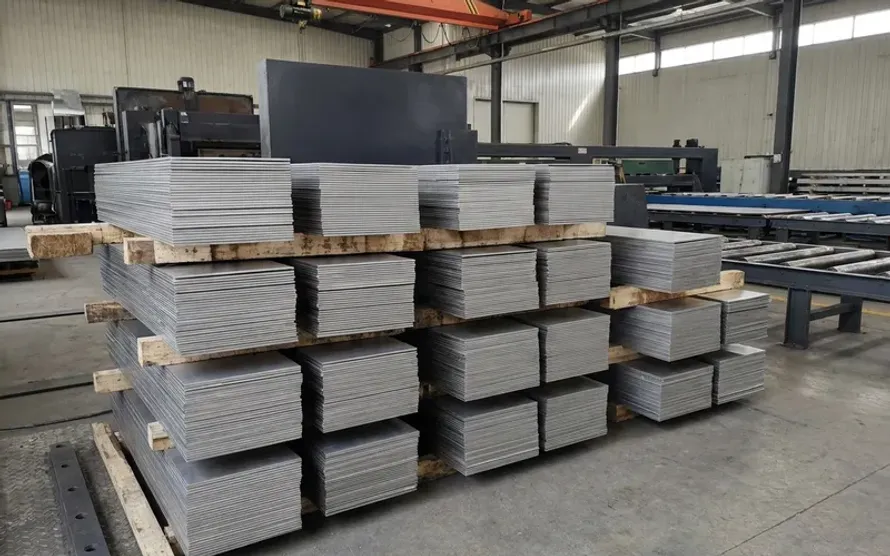
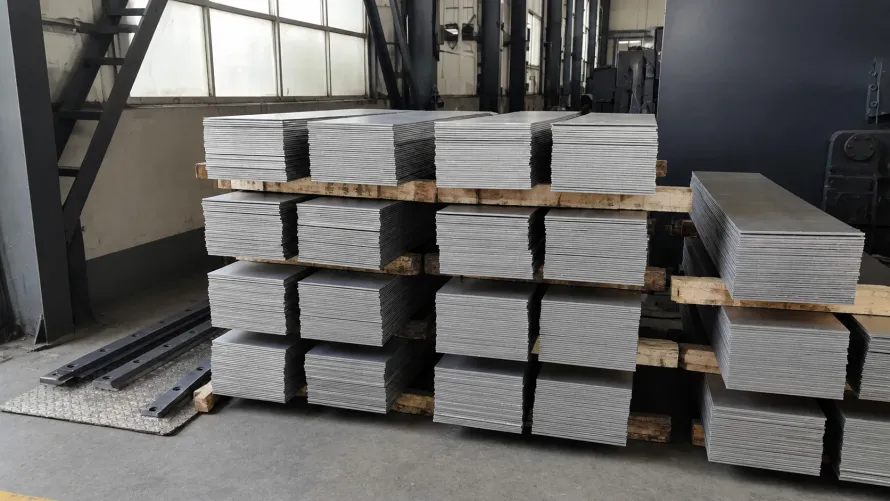
In custom and production Knife Making & EDC manufacturing, waterjet operators frequently nest parts at 0°, 90°, and arbitrary angles on a master sheet of 3.2 mm (0.125”) or 4.0 mm (0.157”) Grade 5 titanium to maximize material yield. While multi-angle nesting saves raw stock, it introduces severe mechanical scatter as soon as the parts reach the CNC mill.
To create an integral frame-lock mechanism, the machinist mills a lockbar relief cutout down to a remaining web thickness of 1.0–1.5 mm (0.040”–0.060”). Because cantilever beam stiffness scales directly with the directional elastic modulus E, a handle scale nested in the Transverse (T) direction requires noticeably greater thumb pressure to disengage the lockbar than an identical scale nested in the Longitudinal (L) direction. Furthermore, when setting the initial inward lockbar bend tension, L-oriented and T-oriented lockbars exhibit different plastic yield thresholds and springback angles. The same phenomenon affects milled or formed titanium pocket clips: mixing grain directions turns a tightly toleranced CAD design into a batch where half the clips feel overly stiff and the other half lack retention force.
Case Study 2: Thin-Wall CNC Enclosures and Long Structural Frames
For precision CNC Machine Shops hogging out deep pockets in 6.0–12.7 mm (0.236”–0.500”) titanium sheet or plate, bulk residual rolling stresses are asymmetrical between the L and T axes. When a machinist removes 70% of the stock volume from a thin-wall housing or a narrow optical mounting frame, the part relaxes along a predictable stress-release curve—if and only if every blank is loaded into the vise with the exact same rolling grain orientation.
When unmarked shear blanks are rotated 90° at random between setups, longitudinal bow transforms into transverse twist. Specifying Surface-Ground & Milled Blanks with permanent laser or ink grain-direction arrows ensures that every blank enters the 4th-axis tombstone or vacuum chuck in an identical crystallographic orientation, making finish-pass toolpath compensation completely repeatable.
Why High-Volume CNC Turning & Anodizing Require “Single Heat Lot” Traceability
Even when rolling grain orientation is strictly controlled, sourcing material for a single production PO from multiple master melt ingots—known as mixing Heat Lots—creates a second set of shop-floor headaches.
A single master ingot of Grade 5 (Ti-6Al-4V / UNS R56400 / Werkstoff 3.7165 / ВТ6) or Grade 2 (UNS R50400 / Werkstoff 3.7035 / ВТ1-0) melted via Vacuum Arc Remelting (VAR) carries a unique Heat Number. Under ASTM B265 (sheet/plate) and ASTM B348 (bar/billet), two different heat lots can both be 100% compliant with the specification while sitting at opposite ends of the allowable chemical window:
- Aluminum (Al): Permitted range of 5.50% to 6.75% in Grade 5.
- Vanadium (V): Permitted range of 3.50% to 4.50% in Grade 5.
- Interstitial Oxygen Equivalent (O, N, C, Fe): Oxygen alone can legally vary from 0.08% in a soft heat up to 0.20% in a high-strength industrial heat.
When a distributor fulfills a 100 kg (220 lb) order by pulling 40 kg (88 lb) from Heat Lot A and 60 kg (132 lb) from Heat Lot B, two critical production processes suffer immediate drift:
1. Type III Interference Anodizing Color Shifts
Titanium anodizing does not use dyes; the vibrant colors seen on EDC hardware, marine instruments, and motorsport components are generated by thin-film optical interference across a transparent anodic titanium dioxide (TiO2) layer. When parts are processed through Anodizing & Bead-Blasting Prep and immersed in an electrolyte bath at a fixed DC voltage—such as 28 V for deep cobalt blue or 55 V for rich gold on our Titanium Anodizing Color Chart—the final thickness of the TiO2 barrier layer is governed by the ionic conductivity and dissolution rate of the metal substrate during acid etching and oxidation.
If Heat Lot A contains 6.4% Al / 0.18% O and Heat Lot B contains 5.7% Al / 0.11% O, their alpha-to-beta phase ratios and surface etching kinetics in acid pickling baths differ measurably. At the exact same immersion time and 28.0 V rectifier setting, the resulting TiO2 oxide film thickness can shift by 3 to 6 nm between the two heats. Because visible light interference is sensitive to nanometer-scale path differences, mating assemblies (such as a knife show-side scale and lock-side scale, or a two-piece CNC housing) pulled from different heat lots will emerge from the tank with an unmistakable shade mismatch.
2. High-Speed Swiss-Lathe Chip Breaking and Tool Deflection Drift
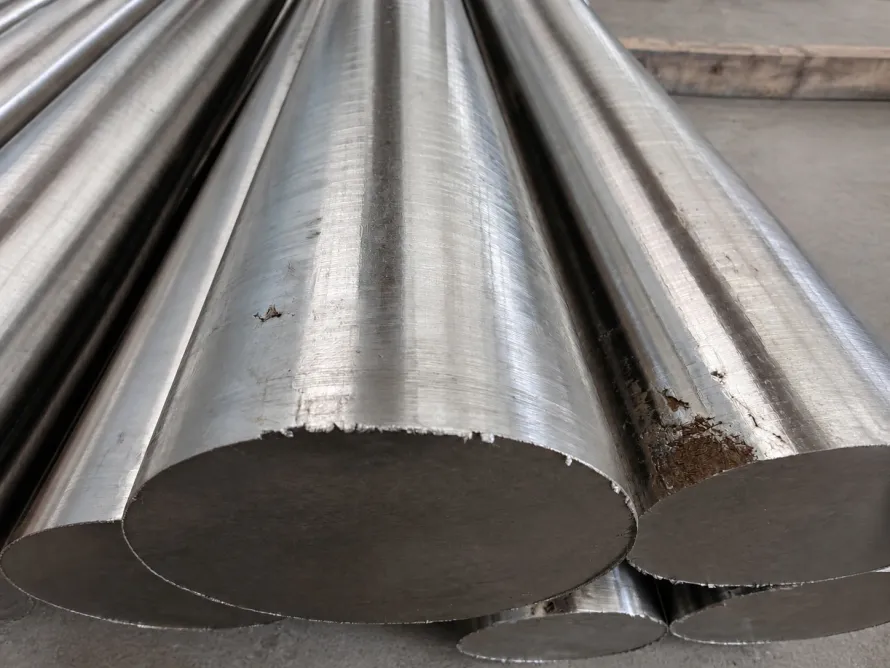
In unmanned Swiss-type CNC sliding-headstock lathes and 5-axis mill-turn centers machining 6.35–25.4 mm (0.250”–1.000”) bar stock, interstitial oxygen content acts as a potent solid-solution strengthener. A heat lot sitting near 0.19% O exhibits higher shear flow stress, higher cutting temperatures, and steeper radial tool deflection than a heat lot sitting at 0.12% O.
Every time the bar feeder transitions from one heat lot to another mid-run, radial springback on tight ±0.005 mm (±0.0002”) bearing journals shifts, chip curling geometry changes, and operators are forced to stop the machine to dial in new wear offsets (Tool Offset). Specifying a Single Heat Lot locks the chemical baseline across the entire batch so that tool life, chip control, and dimensional offsets remain stable from the first part to the last.
How to Lock In Both Requirements When Ordering
You should not have to write a multi-page quality addendum just to receive consistent blanks or bars. When sourcing cut sheet blanks, precision-ground plates, or CNC bar stock through our certified partner facilities, you can enforce both metallurgical controls directly during quotation:
- Select the Engineering Checkboxes in Our RFQ System: Our interactive Get a Quote form includes dedicated engineering toggles for
Mark Rolling Grain DirectionandSingle Heat Lot Required. - Specify Your Nesting Axis: When
Mark Rolling Grain Directionis checked on sheet or blank orders—for example, 3.2 × 100 × 300 mm (0.125” × 3.94” × 11.81”) Grade 5 blanks—each piece is clearly marked with the longitudinal rolling direction arrow and sheared or waterjet-cut with consistent L-axis alignment. - Full Heat-Lot Documentation: Every order flagged with
Single Heat Lot Requiredis pulled from a single master VAR melt batch and shipped with a Material Test Certificate (MTC) with heat-lot traceability and Certificate of Conformance (CofC) verifying chemical uniformity across your entire delivery.
Ready to eliminate springback scatter and anodizing color rejection on your next production run? Configure your Grade 5 or Grade 2 titanium blanks with Grain Direction Marking and Single Heat Lot control here.