New ECP Review Moves AM Titanium Finishing From Recipe to Interface Window
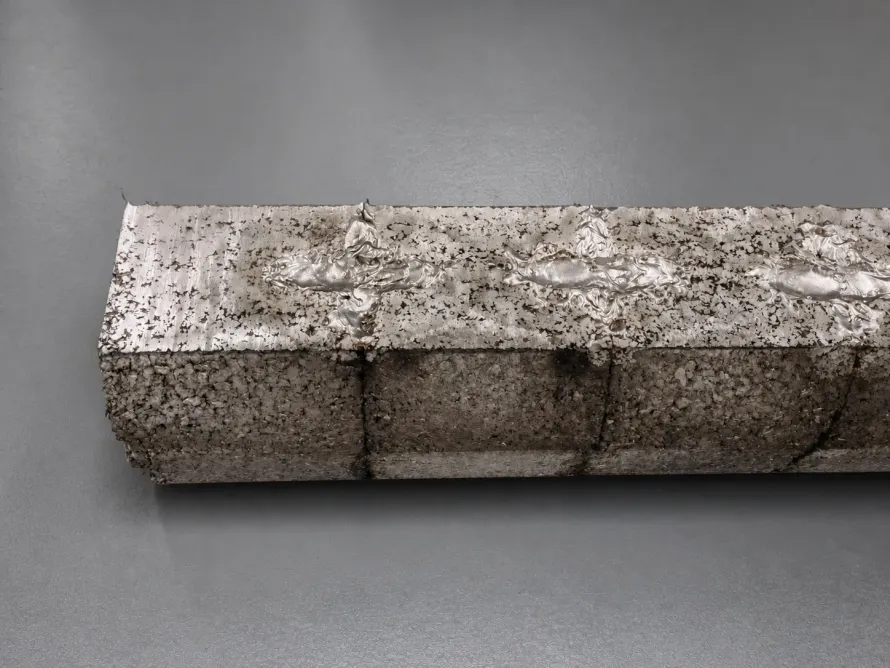
A peer-reviewed review published in Frontiers in Chemistry on 2026-08-24 argues that electrochemical polishing of additively manufactured titanium should be designed from mechanism, not copied as a recipe. Its subject is Ti and Ti-6Al-4V surfaces left with balling, partially melted particles, scan-track ridges and near-surface porosity after additive manufacturing. The authors connect those starting conditions to current distribution, mass transport and the interfacial layer that controls anodic dissolution (review).
The practical shift is larger than choosing a safer electrolyte or a better voltage. The review groups the process into three coupled families: the specimen, the electrochemical operating condition and the electrolyte. A setting belongs to a physical interface and cell geometry. Move it to a different part, build orientation or cathode arrangement and the same nominal recipe can create a different removal pattern.
Roughness Reduction Can Hide Two Different Jobs
Electrochemical polishing is often summarized as preferential removal from peaks. That describes macro-smoothing, where geometry concentrates current and the high points dissolve faster. Micro-smoothing or brightening asks another question: can the process suppress local differences caused by crystallographic orientation, grain boundaries and phase distribution?
Those mechanisms can occur together, but they are not interchangeable. A part can lose its tallest asperities without developing a uniform fine surface. It can also become visually bright while an edge, internal channel or thin feature receives excessive removal. A single average roughness result therefore cannot show whether the whole component stayed inside its dimensional and functional envelope.
The review uses the Wagner number to explain how electrode kinetics and ohmic effects share control of current distribution. It then moves to tertiary current distribution when concentration gradients and mass transport matter. For buyers, the terminology has a simple meaning: part shape governs where current wants to go, while the interface governs whether that local current produces controlled smoothing, passivation, pitting or gas evolution.
The J–V Curve Is a Process Map, Not a Machine Setting
The review divides a representative current-density–voltage curve into four regions: kinetic-limited dissolution (I), passivation (II), a diffusion-limited plateau (III) and oxygen evolution (IV). The useful polishing window is associated with controlled mass transport, but the voltage that reaches it is not universal. Electrolyte resistance, temperature, agitation, electrode spacing, exposed area and surface history all move the operating condition.
That is why a voltage-time pair is weak transfer evidence. Two cells can use the same displayed voltage while producing different local current densities and boundary layers. A process change can also occur during a long run as Joule heating changes electrolyte temperature. The buyer needs evidence of the operating regime and the resulting removal distribution, not only a setpoint copied from a coupon.
Electrolyte names create the same trap. The review decomposes formulations into solvent, supporting electrolyte, acid and additive. Each unit changes conductivity, oxide disruption, viscosity, complexation or interfacial stability. Acid-based, organic, ionic-liquid and deep-eutectic systems are therefore not simple substitutes. The transferable question is what interfacial state each formulation maintains on the actual geometry.
A Six-Line Geometry-to-Interface Transfer File
| Control line | What must be defined | Evidence before release |
|---|---|---|
| Incoming surface | Build orientation, attached particles, profile scale, near-surface defects and prior cleaning | Location-based topography and a controlled pre-clean state |
| Cell geometry | Part orientation, exposed area, cathode shape, spacing, shielding and electrical contacts | Cell drawing plus current-distribution rationale or simulation |
| Operating region | Applied mode, current response, temperature, agitation and run time | J–V evidence and a recorded process window, not one setpoint |
| Electrolyte function | Solvent, supporting electrolyte, acid, additive and bath condition | Controlled formulation, bath age and safety/handling record |
| Removal result | Peak reduction, micro-smoothing, edge loss, internal surfaces and dimensional change | Location-based roughness, thickness and dimensional inspection |
| Functional and change boundary | Cleanliness, fatigue or corrosion relevance, geometry family and requalification triggers | Part-relevant validation and approved change-control limits |
This file separates process capability from product release. A supplier may demonstrate a stable bath on a simple coupon. A buyer of 3D-printed titanium parts still needs proof that current reaches recesses without over-polishing edges or changing load-bearing dimensions. A downstream polishing service also needs a documented starting surface; it cannot recover information that was never tied to the build orientation and part identity.
Simulation can narrow the search space. The review positions finite-element tools as a way to predict electric fields, current distribution, mass transport and material removal on complex geometry. That can identify high-risk edges or shadowed regions before trials. It does not replace coupons, dimensional inspection or functional validation, because the model still depends on boundary conditions and material behavior that must be checked.
The Useful Conclusion Is About Transfer
The review does not validate one production electrolyte or declare ECP ready for every AM titanium component. Its durable contribution is a better unit of control. The process window belongs to the coupled specimen, cell, electrical response, electrolyte and interface.
For procurement, that changes the question from “Which recipe produced the lowest roughness?” to “Which evidence shows that this geometry remained in a stable interface window and reached its dimensional and functional endpoint?” That is a stricter question, but it is also the one that can survive a change in part size, build orientation, cathode design or finishing supplier.
FAQ
# What is the main lesson of the new AM titanium ECP review?
# Why is voltage alone insufficient for an ECP specification?
# Which J–V region is associated with useful electropolishing?
# What should an AM titanium buyer require before release?
Need this material? Get a factory-direct quote.