New SJ1100 Study Shows Why Straightening Is a Property-Setting Step for Titanium Sheet
A Frontiers in Materials paper published on 2026-08-12 compared rolling and post-rolling routes for SJ1100, a Ti-8Al-2V-1Cr-1Zr alloy developed for lightweight, high-strength applications. The most important result for a sheet buyer was not a new peak strength. It was the cost of obtaining it. A 2-mm sheet annealed at 820 °C for 40 min and straightened at 600 °C for 4 h recorded the highest strength among the tested states, but elongation fell to 1.5–6.5% depending on test direction (paper).
When the researchers added another anneal at 800 °C for 50 min after straightening, elongation recovered to 12.5–13% while strength decreased. That makes straightening more than dimensional finishing. It becomes a thermomechanical step that changes stored strain, grain evolution, texture, residual stress and directional tensile response.
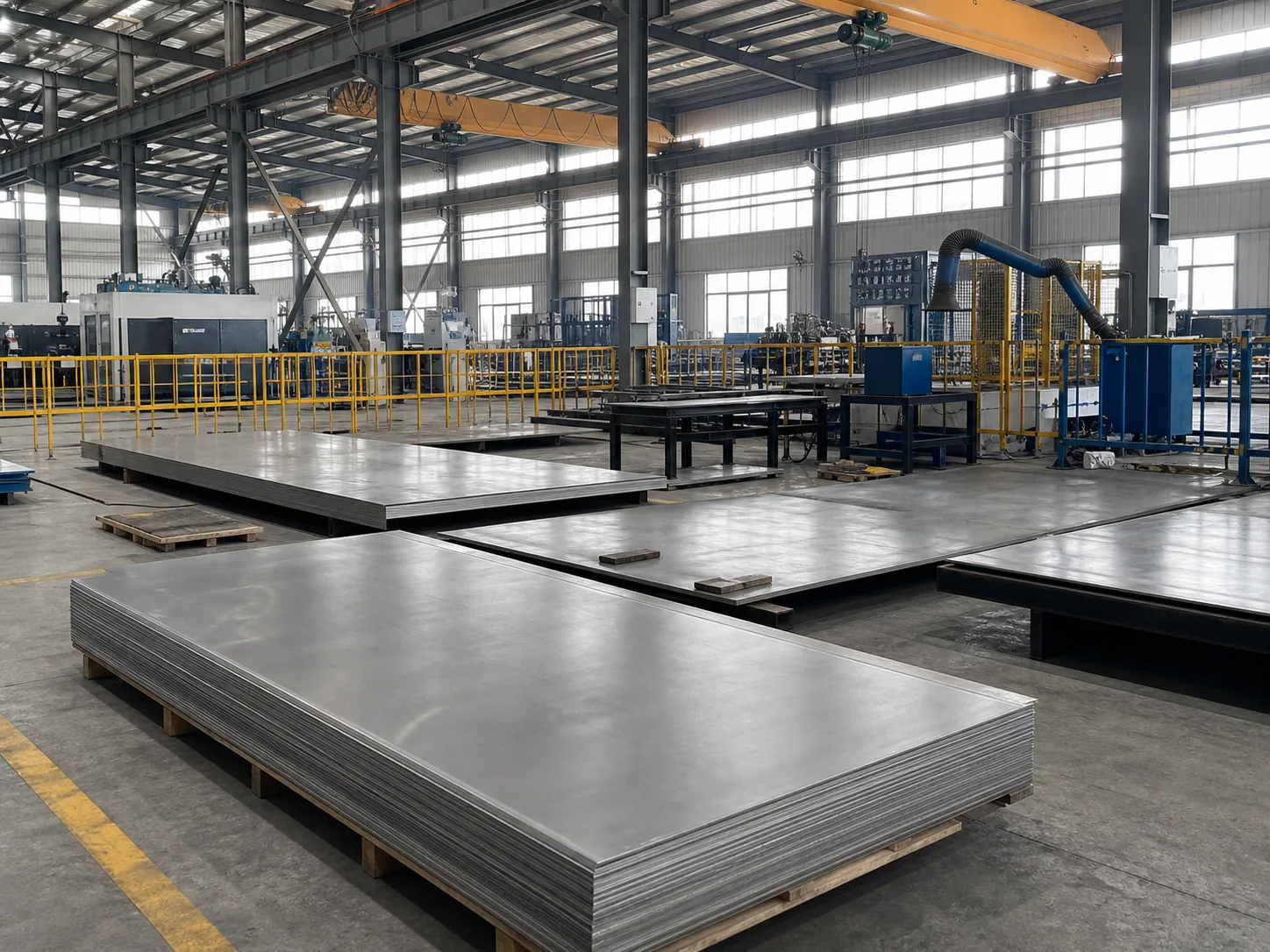
Flatness and Mechanical State Share the Same Operation
The study compared 2-mm cold-rolled sheet with a 30-mm hot-rolled plate across combinations of annealing, aging and straightening. The authors used metallography, scanning electron microscopy, EBSD and room-temperature tensile testing. Tensile specimens were taken in longitudinal and transverse directions under ASTM B265-based testing.
Straightening introduced local plastic strain. At elevated temperature, dislocations slipped and reorganised, stored energy became non-uniform and preferred orientations developed. The straightened sheet therefore carried a strong directional response: its longitudinal elongation was much lower than its transverse result. The paper connects that imbalance with texture and local strain concentration rather than treating flatness correction as mechanically neutral.
The second anneal changed the state again. Recovery and recrystallisation created new grain boundaries and orientations, reduced texture intensity and relieved residual stress. The key industry mechanism is sequence dependence: the same nominal alloy and sheet thickness can leave production with different properties because straightening came before or after a restoring thermal step.
A Six-Coordinate Route-State Map
| Coordinate | Buyer question | Evidence to retain |
|---|---|---|
| Product geometry | Was the material 2-mm sheet or 30-mm plate, and what direction is critical? | Thickness, width and rolling direction |
| Deformation history | What hot- and cold-rolling reduction created the stored energy? | Pass schedule and reduction record |
| Straightening condition | What load, temperature, duration and contact pattern corrected flatness? | Machine recipe and lot trace |
| Thermal sequence | Did aging or annealing occur before or after straightening? | Furnace chart and operation order |
| Directional properties | Do longitudinal and transverse results remain inside the design need? | Oriented tensile plan and results |
| Change boundary | Which mill, thickness, leveler or thermal change reopens qualification? | Approved route and revalidation trigger |
The map prevents a familiar mismatch. Procurement may specify chemistry, thickness, room-temperature tensile minima and flatness as separate lines. Production can satisfy each measured item while the route linking them changes. A route-state file keeps the geometry correction attached to the mechanical evidence it helped create.
The Paper Has a Clear Evidence Boundary
The alloy is described as high-temperature titanium, but this study does not establish high-temperature service performance. It reports microstructure and room-temperature uniaxial tensile behaviour. It does not provide creep, fatigue, oxidation, thermal-cycle or component-life evidence. Buyers should not turn the alloy name or the reported strength into an aircraft-engine service claim.
There is also a source-interest limit: the authors were employed by the company that developed SJ1100. The journal page discloses that relationship. It does not invalidate the experiments, but it makes independent replication and application-specific qualification more important before commercial release.
For buyers of titanium sheet and plate, the practical change is to request the full order of operations. “Annealed” is incomplete if a later hot-straightening step altered the released state. The site’s earlier Ti65 ring uniformity analysis focused on location differences across a formed section. The new SJ1100 work is distinct: it shows that a geometry-correction operation can itself create a direction-dependent property state in sheet.
The restrained conclusion is useful. The tested sequence of 820 °C for 40 min plus 600 °C for 4 h produced high strength but poor and anisotropic elongation. Adding 800 °C for 50 min improved the balance to 12.5–13% elongation. A buyer should therefore qualify straightening, annealing and specimen direction as one route, not buy flatness and tensile properties as unrelated certificates.
FAQ
# What did the SJ1100 titanium sheet study find?
# What changed after another anneal?
# Does the study establish SJ1100 high-temperature service performance?
# What should a titanium sheet buyer retain?
Need this material? Get a factory-direct quote.