New Ti65 Ring Study Turns Heat Treatment Into a Cross-Section Uniformity Question
An open-access paper in the July–August 2026 issue of the Journal of Materials Research and Technology reports a two-stage heat-treatment route for hot-spun Ti65 alloy rings. The research addresses a production problem hidden by the finished geometry: local, sequential deformation can leave a high-energy outer region and a low-energy inner region across the same ring wall.
Conventional single-step annealing did not remove that starting imbalance. The proposed route used a 650°C pre-treatment followed by 990°C annealing in the α + β phase field. The intermediate step consumed stored energy where it was high and created new nucleation conditions where it was low, allowing the later recrystallization and phase transformation to proceed more uniformly.
The reported result was not merely a better average hardness. The through-thickness hardness gradient seen after conventional annealing was virtually eliminated, while the cross-section developed more consistent primary-alpha content and restored crystallographic relationships. For buyers of complex titanium rings, that moves the question from “Was the furnace cycle completed?” to “Did every critical region enter the cycle with a compatible stored-energy state?”
Hot Spinning Leaves A Process Memory In The Wall
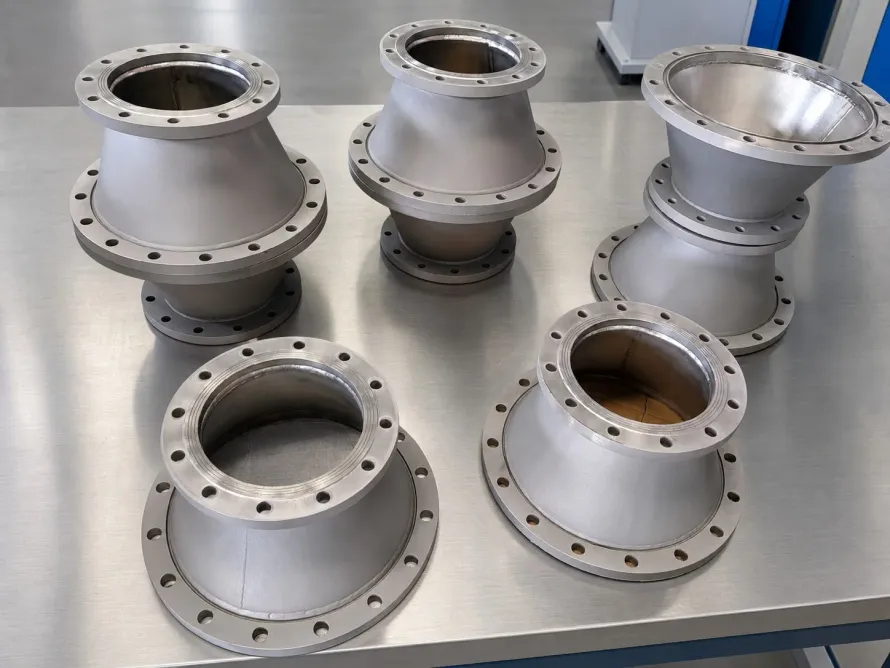
Hot spinning can make thin-walled rings with flanges and variable cross-sections closer to final geometry than conventional ring rolling. Its advantage comes from localized and continuous deformation. The same localization, combined with titanium’s low thermal conductivity and high deformation resistance, produces non-uniform temperature, stress and strain fields.
Those fields become stored deformation energy. In the studied ring, the outer surface carried higher stored energy and the inner surface lower energy. During a direct anneal, the two regions therefore did not share the same recrystallization kinetics. A cycle can be uniform in furnace temperature while the material response remains non-uniform.
The researchers’ 650°C pre-treatment performed two different jobs. In the high-energy region it initiated partial recrystallization and equiaxed grains, consuming some energy and suppressing abnormal coarsening. In the low-energy region it introduced dislocation cells and silicide precipitates. The precipitates provided heterogeneous nucleation sites during the subsequent 990°C anneal. This preconditioning synchronized transformation across the section (open-access paper).
That is the industry mechanism: heat treatment responds to deformation history, not only to the programmed temperature. A ring’s inner wall, outer wall, flange and transition may behave as different starting materials even when they share one heat number.
A Uniform Certificate Can Cover A Non-Uniform Ring
Ti65 is a near-α high-temperature titanium alloy described in the paper as promising for 600–650°C aero-engine applications. The study reports microstructure and microhardness evidence; it does not qualify a flight component, establish design allowables or prove fatigue, creep or dwell performance for a commercial ring.
That limitation is exactly where buyer value begins. A chemistry certificate and furnace chart are lot-level records. A complex ring is a spatial product. If process strain and cooling differ through thickness or around a profile, a single coupon or one surface hardness reading can miss the region least representative of the average.
The procurement risk is therefore sampling collapse: many positions are compressed into one result. Suppliers need a location model before choosing metallography, hardness, ultrasonic testing or mechanical-test extraction points. Buyers need to know whether those points cover the flange, thin wall, thick transition, inner surface, outer surface and any heavily worked zone that controls service.
A Five-Zone Ring Uniformity Map
| Control zone | Buyer question | Evidence to retain |
|---|---|---|
| Forming history | Where were strain, temperature and cooling most different during spinning? | Process map, geometry, reductions, passes, tooling contact and thermal record |
| Pre-treatment response | Which regions recover, recrystallize or precipitate first? | Location-based microscopy, hardness and pre-treatment time/temperature evidence |
| Final anneal response | Did the α + β anneal synchronize rather than magnify the gradient? | Furnace uniformity, section map, primary-α fraction and grain evidence |
| Property coverage | Are hardness and required mechanical properties consistent at critical locations? | Through-thickness traverse, circumferential plan, specimen orientation and acceptance limits |
| Release and change | What requires re-mapping after a route or geometry change? | Approved baseline, deviation record, tooling/process changes and engineering release |
The framework is reusable beyond Ti65. Ring rolling, flow forming, spinning and other localized hot-working routes can all create a spatial process memory. The correct map will differ, but the principle remains: sampling must follow the gradient that the process can create.
What Ring Buyers And Processors Can Use Now
Buyers of titanium forgings and rings should ask the supplier to identify critical sampling zones before approving the manufacturing plan. The request should connect forming simulation or process knowledge to actual metallography, hardness, NDT and mechanical-test locations.
Processors should treat the two-stage result as a mechanism, not a universal recipe. The cited 650°C and 990°C stages belong to the studied Ti65 condition. Another alloy, wall thickness, reduction pattern or cooling history may require a different pre-treatment or may not benefit from the same route. What transfers is the need to equalize transformation readiness before the final anneal.
For titanium heat treatment, furnace calibration remains necessary but insufficient. The input condition must also be bounded. If a new profile, larger diameter, altered pass schedule or different transfer time changes the stored-energy map, repeating the old furnace program may not reproduce the old cross-section.
The restrained conclusion is that the new paper offers a credible way to reduce deformation-induced heterogeneity in a hot-spun Ti65 ring. Its wider industrial value is a buyer rule: a uniform heat-treatment record is not proof of a uniform ring. Release evidence should be spatial enough to follow the process memory through the wall.
Industry FAQ
What did the 2026 Ti65 ring study demonstrate?
It demonstrated that a 650°C pre-treatment followed by 990°C α + β annealing could synchronize microstructural evolution across a hot-spun Ti65 ring and virtually eliminate the reported through-thickness hardness gradient.
Why was conventional annealing insufficient?
The ring began with different stored-energy states across its wall. Those regions had different recrystallization kinetics, so one direct anneal did not make their material responses uniform.
Does the study qualify a Ti65 aero-engine ring?
No. It provides microstructure and microhardness evidence for a studied condition, not component allowables, fatigue, creep, dwell or flight approval.
What should a titanium ring buyer request?
Request a forming-history map, location-based microstructure and hardness evidence, critical-zone NDT or mechanical testing, and change rules linking geometry and process revisions to renewed qualification.
FAQ
# What did the 2026 Ti65 ring study demonstrate?
# Why was conventional annealing insufficient?
# Does the study qualify a Ti65 aero-engine ring?
# What should a titanium ring buyer request?
Need this material? Get a factory-direct quote.