New Iodine-CVT Study Moves High-Purity Titanium Buying From Purity Grade to Impurity Route
A paper made available online by Separation and Purification Technology on July 21, 2026 gives high-purity titanium buyers a more useful question than “How many nines?” The researchers studied iodine chemical vapor transport, or iodine-CVT, for direct production of high-purity, low-oxygen bulk titanium. They found that metallic impurities and oxygen do not travel through the process in the same way.
For Fe, the study identified a critical concentration at the titanium growth front. Below and above that boundary, impurity movement followed different regimes: an early diffusion-dominated transient stage and a later quasi-steady stage shaped by solid-state diffusion and gas-phase transport. The same mechanism could explain the behavior of Ni and Al. Oxygen, by contrast, was limited mainly by gas-phase mass transfer and was attributed to background oxygen-bearing species.

That distinction changes procurement logic. A final purity grade can describe the total result, but it cannot show which impurity was rejected, where another one accumulated, whether the deposit had reached steady behavior, or whether oxygen entered from the source, the transport path or the background atmosphere.
One Purity Number Can Hide Several Transport Mechanisms
The team used titanium produced by molten-salt electrorefining followed by electron-beam melting as the source. Iodine-CVT experiments covered average temperatures from 1303–1413 K and system pressures from 60–200 Pa. Metallic impurities were measured by glow discharge mass spectrometry, oxygen by inert-gas fusion, and spatial distributions by time-of-flight secondary ion mass spectrometry.
Those methods matter because a bulk average can hide a transition. The paper reports that Fe at the growth front moves toward a critical concentration. During the initial stage, diffusion from the underlying titanium influences the developing layer. Later, the deposit approaches a quasi-steady condition in which solid-state and gas-phase transport balance. Ni and Al can be interpreted through the same mechanism, although their individual transport and removal behavior differs.
Oxygen does not fit that metallic-impurity model. The authors concluded that oxygen incorporation is controlled by gas-phase mass transfer and most likely comes from oxygen-bearing species in the background atmosphere rather than being carried from the source through the iodine-CVT reaction path. Their experiments used a source–substrate temperature difference of about 320 K, and the paper treats atmosphere quality as part of the purification mechanism, not merely a housekeeping variable (peer-reviewed study).
This is the industry mechanism: purification is selective transport through time and space. “Feed purity in, product purity out” is too coarse. The production run has a transient, a growth front, competing diffusion paths and an atmosphere that can add a different class of impurity.
High-Purity Feedstock Is Not Yet A Finished Target
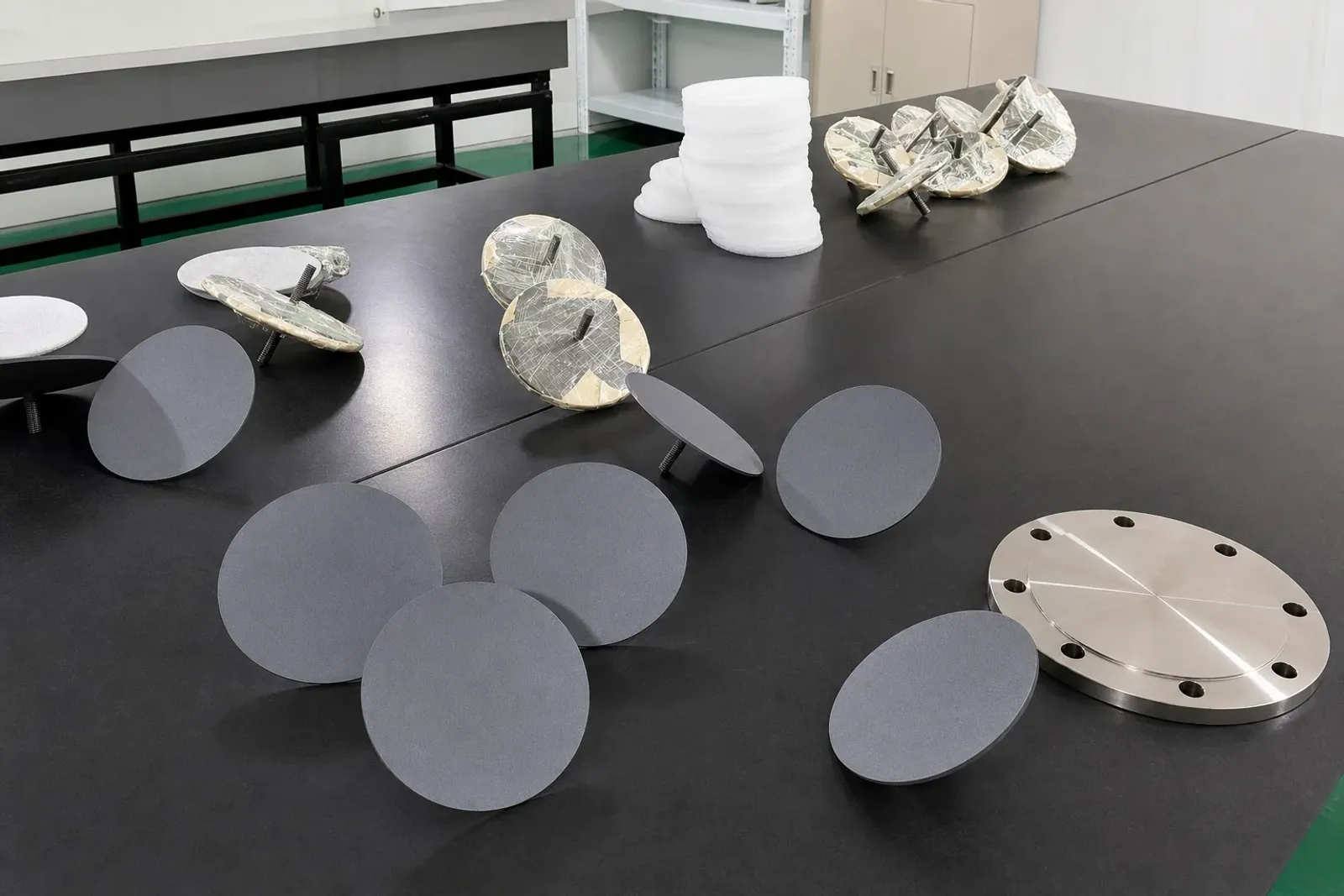
The buyer consequence appears most clearly in semiconductor materials. The paper explains that high-purity titanium targets support adhesion layers, diffusion barriers and other functional films. Metallic impurities can migrate into adjacent layers, while oxygen can raise film resistivity. The study does not qualify a sputtering target, but it clarifies why target buyers cannot treat every impurity as one interchangeable subtraction from a purity percentage.
An older ASTM specification for high-purity titanium sputtering targets made the same boundary visible in another way: Grades 4N, 4N5 and 5N were based on total metallic impurity, yet the specification warned that grade alone did not establish suitability because other factors affect performance (historical ASTM scope). That document is historical, not a current purchasing instruction. Its useful point is the separation between a purity label and an application release decision.
Downstream conversion can widen the gap. A purified titanium deposit may still be consolidated, forged, rolled, machined, joined to a backing plate, cleaned and packaged. Each step can change oxygen exposure, metallic contamination, grain structure, surface condition or sampling representativeness. A certificate for the source metal should therefore not be silently reused as proof for the finished geometry.
A Five-Layer Impurity-Route Map
Before accepting high-purity titanium for an electronic or other contamination-sensitive use, five layers should connect.
| Layer | Buyer question | Evidence to retain |
|---|---|---|
| Source state | What material entered purification, and where were its impurities located? | Source route, lot identity, metallic and interstitial chemistry, sampling plan and analytical limits |
| Transport selectivity | Which impurities are transported, rejected or retained under the chosen conditions? | Temperature, pressure, iodine charge, thermodynamic basis and impurity-specific results |
| Growth-front regime | Was the sampled deposit transient, quasi-steady or a mixture of both? | Run time, deposit position, growth history and spatial concentration profiles |
| Atmosphere boundary | What controls oxygen-bearing background species and leak or outgassing risk? | Vacuum history, pressure trend, gas analysis, equipment condition and blank or control evidence |
| Product verification | Does the converted product still meet the application requirement? | Conversion history, surface and microstructure records, final chemistry, location-based sampling and release criteria |
The map does not require every buyer to operate the purification reactor. It requires the supplier and buyer to agree on which evidence survives the handoff from purified deposit to saleable product.
What Buyers And Suppliers Can Use Now
For buyers of special titanium alloys and controlled titanium materials, the immediate lesson is to specify impurity identity and test method instead of relying on a headline purity alone. State whether oxygen is included in the grade calculation, which metallic impurities have individual limits, where the sample is taken and whether a bulk average is acceptable.
Suppliers should separate process-development evidence from lot release. A mechanism study can justify where to sample and which process variables deserve alarms. Recurring orders still need calibrated methods, detection limits, contamination controls, lot boundaries and change rules. A longer run, new source lot, chamber maintenance, altered substrate geometry or downstream conversion route can change what the certificate represents.
The same discipline applies after titanium CNC machining. Machining cannot be assumed to preserve a contamination-sensitive surface without cleaning, handling and verification rules, while a clean surface test does not replace bulk chemistry. The evidence should follow the impurity route appropriate to the product.
The restrained conclusion is that iodine-CVT offers a credible route toward high-purity, low-oxygen titanium, and the July study explains why its control cannot be reduced to one final number. Metallic impurities follow a growth-front transport balance; oxygen follows the atmosphere. A serious purchase specification should keep those mechanisms separate until the finished product has been verified.
Industry FAQ
What did the 2026 iodine-CVT titanium study find?
It identified a critical Fe concentration at the growth front that separates a diffusion-dominated transient stage from a quasi-steady stage; the same framework also explained Ni and Al behavior.
Why is oxygen different from the metallic impurities?
The study attributed oxygen incorporation mainly to gas-phase mass transfer and background oxygen-bearing species, not to the same source-to-deposit pathway governing Fe, Ni and Al.
Does a 4N or 5N purity label prove target suitability?
No. Total purity compresses several risks into one number. Application suitability also depends on the identity and location of impurities, oxygen, microstructure, surface condition and downstream processing.
What should a high-purity titanium buyer retain?
Retain source chemistry, purification conditions, time- or position-resolved impurity results, atmosphere and leak controls, analytical methods and detection limits, conversion history and final product verification.
FAQ
# What did the 2026 iodine-CVT titanium study find?
# Why is oxygen different from the metallic impurities?
# Does a 4N or 5N purity label prove target suitability?
# What should a high-purity titanium buyer retain?
Need this material? Get a factory-direct quote.