New TC4 Forceps Study Makes Workflow Part of Instrument Evidence
A peer-reviewed paper published by Scientific Reports on 2026-09-02 tested a single-piece, forged Ti-6Al-4V (TC4) purse-string forceps in a laparoscopic animal workflow. The relevant result is not that titanium automatically makes a better surgical instrument. It is that instrument evidence has to follow the device through motion, task sequence and reuse—not stop at the alloy name (Scientific Reports).
The researchers randomized 20 pigs, 10 to the new forceps workflow and 10 to the OrVil comparator. All procedures were completed without mortality. Each group had one reported complication. That is useful preclinical evidence, but it is not human clinical validation and it is too small to establish uncommon-event rates.
The workflow result is more informative than a single time saving
The instrument uses two rotating axes. Its jaws opened to approximately 68 degrees and could bend laterally by approximately 14 degrees. Those geometric facts matter because the device was developed to perform transection and purse-string placement inside a constrained laparoscopic field. A material certificate alone cannot show whether those movements are reachable, stable or controllable during the task.
The timing data also resist a simple “faster” claim. Esophageal dissection treatment took 9.1 ± 1.6 minutes with the forceps and 7.4 ± 1.3 minutes with OrVil (p=0.02), so that step was slower. Anvil placement and fixation took 10.5 ± 1.5 versus 12.7 ± 1.9 minutes (p=0.01), favoring the forceps. Once the two steps were combined, total anvil-operation time was 19.6 ± 3.1 versus 20.1 ± 2.9 minutes, with p=0.70: no statistically significant difference.
That pattern is the mechanism insight. A device can shift time from one step to another without changing the whole workflow. Buyers and development teams should therefore separate task-level advantages from the end-to-end endpoint they actually need to qualify. Otherwise a favorable sub-step can be presented as a system gain that the data do not show.
The reported total operation times, 187.2 ± 12.7 and 197.7 ± 10.6 minutes, also did not meet conventional statistical significance (p=0.06). They should not be described as a proven 10.5-minute saving.
Reuse is an evidence chain, not a cost adjective
The paper says one forceps was used for all 10 experimental animals and describes the instrument as sterilizable and reusable. Its cost comparison lists a technical-sample forceps at RMB 22,000 and 10 OrVil units at RMB 60,000 in total. But the comparison does not include the repeated-decontamination expense that the paper separately acknowledges, and a 10-use animal series does not establish a validated service life.
For procurement, the economic question is therefore conditional:
cost per released use = acquisition + validated reprocessing + inspection + maintenance + failure reserve, divided by accepted cycles.
That is an analytical framework, not a figure reported by the authors. It prevents a prototype purchase price from being mistaken for life-cycle cost. A reusable claim should be supported by cleaning efficacy, sterilization compatibility, functional cycling, surface-condition inspection and a retirement rule. For a forged and machined TC4 instrument, traceability should also connect the finished device to the relevant material and special-process records.
A six-link instrument evidence map
The study supports a practical evidence map for buyers evaluating a reusable titanium instrument:
| Link | Question | Evidence to retain |
|---|---|---|
| Material and route | Is the released device the same TC4 material and manufacturing route as the evaluated article? | Specification, heat/lot identity, forging and machining route, controlled finishing |
| Motion geometry | Can the device reach and hold the intended position? | Jaw opening, articulation range, force or stability test, tolerance and inspection method |
| Step endpoint | Which task becomes easier or faster? | Predefined task time, handling error and completion criteria |
| Whole workflow | Does the full procedure improve? | Combined time, complications, failures and comparator-defined analysis |
| Reuse boundary | How many safe cycles are supported? | Validated cleaning, sterilization, functional cycling, inspection and retirement limits |
| Human-release boundary | Does the evidence match intended clinical use and jurisdiction? | Human data and regulatory documentation appropriate to the claimed indication |
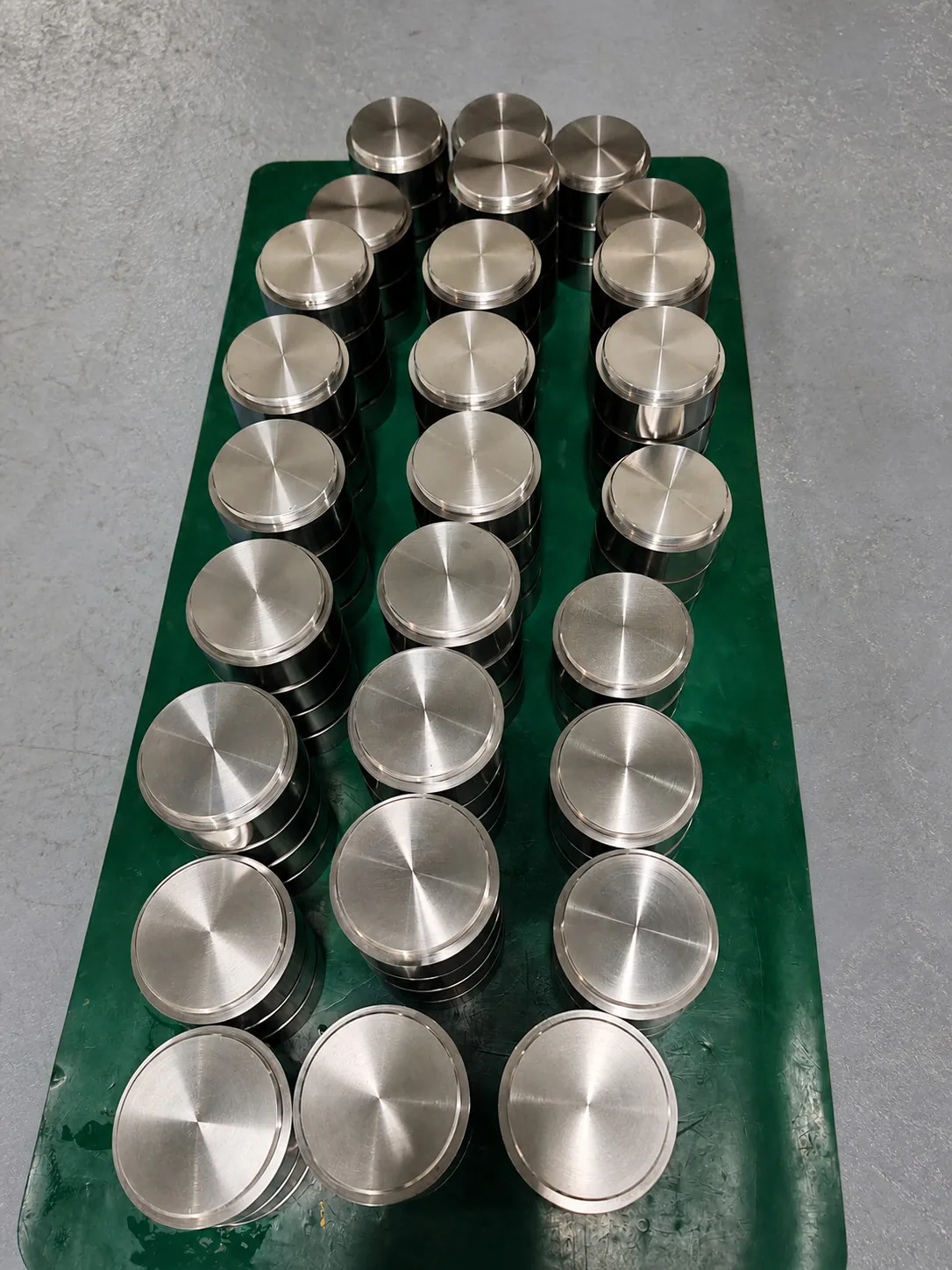
This map also clarifies where a titanium supplier fits. A supplier of titanium forgings or CNC-machined titanium parts can support material identity, process control, tolerances and surface records. It cannot convert an animal experiment into a clinical claim. The device manufacturer retains responsibility for design verification, reprocessing validation, risk management and market authorization.
What the source does not establish
The experiment is preclinical, single-center and small. It reports one complication in each 10-animal group, which is insufficient for a robust safety comparison. The instrument was a technical sample rather than evidence of stable series production. The paper also contains different trocar dimensions in its general description and procedural account; this analysis therefore makes no port-size compatibility claim.
The author list includes personnel affiliated with a medical-instrument factory, while the paper declares no competing interests. That is not proof of bias, but it is a reason to keep source provenance and independent validation visible. The publication date is 2026-09-02; the 2025-08-12 date in the record is acceptance, not the public-news date.
The buyer conclusion is narrow: TC4 can be engineered into a compact articulated instrument, and the animal comparison provides useful task-level evidence. Qualification still has to connect alloy, geometry, workflow, reprocessing and clinical scope. Leaving any one of those links implicit turns a device dossier into a material story rather than a release case.
Source boundary: This analysis uses the complete publisher PDF and record for DOI 10.1038/s41598-025-16010-8. It preserves the reported step-level results, distinguishes non-significant whole-workflow comparisons from significant sub-step differences, and does not infer human clinical readiness.
FAQ
# What did the new TC4 forceps study test?
# Did the TC4 forceps shorten the complete anvil workflow?
# Does the study prove the device is ready for human clinical use?
# What evidence should a buyer request for a reusable titanium instrument?
Need this material? Get a factory-direct quote.