Newport News' ARCEMY Fleet Turns Titanium WAAM Into a Wire-to-Release Question
AML3D’s latest Newport News Shipbuilding update is easy to misread as another metal 3D printing capacity story. For titanium buyers, the more useful signal is narrower and more demanding: large-format wire additive manufacturing is moving closer to shipbuilding production, but a deposited titanium shape is still not a released titanium product.
In a June 19, 2026 ASX release, AML3D said it had commissioned the first two custom, large-scale ARCEMY X systems for Newport News Shipbuilding, a division of HII. The company said that work completed an initial approximately AU$4.5 million order. It also said a second approximately AU$9.9 million order for four additional systems is tracking for delivery in early 2027, giving Newport News a planned fleet of six custom ARCEMY X systems.
The detail that matters for product buyers is not only the system count. AML3D said the first two Newport News systems use a 10,886 kg positioner to create heavy-capacity build capability for shipbuilding applications. It also connected the fleet to lead-time reduction and alternatives to traditional manufacturing techniques.
That is a real capacity signal. It is not, by itself, a titanium part approval.
Why Titanium Buyers Should Watch the Signal
AML3D separately lists titanium among the materials for its WAM and ARCEMY systems, including Ti-6Al-4V and CP-Ti. That makes the Newport News signal relevant to titanium product buyers, but only with a boundary: the public release does not say Newport News is producing titanium parts, naming titanium alloys for a specific ship component, or approving a released titanium route.
That boundary is exactly why the news is useful. Wire arc additive manufacturing can change the economics and lead-time profile of large metallic parts, especially where casting, forging, billet machining or replacement-part sourcing is slow. Titanium raises the evidence bar because its value comes from the controlled relationship between alloy identity, oxygen exposure, thermal history, post-processing, inspection and application environment.
For procurement teams, the question is no longer simply whether a supplier has a large metal AM machine. It is whether the supplier can produce a wire-to-release file that keeps material identity and process evidence connected from feedstock to final acceptance.
The Capacity Story Is Becoming a Control Story
Defense and maritime manufacturing are pushing additive systems closer to end-use workflows. A UK government update on additive manufacturing for submarine maintenance and support points in the same direction: production and repair capability are being pulled nearer to fleet support, maintenance and constrained supply chains.
That shift can reduce waiting time for some part families, but it also moves more responsibility onto the digital and physical control system around the part. In titanium, the release question becomes sharper because the buyer must know what is being controlled and where the approval boundary sits.
An ORNL technical paper on safety analysis for a titanium wire arc additive manufacturing system with an inert enclosure is a useful reminder that titanium WAAM is not only a robot path. Shielding, atmosphere, material handling and process safety are part of the operating envelope. The same discipline carries into buyer evidence: if the product depends on titanium’s corrosion resistance, strength-to-weight ratio or service reliability, the build record must show how the process protected those properties.
What a Wire-to-Release File Should Contain
For titanium bars, plates, tubes, forgings, deposited preforms or machined components, a buyer should not treat wire AM as a shortcut around qualification. It is a different route that needs its own evidence chain.
| Evidence layer | Buyer question | Useful record |
|---|---|---|
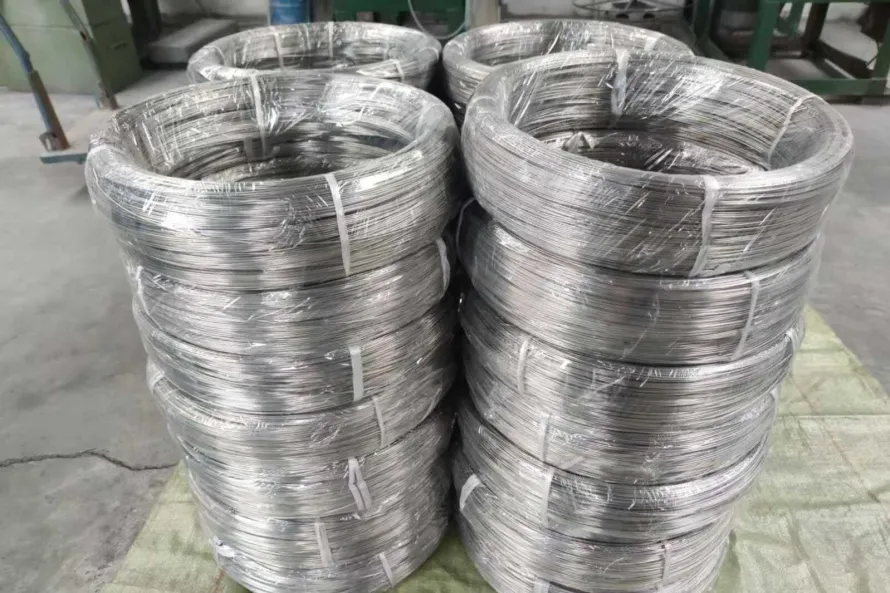
| Wire and chemistry | Does the deposited material start from the specified titanium alloy and controlled lot? | Wire certificate, chemistry record, supplier lot identity, incoming inspection |
| Shielding and atmosphere | Was titanium protected from the exposure risks that can change properties? | Shielding plan, inert enclosure or local shielding record, oxygen monitoring where applicable, handling procedure |
| Machine and software | Is the build tied to a controlled machine, parameter set and program revision? | Machine ID, software version, build file, parameter log, operator authorization |
| Thermal and build history | Does the heat input, interpass condition and deposition sequence match the accepted route? | Build log, temperature or process-monitoring data, pause/restart records, nonconformance notes |
| Post-processing | How does the deposited shape become the released geometry? | Heat treatment, stress relief, machining route, cutting plan, surface finish record |
| Inspection and acceptance | What proves the part is acceptable for the intended service? | Dimensional report, NDT or CT where required, mechanical test plan, corrosion or pressure evidence if service demands it |
| Release authority | Who has approved the route and what is the change boundary? | Customer approval, qualified procedure, drawing revision, concession record, change-control rule |
This file matters even when the final product is not a fully printed part. Many titanium buyers will see hybrid routes: deposited preforms that are machined later, repaired or built-up features on traditionally made bodies, or large near-net shapes that replace heavy billet removal. In those cases, the weakest link is often the boundary between additive deposition and conventional finishing.
How Buyers Can Use the News Now
The Newport News/AML3D fleet should make buyers ask better questions, not rush to replace existing titanium supply routes.
First, separate machine capacity from product release. A six-system fleet can improve optionality, but it does not tell a buyer whether a specific titanium alloy, geometry, wall condition, service environment or inspection route has been qualified.
Second, identify the product form affected. A titanium pressure part, submarine-adjacent fitting, aerospace bracket, heat-exchanger component and machined ring do not share one evidence burden. The release file should follow the function and failure mode, not the marketing category “metal AM.”
Third, ask whether the AM route is substituting for forging, plate machining, tube fabrication, casting, repair or spare-part stocking. Each substitution changes the comparison baseline. If the legacy route had MTRs, NDT hold points and customer approval, the wire AM route needs equivalent or better evidence, not a thinner document packet.
Supplier Implications
Titanium suppliers that want to benefit from the wider move toward large-format metal AM should prepare evidence before buyers ask for it.
The most useful supplier package will connect product form to route: wire source, alloy designation, build envelope, shielding method, heat treatment, machining recovery, inspection, release authority and change-control triggers. The package should also state what is not covered. If a route is proven for a demonstration geometry, it should not be presented as blanket approval for all titanium parts. If the process is approved for one alloy, that approval should not be stretched to another alloy or service environment.
The site-original lesson is simple: as wire AM scales into shipbuilding and maintenance ecosystems, titanium buying becomes less about whether a machine exists and more about whether the route is auditable. A heavy-capacity system can make a large shape. A wire-to-release file is what makes that shape a buyer-ready titanium product.
FAQ
# Does Newport News' ARCEMY fleet prove titanium parts are approved?
# Why is the AML3D update relevant to titanium buyers?
# What is a wire-to-release file?
# Why does titanium WAAM need more than machine capacity?
# How should buyers compare WAAM with forging or machining routes?
Need this material? Get a factory-direct quote.