6 Industries Where Titanium Mesh Is Irreplaceable
Titanium mesh is not a headline product. It lacks the visibility of aerospace forgings or the press attention of medical implants. But its range of applications is almost certainly wider than you expect.
From electrolytic cells in chlor-alkali plants to cranial repair plates on neurosurgical tables, from pre-filtration systems in desalination facilities to anode baskets in electroplating lines — titanium mesh fills an indispensable role across six industries. Each one demands a different combination of mesh aperture, wire diameter, grade, and surface condition.
1. Chemical Filtration: The Only Material That Survives
The chemical industry is the largest end market for titanium mesh.
In sulfuric acid, hydrochloric acid, and wet chlorine environments, stainless steel mesh typically lasts 3–6 months. Titanium mesh lasts 5–10 years. Unit cost is roughly three times higher; service life is more than ten times longer. Life-cycle cost comparison is decisive.
Typical applications:
- Anode substrates in chlor-alkali electrolytic cells — titanium mesh as the base, coated with RuO₂-IrO₂ or IrO₂-Ta₂O₅ catalyst layers
- Liquid/gas filtration elements in chemical reactors
- Filter cartridge frames in concentrated acid service
Selection criteria: Grade 1 or Grade 2 (commercially pure titanium, best corrosion resistance). Aperture matched to filtration duty — 2–5 mm for coarse duty, 0.1–0.5 mm for fine filtration. Wire diameter 0.5–2.0 mm. Surface condition: acid-pickled and clean to ensure coating adhesion.
2. Medical Implants: The Highest-Value Segment
Medical titanium mesh commands a unit price 5–10 times that of industrial-grade mesh. The reason is straightforward: biocompatibility requirements and the cost of regulatory certification.
Typical applications:
- Cranial mesh plates — covering bone defects following neurosurgery
- Maxillofacial repair mesh — mandible reconstruction, orbital floor repair
- Pelvic reconstruction mesh
- Guided bone regeneration (GBR) barrier membranes in dental implantology
Titanium mesh holds its position in medical use because of three properties: mechanical behavior closer to bone than any alternative (elastic modulus ~114 GPa, versus ~20 GPa for bone and 193 GPa for stainless steel), complete biocompatibility with no immune rejection, and clean imaging under both CT and MRI without artifact generation.
Selection criteria: Grade 1 CP titanium or Grade 5 ELI (ASTM F136/F67). Wire diameter is extremely fine: 0.1–0.5 mm. Aperture 0.3–1.5 mm. Processing must include ultrasonic cleaning, vacuum annealing, and sterile packaging. Every batch requires a complete biocompatibility test report.
“Medical-grade mesh carries the best margins, but also the highest barriers to entry. Qualifying a new supplier through FDA 510(k) or EU CE MDR certification typically takes 18–24 months. That’s why medical customers rarely change suppliers once they’ve validated a source.” — Technical Engineer Hu
3. Desalination and Water Treatment: The Filtration Layer in a $250B Build-Out
Middle East desalination investment is projected to exceed $250 billion. Every reverse osmosis (RO) system requires titanium mesh in its front-end pre-filtration stage — removing coarse particulates from seawater before they reach the expensive RO membranes.
Typical applications:
- Primary and fine-filtration screens in seawater desalination units
- Electrolytic electrode substrates in wastewater treatment (coated titanium anodes)
- Pre-filter elements in reverse osmosis systems
Selection criteria: Grade 2 titanium mesh, aperture 0.5–3 mm. Seawater carries approximately 19,000 ppm Cl⁻; the self-repairing TiO₂ passive film on Grade 2 performs exceptionally well in this environment. Where crevice structures exist, upgrade to Grade 12 (Ti-0.3Mo-0.8Ni). Tube and mesh materials are often procured together — tubes for heat exchangers, mesh for filtration units.
4. Electroplating and Hydrometallurgy: The Standard Anode Basket Material
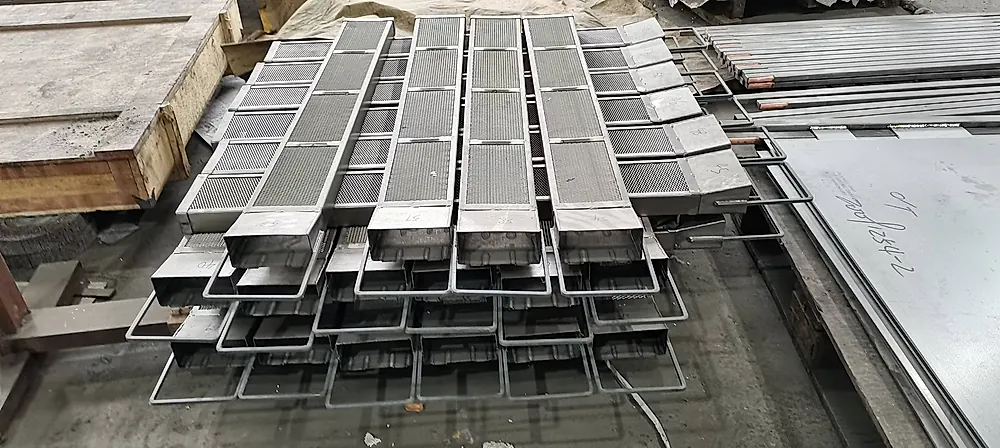
The electroplating industry is a sizeable and often overlooked titanium mesh market. Every plating bath requires anode baskets to contain the anode material — nickel balls, copper balls, and similar — and the basket must resist dissolution in an energized electrolyte. Titanium is the only cost-effective material that meets this requirement.
Typical applications:
- Plating bath anode baskets loaded with nickel, copper, or tin ball anodes
- Electrode mesh plates for electrolytic copper, nickel, and zinc refining
- Titanium mesh substrate plus Ru-Ir or Ir-Ta coating = coated titanium anode
Selection criteria: Grade 1 titanium mesh, wire diameter 1.0–3.0 mm, aperture 3–10 mm (allowing free electrolyte circulation). Anode baskets are fabricated by welding — titanium welding must be performed under argon shielding, otherwise weld oxidation causes embrittlement.
5. Aerospace: Precision Filtration in Hydraulic Systems
Aerospace hydraulic systems require exceptionally clean fluid (NAS 1638 Class 5–7). Titanium mesh filter elements weigh roughly 60% of equivalent stainless steel parts and resist the trace-moisture corrosion present in hydraulic oil.
Typical applications:
- Hydraulic system filter assemblies in aircraft
- Precision fuel system filtration screens in turbine engines
- Lightweight shielding and structural mesh in spacecraft
Selection criteria: Grade 5 titanium mesh (strength requirement), wire diameter 0.05–0.2 mm (extremely fine), aperture 5–40 μm (precision filtration). AMS standards apply. Each batch requires a particle-count test report.
6. Marine Engineering: Ballast Water Treatment and Corrosion Protection
The IMO Ballast Water Management Convention requires all vessels to install ballast water treatment systems. Titanium mesh is the core component in electrolytic disinfection units — serving as the anode that generates sodium hypochlorite to eliminate marine organisms.
Typical applications:
- Electrolytic anodes in shipboard ballast water treatment systems
- Pre-filtration screens for seawater intake piping on offshore platforms
- Titanium mesh linings in corrosion-protection assemblies
Selection criteria: Grade 2 titanium mesh with coating treatment. Marine environments present high Cl⁻ concentration and significant temperature cycling — coating adhesion and substrate corrosion resistance are equally critical.
Six markets, six distinct sets of technical requirements. If you are evaluating titanium mesh for any of the applications above, start by fixing three parameters: grade (Gr.1 / Gr.2 / Gr.5), aperture size, and wire diameter. Bring those three parameters and a description of your operating conditions to us — we can provide a selection recommendation and quotation within 24 hours.
Related Products & Services
- Product → Titanium Mesh — Full specification range, Gr.1/Gr.2/Gr.5, apertures from 0.05 to 10 mm
- Product → Titanium Anodes & Electrodes — Coated titanium anodes for electrolytic and electroplating applications
- Service → Fabrication — Titanium mesh welding and custom anode basket manufacturing
Related Articles:
Need this material? Get a factory-direct quote.